There’s been a lot of chatter over the past week about what’s happening to Twitter’s traffic and engagement, as well as that of Threads, and whether the two are related and ~what’s it all mean for the future of social media~

This is my attempt to cut through some of the noise, with actual data – and empirical observations.

All derives from this week’s column in the @WSJ

1/

https://www.wsj.com/articles/heres-how-twitter-could-become-irrelevant-b2b027af

Here’s How Twitter Could Become Irrelevant

Threads, from Instagram, has many distinct qualities that make it the first credible threat to Elon Musk’s vision of what a social network should be

WSJ

Here’s the conclusion, for those who want the headline and then would rather move on with their lives.

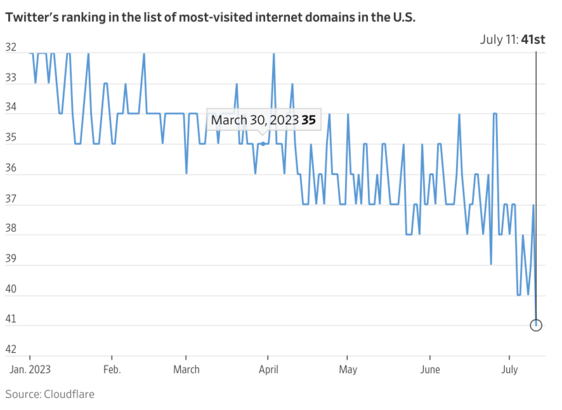
Traffic to Twitter appears to be declining over time. Threads seems to be responsible for a little of that decline, when it first launched. But really, what’s happening is a story of long-term decline in engagement with Twitter. 2/

Another conclusion:

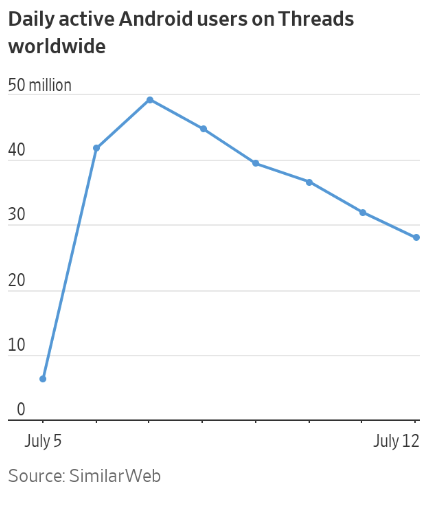
Much has been made of the surge and sudden drop in usage of Threads.

If you’ve never looked at the chart of the usage of a service when it goes supersonic, you might naively think this means Threads is already in trouble.

But a saw-tooth pattern where adoption is followed by a decline in usage – and then subsequent waves of re-engagement – is normal.

3/

Remember, this is just *week 1* plus 2 days for Threads. Fastest-growing app in history is probably going to do some weird things in the first months of its life.

And anyone who is a veteran of the endless cycles of "oh Mastodon saw a surge / oh now everyone is leaving" knows that this is how adoption of a service works.

As Eugene Wei told me, we’re going to know a lot more in a month, 6 months, a year. All conclusions at this point are premature.

4/

So now I want to point you to others who are being smart about this and who have explained Twitter’s long-term decline.

First, there’s this piece by @taylorlorenz which points out what should be blindingly obvious: Twitter’s real competition isn’t Threads, it’s TikTok.

https://www.washingtonpost.com/technology/2023/07/07/twitter-dead-musk-tiktok-public-square/

5/

How Twitter lost its place as the global town square

Twitter is hemorrhaging relevance, and Meta's Threads made an impressive debut, but TikTok is the social media app to beat.

The Washington Post

And here’s a conclusion that @profgalloway and I both reached: Twitter’s problem isn’t threads, it’s Elon Musk’s leadership. By driving away users, mostly through changes to its algorithm and secondarily through his editorial decisions, he’s the real disruptor here.

“The misperception about disruption is that it’s a function of innovation or excellence. In fact, disruption is driven by stasis and the incompetence of incumbents.”

https://www.profgalloway.com/threadzilla/

6/

Threadzilla | No Mercy / No Malice

Last week, Twitter became MySpace: a social network void of innovation being slowly euthanized by Meta. In less than a week, Meta’s Threads registered 110 million users — equivalent to the combined population of Germany and Australia, and the most violent corporate disruption in platform history. What can be learned? Bloat The business strategy that […]

No Mercy / No Malice

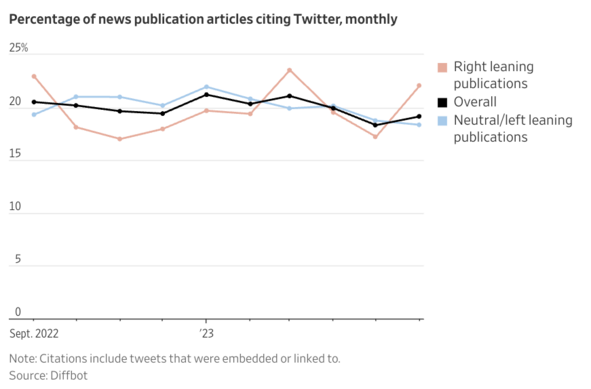
For those of you who stuck around this long, here’s a WSJ exclusive. No one else has this data. It comes from Diffbot, which crawls and indexes the web like Google does, and then sells access to all that data to companies.

Guess what effect all this decline has had on Twitter citations – links, embeds – in the news media, regardless of political orientation?

Zilch. Nada.

This is one area Twitter retains its death-grip on attention.

This is a long thread already, but it’s just a portion of what I was able to dig up or convey on what’s really happening with Twitter and Threads, Musk and Zuckerberg and the rest. Many insights are not my own but belong to @Noupside
Eugene Wei and Maelle Gavet, head of Techstars

I wish I could have quoted them at length. What I learned from talking to them this week is that we are in for VERY interesting times for social media.

fin/

@mimsical Twitter is built into CMSes, page structure, newsroom standards and staffing and workflows. Those things take time and sometimes embarrassment to change. But the coefficient of enshittification has been high enough for long enough that they are likely to get dismantled, and it won’t be gradual
@bdeskin @mimsical I’ve been waiting for this to happen

@mimsical this is really interesting! twitter had become so commonly cited in the new media (because so many journalists are on twitter? because politicians and celebs use twitter as the medium and sidestep other media so they have no choice?) its a bit of a self-reinforcing pattern, the media cites twitter which makes it important, which means the vip users still want to be seen on it. but it also doesn't seem like a very monetizable asset for twitter.

iirc twitters income statement in the 10ks and 10qs before musk were pretty solid. its really a self-inflicted decline.

@mimsical What that graph says to me is Twitter's becoming a right-wing outfit. The blue line's in a slow but steady decline, while the red line, while volatile, is increasing.

My take on this is Musk bought Twitter to control the political narrative, and it looks like he's succeeding.

@mimsical
I notice this regarding sports writers. They can't seem to resist, embedding as many as 10 per article
@mimsical I think a major anchor for Twitter's relevance still comes from municipalities, entities, and organizations still trying to use it for communicating to the public. With brands starting to steer clear of Elon's hubris, that remaining cohort would stand to benefit from moving their official communications over to the #fediverse.
@mimsical @profgalloway Somehow, this sounds like the biggest “duh!” of the year.