Why the sun seems brighter at night—at least to neutrino detectors.🧵

First, what are neutrinos?
They’re tiny subatomic particles which interact so rarely with other matter that trillions of them have passed through your body while you read this sentence. Without leaving a trace. In your whole life, only a handful of them will actually interact with your body & give an electron a minuscule kick. (Nothing to worry about!)

The sun also produces neutrinos, as a byproduct of nuclear fusion … (1/8)
Since neutrinos interact so rarely with other matter, they can escape from the centre of the sun undisturbed. So if we detect them, they can tell us what’s going on in the interior of the sun: what nuclear fusion reactions are happening at what rate, how much total energy is produced, and even how hot it is. (16 million ºC, ± a few per cent. Yes, we know the temperature at the centre of the sun almost as well as that of the room you’re in right now. 🤯)

Of course, detecting them is hard … (2/8)

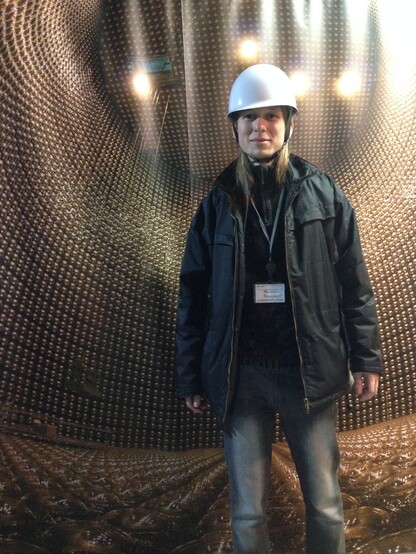
Since neutrinos interact so rarely with other matter, we need to build giant detectors to observe a reasonable number of them. My favourite detector? Super-Kamiokande! Just look at these stunning images of its interior: https://www-sk.icrr.u-tokyo.ac.jp/en/sk/experience/gallery/

Now, neutrinos can travel through the whole earth, so Super-K can even observe them at night. And it even sees more solar neutrinos at night!

Why, you wonder? Read on; it’s gonna get weird! 😍 (3/8)

Gallery | Super-Kamiokande Official Webiste

The Super-Kamiokande is a research experiment that aims to unravel the mysteries of elementary particles and the universe through observations of neutrinos and other particles. Since 2020, Super-Kamiokande has added a kind of rare earth material to the pure water in the tank and has started a new experiment for making other discoveries.

Super-Kamiokande Official Webiste

There are actually 3 types: “electron neutrinos” (which prefer to interact with electrons), “muon neutrinos” and “tau neutrinos” (which prefer to interact with the electron’s heavier “sibling particles”, muons and taus, and are less likely to interact with electrons).
These three types can change into each other, back and forth; and they do that in very peculiar ways when going through matter. (Let’s skip the “why?” for now.)

Now, the sun initially produces only electron neutrinos … (4/8)

… but as those electron neutrinos exit the sun, they change their type! After this, only about 32% of them are still electron neutrinos. The other 68% have changed into muon or tau neutrinos—and since our detector Super-K contains pure water (with plenty of electrons, but no muons or taus), those 68% are about 6 times less likely to be detected.

So at daytime, Super-K sees 32% + (1/6 × 68%) ≈ 43% as many solar neutrinos as we’d expect if neutrinos didn’t change type.

But at night … (5/8)

… but at night, the solar neutrinos have to travel through the whole earth before reaching Super-K. And while a few km of thin atmosphere won’t impact the neutrinos much, 1000s of km of rock will have an effect. It’s not nearly enough to *block* the neutrinos; but it is enough for some of them to change their type yet again.

The end result: Some muon or tau neutrinos change back into electron neutrinos! (6/8)

The exact math is messy and even depends on the time of night (e.g., whether the neutrinos travel through the whole earth, including the core, or whether they just graze the mantle for a few thousand km), but the end result is …
🥁🥁🥁
… about 2–3% more electron neutrinos than during the day!

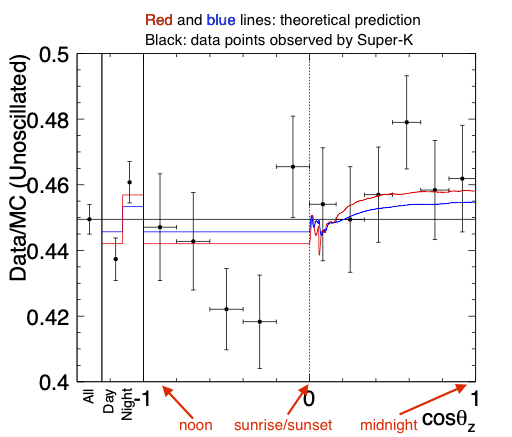
Since Super-K can see electron neutrinos much better, it should see about 2–3% more events during the night—and it does! 44% during the day, 46% at night. (7/8)

So, to neutrino detectors, the sun looks slightly brighter at night!

… and that’s why Corey Hart wears his sunglasses at night 🙃
https://www.youtube.com/watch?v=X2LTL8KgKv8

(Okay, that last bit was a joke. Everything else in this thread is true, apart from minor simplifications. And if you’re a physicist and want to know all the gory details … check out this Super-K paper: https://inspirehep.net/literature/1472086) (8/8)

Corey Hart - Sunglasses At Night (Official Music Video)

REMASTERED IN HD!Music video by Corey Hart performing Sunglasses At Night.#CoreyHart #SunglassesAtNight #Remastered

YouTube
@JostMigenda I love this...and was gonna respond, "NOW can I get the whys?" lol but no, you already gave me a link! (No, I'm not a physicist, just a nerdy physics fan) You da best! <3
@JostMigenda thanks for sharing! That is really fascinating stuff.