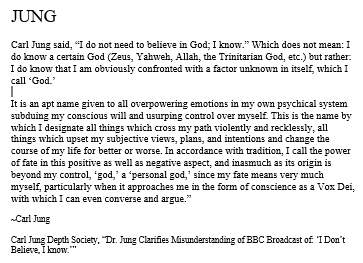
@ceejaedevine Just to get this out of the way, Saying “I don’t need to believe… I know” misunderstands what knowledge is; a subset of belief. You can’t know something without also believing it. (I know I’m nitpicking his rhetoric, but I think it’s pretty important in these conversations)
That said, I don’t think that really clarifies anything for me. Jung’s definition of God just seems to be a name for the aggregate mysteries in the world and his experience.
I also experience things that I don’t understand and often attribute meaning or agency to patterns and coincidences I notice around me. However, it seems that those responses on my part are fairly reasonably explained by psychology, evolution, etc.. Wherever there are gaps in understanding, I’m perfectly happy to acknowledge those gaps and hope to have an answer one day. If I wanted to, I could refer to those gaps as God and everything that Jung says in that quote could apply to me without issue, even though I don’t believe in a being external to my mind that I call God.
It seems like you believe in an actual being that you call God though, right? Maybe I’m missing something, but I don’t see how what you said justifies that.
 Ceejae Devine
 Breadless Norseman