 Steve Stewart-Williams
This photo of the sun might not look too impressive... until you realize it was taken at night – not looking up but looking down, through the entire Earth, using neutrinos rather than light. Amazing! https://apod.nasa.gov/apod/ap980605.html
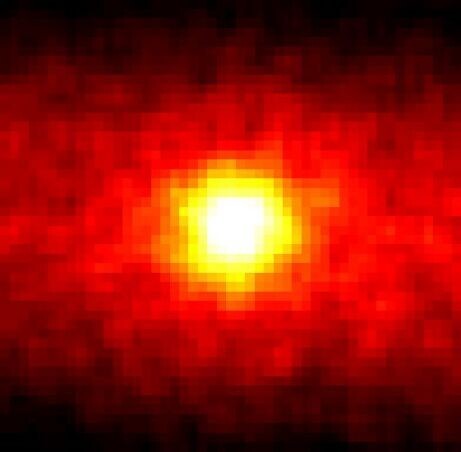
@SteveStuWill Not just at night—that photo was taken using over a year of 24/7 “exposure”.
(Though here’s one of my favorite facts I learned while working on this experiment: We do actually see slightly *more* neutrinos at night, when they have to travel through the whole Earth!)
@JostMigenda @SteveStuWill Does that imply that passing through more mass has an effect on whether a neutrino will interact with future mass?
I keep starting the next sentence with "I would have thought..." but I realize that of course any approach to anything Standard Model-related that begins with "I would have thought" is probably by definition wrong. I think what I mean to ask is:
How does passing through the Earth affect neutrinos?
@UncivilServant @JostMigenda @SteveStuWill It affects them very little. On the other hand it completely blocks muons or other particles created by cosmic rays hitting the atmosphere.
Therefore, considering only particles moving upwards improves the signal/noise ratio because it eliminates the latter.
@badibulgator @UncivilServant @SteveStuWill That’s a real effect & very important when observing high-energy neutrinos! Solar neutrinos on the other hand have ~10000 times less energy than an average cosmic ray muon, so we’re not at risk of mistaking them for each other.
No, the day/night asymmetry I’m talking about is a bit more subtle. I’ll try to write an explainer thread this evening, after work.
@JostMigenda @badibulgator @SteveStuWill Wow, I was aware that muon and tau neutrinos existed, but I hadn't even thought about them. I mean, it's not like we worry about microchips using muons instead of electrons...we don't, do we?
Errrm, is this another one of those "thank G_d we have a geomagnetic field" things?
@UncivilServant We don’t; electrons, muons and taus don’t change into each other like that. That’s a neutrino thing.
(And it’s unrelated to the geomagnetic field; electrons don’t do that in space either.)
 Joshua Carter
 Grant Canterbury
 ChookMother 🇦🇺🦘
 Jost Migenda
 Noah Cook
 Badibulgator
 Peacebringer
 Zem 🇪🇹 🇪🇺
 sebsauvage
 Doug 🌈🇨🇦
 Ossie
Ossie 
 RouseWorld
 Ω 🌍 Gus Posey
 Mark Tomczak
 John Caveney woke is me🛠️
 Sandor Szücs
 EndlessMason