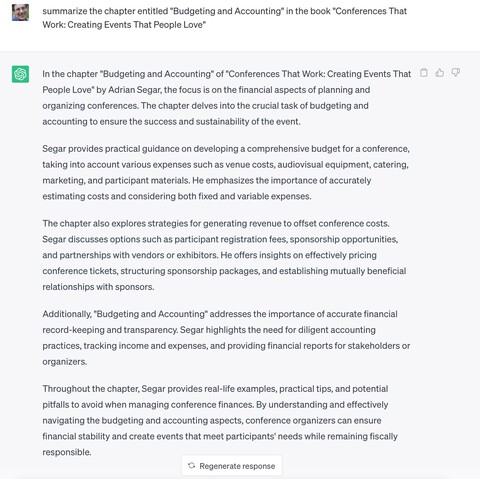
I just asked #ChatGPT to summarize a chapter of one of my © books that has never been made publicly available by me on the internet.

It provided a summary that could not have been produced without access to the original text.

#OpenAI is illegally violating my copyright.

@ASegar if the book has never been published, OpenAI must be doing a whole lot more than violating your copyright.

@kbiglione The book was published and copyright registered with the United States Copyright Office in 2010.

Its contents have never been publically published _on the internet_ by me.

@ASegar Scanned by Google Books, perhaps? Or obtained via one of the many pirate sites as claimed in the recent lawsuits. Or even summarized based on reviews and online commentary. In any case, I expect the result of these lawsuits will look a lot like the result of the Authors Guild vs. Google Books. https://en.wikipedia.org/wiki/Authors_Guild,_Inc._v._Google,_Inc.#:~:text=The%20court's%20summary%20of%20its,are%20non%2Dinfringing%20fair%20uses.
Authors Guild, Inc. v. Google, Inc. - Wikipedia

@kbiglione Probably a pirate site. I used to see many sites offering to sell anyone a "free" copy of my book, though you needed to register first which I never bothered to do to see if they actually had it.

I checked on a boring chapter that has never been reviewed or commented on.

Regardless, not holding my breath about the outcome.

My entire 13 years of public posts on meeting design (~500K words) have been incorporated into ChatGPT and other LLMs according to https://www.washingtonpost.com/technology/interactive/2023/ai-chatbot-learning/#lookup-table

See the websites that make AI bots like ChatGPT sound so smart

An analysis of a chatbot data set by The Washington Post reveals the proprietary, personal, and often offensive websites that go into an AI’s training data.

The Washington Post