
Settle in for a Sunday Junk Science take-down!

In this opinion piece, Milloy’s opinion gets an F in accuracy, but it's an absolute master-class in denialist propaganda. He employs the classic tactic of discrediting experts with what seem to be reasonable, obvious statements. They’re superficial and easy to discredit, but the point is to hijack the narrative.
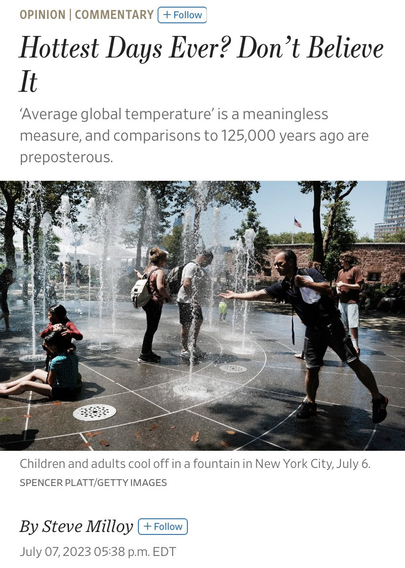

He first tries to lay blame with the media's use of Climate Reanalyzer, a tool developed by my colleagues here at UMaine, claiming it exaggerates temperature anomalies (aka, warmer or colder than average) relative to a different website, temperature [dot] global.

Temperature [dot] global has little info about data sources or methods, and the "About" lists no names or orgs.

They say their averages are calculated from a "30-year mean," but it's not provided. The only time interval mentioned is on in the one graph provided: Jan 2015-Jun 2023.

In contrast, Climate Reanalyzer (which has extensive information about the data sources and methods) reports anomalies are from a 1979–2000 average for the 2 m temperature anomalies, because that predates the significant warming in the Arctic. This is important, because...

https://climatereanalyzer.org/

Climate Reanalyzer

The window of time we use to calculate climate averages (aka, "climate normals") is updated periodically, so that we can compare temperatures to something expected. We don't expect temperatures to be like 1915 or 1962, we expect them to be more like the last couple of decades.
These normals are great for calculating weather forecasts. Here's the trouble: as the world warms, those "normals" become warmer, too. Our current "normal," 1991-2020, is a little warmer than the previous one (1981–2010), which in turn was warmer than the one before it.

If you just compare current temperatures to the last few years (e.g., since 2015, as his website does), of COURSE you'll have smaller anomalies than if you calculate them against a normal from a cooler past. Congratulations! You've discovered global warming!

Milloy argues that Climate Reanalyzer's results are skewed because it shows more warming in the Arctic, but his website is actually designed to erase that signal. It's like saying winter doesn't exist because yesterday was hot, too.

This is why data literacy is so important. It may be that Milloy didn't have access to good education and failed to learn math in school. But it's more likely that he, like the website he references, is deliberately, if crudely, misleading people by playing games with averages.

The second thing he says is that we can't compare temperatures 125,000 years ago to today, because we didn't have satellites then. As I always say, if something seems super obvious, you're likely not the first person to think about it, but wow, denial propagandists love this one.

The armchair climate disinformation brigade cites these data all the time ("it's been warmer before!") so it's fun to see this pop up in a new context ("we have no idea how much, though!").

Here's the thing: we actually have lots of information about Earth's past climates!

We don't have direct measurements. Instead, we have what are called "proxies," bits of preserved forensic evidence in nature that record aspects of Earth's climate. These tools have been highly vetted with decades of study, which is easy to do, because they still exist today.

Proxies include things like air bubbles in ice cores that captured past atmospheres, or the head capsules of tiny aquatic insect larvae that prefer different water temperatures, or tree rings, corals, or chemicals made by leaves that preserve in mud after the leaves break down.

Once vetted, these proxies ("proxy" because they stand in for the thing we are trying to understand, like temperature) provide records across the globe.

These records were even used to test early climate models, to see if they could recreate the climate changes of the past.

So we actually have two types of evidence about past climates: multiple lines of forensic evidence from environmental proxies in the recent fossil record (land, ice, freshwater, and oceans), and highly sophisticated climate models that were trained and vetted for accuracy.

So, how are the temperatures of 125,000 years ago relevant to today? Thanks for asking! That was the peak of our last warm period (remember, Earth has had a series of glacial cycles over the last 2.5 million years). It was a warm one, for different reasons than today is warm.
(As a side note, In 1911, a scientist named Milutin Milankovitch produced a series of hand calculations predicting how changes in Earth's tilt and orbit would affect how much of the sun's energy the northern hemisphere would receive, causing cold glacials and warm interglacials. His work was later validated when we had long-term climate records from the first ice cores!).
(What we do know is that based on these natural cycles, we should not be warming now. In fact, Earth's paleoclimate record is one of the most powerful lines of evidence we have that current warming is caused by adding heat-trapping gases, plus changing the land surface with deforestation for agriculture).
So, where were we? Rather, WHEN were we? Right! 125,000 years ago, in the balmy climates of the last interglacial, which was 1-2 degrees C warmer than today. Sea levels were 4-6 (and maybe as much as 10) meters higher than today (that's 13-32 feet, to us Yanks). Sounds fun!
I'm surprised that as a lawyer, Milloy doesn't care about past precedence. But as a tobacco lobbyist, he clearly proved he's happy making arguments that contradict the science. And as a former policy strategist for the largest coal company in the US, he sure knows how to spin.

@JacquelynGill US lawyers like Milloy (and me) are trained to “distinguish” or manipulate past precedent rather than *follow* it—honestly, as the tobacco lawyers proved for years, the same goes for factual evidence (and esp anything statistical—US law is still biased towards very fallible first-hand human witnesses).

So, sadly, I’d have to say what Milloy does here fits into a dark & deep tradition of US lawyering.

@krisnelson @JacquelynGill The difference between science and advocacy is that in science, you try to disprove *your own* theories.

@rpardee @krisnelson @JacquelynGill

no, not really

you try to get citations and press coverage so you get grants and then you might do some research but maybe you'll just macchiarini or raoult your way forward and make some monies instead

or ride some technical train and then reinvent race biology like some nobelist

@troglodyt @rpardee @krisnelson @JacquelynGill Well if you are a bad scientist you might do that. The rest of us do try to make our hypotheses falsifiable.