
What gives you a WAP? Not the things that turn you on - we're all unique and beautiful and occasionally freaky in that regard. What physiological mechanisms make a vagina and vulva wet? Let's explore!

Vaginal lubrication isn't caused by a single thing. There's lots of processes going on which make the vagina a moist environment. Even when you're not turned on, the vagina is usually fairly damp.

Outside of arousal, most of the wetness in the vagina comes from the cervix. Cervixes contain glands that secrete mucous. The amount and texture of the mucous varies at stages of your cycle. You can see this in action here: https://masto.ai/@vagina_museum/110571170513632506
Vagina Museum (@[email protected])

Attached: 4 images ยท Content warning: Photos of a human cervix at various stages of the menstrual cycle

Mastodon

As well as cervical mucous, the vaginal flora - the natural colony of bacteria in your vagina which keep it clean - are secreting lactic acid and hydrogen peroxide. There's also a type of fluid called transudate, which comes from the blood vessels and is similar to blood plasma.

These natural secretions leave the vagina as discharge, and have a natural pH of around 4, though it varies with your cycle.

When you're turned on, more lubricating mechanisms kick into action. Increased blood flow to the vagina results in increased production of transudate. This creates a slippery, thin fluid which lubricates the inside of the vagina.

Glands on the vulva also play a critical role in producing wetness, lubricating the entrance to make things even slipperier.

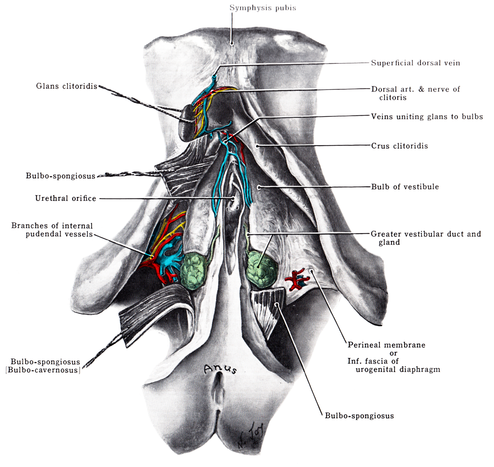
The most important glands in lubricating the vulva and vaginal entrance are the greater vestibular glands, sometimes called Bartholin's glands. This is a pair of pea-sized glands located on either side of the vaginal opening.

You can see them highlighted in green on this diagram (Atlas of Anatomy, JCB Grant, 1962).

And finally, during arousal and orgasm, two more things might produce some wetness, but this doesn't happen for everyone: squirting and ejaculation from the paraurethral glands - more on the composition of these fluids here: https://masto.ai/@vagina_museum/110355761378864563
Vagina Museum (@[email protected])

Let's have a wet and wild, gushy Friday and explore a question we get asked a lot: what's the deal with squirting? Is it just pee? Or is it something else, more similar to semen?

Mastodon

Sometimes the body doesn't produce enough vaginal lubrication: this is known as vaginal dryness. This happens for many different reasons, such as pregnancy, menopause, taking certain medications, autoimmune diseases, soaping or douching, breastfeeding, or simply not being horny.

Vaginal dryness is treatable depending on the cause. This could include lifestyle changes such as stopping douching, using lube for sex, or using a (tested) vaginal moisturiser.

There's lots of things the body is doing to make your vagina wet... and whatever your mind is doing to make it wet is entirely your own business!

@vagina_museum

Do we know why medications can cause vaginal dryness?

@essie_is_okay There's lots of them linked to it - most things that could give you a dry mouth could also give you a dry vagina!