 Carl T. Bergstrom
THREAD: Bias and disparity in a causal modeling framework.
1. A few months ago, @vtraag and @LudoWaltman posted a superb paper to the arXiv.
http://arxiv.org/abs/2207.13665
I've been meaning to write about it for a while and finally found the time.
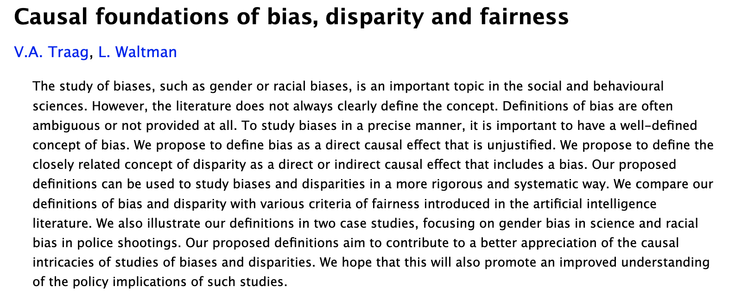

Causal foundations of bias, disparity and fairness
The study of biases, such as gender or racial biases, is an important topic in the social and behavioural sciences. However, the literature does not always clearly define the concept. Definitions of bias are often ambiguous or not provided at all. To study biases in a precise manner, it is important to have a well-defined concept of bias. We propose to define bias as a direct causal effect that is unjustified. We propose to define the closely related concept of disparity as a direct or indirect causal effect that includes a bias. Our proposed definitions can be used to study biases and disparities in a more rigorous and systematic way. We compare our definitions of bias and disparity with various criteria of fairness introduced in the artificial intelligence literature. In addition, we discuss how our definitions relate to discrimination. We illustrate our definitions of bias and disparity in two case studies, focusing on gender bias in science and racial bias in police shootings. Our proposed definitions aim to contribute to a better appreciation of the causal intricacies of studies of biases and disparities. We hope that this will also promote an improved understanding of the policy implications of such studies.
 Thomas