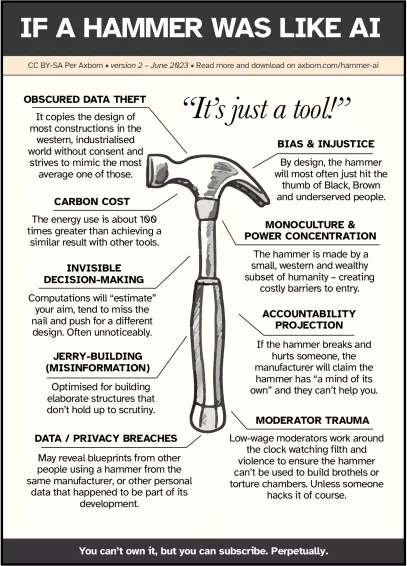
A common argument I come across when talking about ethics in AI is that it's just a tool, and like any tool it can be used for good or for evil. One familiar declaration is this one: "It's really no different from a hammer". I was compelled to make a poster to address these claims. Steal it, share it, print it and use it where you see fit.

https://axbom.com/hammer-ai/

#AiEthics #DigitalEthics
If a hammer was like AI…

Computations will “estimate” your aim, tend to miss the nail and push for a different design. Often unnoticeably.

Axbom
Poster: If a hammer was like AI.

Download and read more: https://axbom.com/hammer-ai/

#AiEthics
If a hammer was like AI…

Computations will “estimate” your aim, tend to miss the nail and push for a different design. Often unnoticeably.

Axbom
I'll add clarifications regarding some of the topics to this thread. 👇

Regarding Monoculture.
Today, there are nearly 7,000 languages and dialects in the world. Only 7% are reflected in published online material. 98% of the internet’s web pages are published in just 12 languages, and more than half of them are in English. When sourcing the entire Internet, that is still a small part of humanity.

76% of the cyber population lives in Africa, Asia, the Middle East, Latin America and the Caribbean, most of the online content comes from elsewhere. Take Wikipedia, for example, where more than 80% of articles come from Europe and North America.

Now consider what content most AI tools are trained on.

Through the lens of a small subset of human experience and circumstance it is difficult to envision and foresee the multitudes of perspectives and fates that one new creation may influence. The homogenity of those who have been provided the capacity to make and create in the digital space means that it is primarily their mirror-images who benefit – with little thought for the wellbeing of those not visible inside the reflection.
@axbom in addition to the internet being 98% published in 12 languages, the code that makes the internet uses syntax that is 100% English
@fasterandworse

Thank you! I've honestly been bad at recognising this and bringing attention to it. So much taken for granted all the time.
@axbom it’s really interesting for the web when you consider how much the difficulty of making accessible web pages is compounded by English element names and attributes that are complex enough as they are for a native speaker

The web is just a small portion of the internet, but your point still stands.

Also worth considering that the web was created by and for Anglophone academia - so a tiny fraction of even the English-speaking world.

HTML’s structure is really predicated on being able to write an academic paper in English. So it uses conventions - headings, tables, ordered lists, figures - from that milieu.

Many of these have no corollaries in other languages or cultures.

@fasterandworse @axbom

(None of this should be read as a pop at Berners-Lee, CERN or the web in general. It is a mad and beautiful thing. But it is what it is, and there are reasons for that. )

@fasterandworse @axbom

@iamdavidobrien @axbom yep, I said the internet in my previous response. But the web is particularly interesting in how easy it is to make *something* but complex to make something semantically correct and accessible, even if English is your language.