The ESA/JAXA BepiColombo spacecraft will makes its 3rd close flyby of Mercury on Monday at 19:34 UTC at an altitude of 236 km.

"This is the 3rd of 6 gravity assist flybys at #Mercury. The flybys, together with more than 15,000 hours-worth of solar electric propulsion, are needed to help the spacecraft overcome the Sun's massive gravitational forces and lose enough energy for capture into Mercury’s orbit in 2025."

More info in thread below.

https://www.esa.int/Science_Exploration/Space_Science/BepiColombo/BepiColombo_braces_for_third_Mercury_flyby
#BepiColombo #ESA
1/n

BepiColombo braces for third Mercury flyby

The ESA/JAXA BepiColombo mission is gearing up for its next close flyby of Mercury on 19 June, when it will pass the planet’s surface at an altitude of about 236 km.

The graphic below shows the timeline of BepiColombo from its launch from Kourou, French Guiana on Oct 20, 2018 to its planned orbit insertion at Mercury on Dec 5, 2025.

It also shows the relative speed of the spacecraft and its distance from Mercury.

BepiColombo has so far completed one flyby of Earth, two of Venus and two flybys of Mercury.

https://en.wikipedia.org/wiki/BepiColombo
#BepiColombo #ESA #Science #Space #Mercury
2/n

BepiColombo - Wikipedia

BepiColombo's speed relative to Mercury was ~3.6 km/s about a month ago. That was just over half the approach speed during the previous 2 Mercury flybys.

During the flyby, BepiColombo will have accelerated to 5.4 km/s relative to Mercury due to the planet’s gravitational pull, but the flyby will reduce its speed relative to the Sun by 0.8 km/s, and change its direction by 2.6°.

Here is an animation of BepiColombo's 7-year trajectory to #Mercury.

https://www.youtube.com/watch?v=OuQtRRQVlmg
#BepiColombo #ESA
3/n

BepiColombo's journey to Mercury

YouTube

Here is a sequence of images from BepiColombo's 2nd close flyby of Mercury on June 23, 2022.

The images were taken by the two monitoring cameras (MCAM) onboard the Mercury Transfer Module, which provide black-and-white images at 1024 x 1024 pixel resolution.

https://www.youtube.com/watch?v=qiNS1gG43I0
#BepiColombo #ESA #Mercury
4/n

BepiColombo’s second Mercury flyby

YouTube

The graphic below shows the location and orientation of the 3 M-CAM monitoring cameras on the Mercury Transfer Module.

The image acquisition system alternates quickly between the cameras with about 15-20 seconds between them.

The M-CAMs have 1024 x 1024 monochrome detectors.

BepiColombo has several other more sophisticated cameras and instruments for science operations.

https://www.esa.int/Science_Exploration/Space_Science/BepiColombo/BepiColombo_braces_for_third_Mercury_flyby
#BepiColombo #ESA #Mercury
5/n

BepiColombo braces for third Mercury flyby

The ESA/JAXA BepiColombo mission is gearing up for its next close flyby of Mercury on 19 June, when it will pass the planet’s surface at an altitude of about 236 km.

Here are a couple of fascinating images from BepiColombo's 2nd flyby of Mercury on June 23, 2022, taken by the M-CAM monitoring cameras?
What can we expect with the 3rd flyby on Monday?
https://www.esa.int/ESA_Multimedia/Missions/BepiColombo/(result_type)/images
#BepiColombo #ESA #JAXA #Mercury
6/n
BepiColombo

BepiColombo will deploy 2 separate orbiters around Mercury -
ESA's Mercury Planetary Orbiter (MPO) will study the planet's surface and interior.
JAXA's Mercury Magnetospheric Orbiter (MMO, aka Mio) will study the planet's magnetic field.

MPO orbit: 480 km by 1,500 km altitude, polar, 2.3 hour period.
Mio orbit : 590 km by 11,640 km altitude, polar, 9.3 hour period.

https://sci.esa.int/web/bepicolombo/-/59934-spacecraft-duo
https://www.esa.int/Enabling_Support/Operations/BepiColombo_operations
#BepiColombo #ESA #JAXA #Mercury
7/n

ESA Science & Technology - A pair of planetary explorers at Mercury

A pair of planetary explorers at Mercury BepiColombo at Mercury. Credit: ESA/ATG medialab The BepiColombo mission differs in one immediately evident way from...

BepiColombo is named after Prof. Giuseppe 'Bepi' Colombo (Oct 2, 1920 – Feb 20, 1984), astronomer and engineer at the Univ of Padua, #Italy.

In 1965, he proposed that Mercury's orbital and rotational periods were locked in a 3:2 resonance, not 1:1.

Colombo's calculations showed how to get a spacecraft to Mercury using gravity assists by Venus and execute multiple flybys, an idea successfully used by the NASA Mariner 10 probe launched in 1973.

https://articles.adsabs.harvard.edu/pdf/1966ApJ...145..296C
#BepiColombo #Mercury
8/n

NASA's MESSENGER is the only spacecraft so far to enter into orbit around Mercury. Much of our knowledge of Mercury’s surface composition, geological history, internal magnetic field and polar deposits of water-ice comes from that mission.
Launch: Aug 3, 2004
Orbit entry: Mar 11, 2011
End of mission plunge into Mercury: Apr 30, 2015
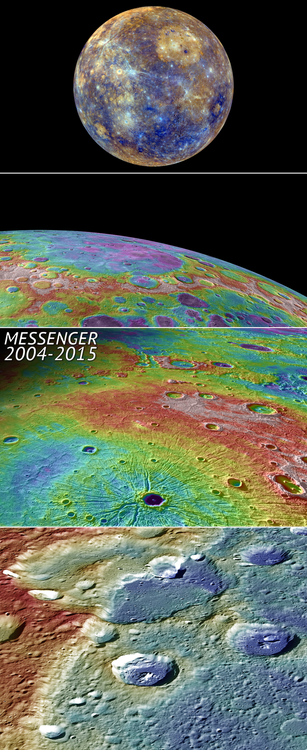
Here is a small sample of color-enhanced images taken by MESSENGER.
More at https://photojournal.jpl.nasa.gov/targetFamily/Mercury?start=100
https://messenger.jhuapl.edu/index.html
#BepiColombo #Mercury #Messenger
9/n
Images of Mercury

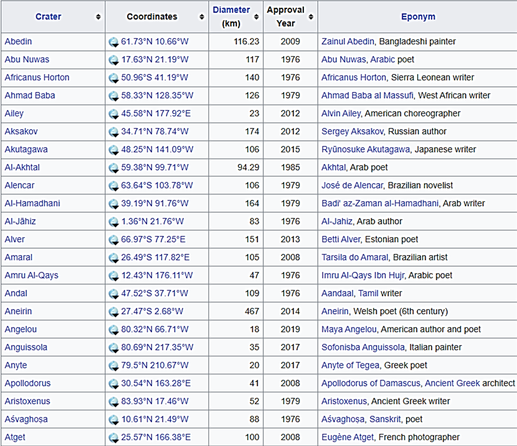
Did you know that most craters on Mercury are named after famous writers, artists and composers?

According to the rules by IAU's Working Group for Planetary System Nomenclature, all new craters must be named after an artist that was famous for more than 50 years, and dead for more than 3 years, before the date they are named.

The graphic below contains the list of names starting with A.
See full list at https://en.wikipedia.org/wiki/List_of_craters_on_Mercury

The names make a good knowledge test 🤔

#BepiColombo #Mercury
10/n

List of craters on Mercury - Wikipedia

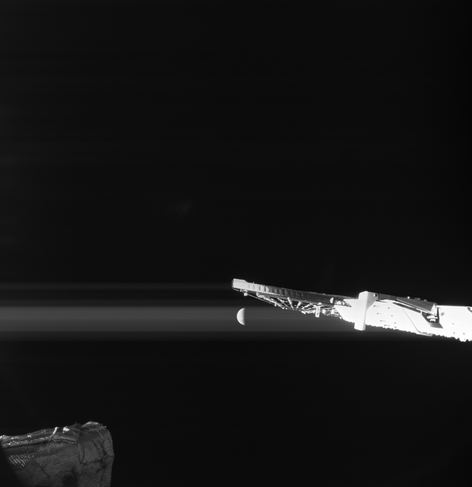
Here is an approach shot of Mercury taken by BepiColombo's monitoring camera M-CAM 1 at 10:32 UTC today from a distance of 121,000 km.

The structure on the right is the solar array of the Mercury Transfer Module (MTM).
The bright stripe spanning the width of the image and passing across Mercury is an imaging artefact.

Images of the flyby today at 17:34 UTC and those of the departure from Mercury will be released tomorrow.

https://www.esa.int/Science_Exploration/Space_Science/BepiColombo
#BepiColombo #Mercury #ESA
11/n

BepiColombo

BepiColombo

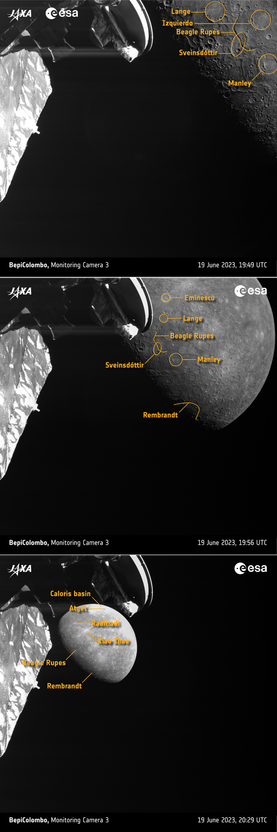
First images from BepiColombo's 3rd flyby of Mercury were just released.

These 3 images were taken by the Mercury Transfer Module’s monitoring camera 3 (M-CAM 3) as the spacecraft swung around the night side of Mercury and raced away, cameras clicking.

Closest approach took place at 19:34 UTC.

Manley is a crater newly named in honor of Jamaican artist Edna Manley (Feb 28, 1900 – Feb 2, 1987).

https://www.esa.int/Science_Exploration/Space_Science/BepiColombo/A_trio_of_images_highlight_BepiColombo_s_third_Mercury_flyby
#BepiColombo #Mercury #ESA #JAXA
12/n

A trio of images highlight BepiColombo’s third Mercury flyby

The ESA/JAXA BepiColombo mission has made its third of six gravity assist flybys at Mercury, snapping images of a newly named impact crater as well as tectonic and volcanic curiosities as it adjusts its trajectory for entering Mercury orbit in 2025.

Here is some more info on crater Manley, which was recently named, on Jun 13, 2023, after Jamaican sculptor, painter, and printmaker Edna Manley (1900-1987) .
https://planetarynames.wr.usgs.gov/Feature/16218
https://en.wikipedia.org/wiki/Edna_Manley
#BepiColombo #Mercury #EdnaManley #Manley
13/n
Planetary Names

@AkaSci For a hot second, I thought someone had named a crater after Scott Manley, the space Youtuber. Edna Manley seems a more appropriate choice and a good way to honor a historical figure.

@azar
Take a look at post #10 in this thread for some info on how craters on Mercury are named.

According to the rules by IAU's Working Group for Planetary System Nomenclature, all new craters must be named after an artist that was famous for more than 50 years, and dead for more than 3 years, before the date they are named.

#Mercury