There was a stretch when Elon Musk took over twitter and started charging for blue checks (lmao) and some of his sycophants started talking about “Veblen goods.”

A Veblen good is something for which demand *increases* as price increases, in contact to the neoclassical orthodoxy that demand decreases axiomatically with price.

Veblen goods are things that rich people buy to signal their wealth and status. Jewelry, fancy watches, yachts, Ivy League degrees. Things that cost many thousands or millions of dollars.

The idea that an $8 verification on twitter would ever be a status symbol for the rich was fucking ludicrous.

1/8

But why is it called a Veblen good? I’m so glad you asked!

Veblen goods are named after Thorstein Veblen, a Norwegian-born American economist who wrote around the turn of the 20th century. Veblen was a heterodox economist who critiqued capitalism from an angle that was not Marxist, but definitely complemented Marx’s analysis.

Veblen noted the existence of Veblen goods in his broader study of what he coined “conspicuous consumption” by the “leisure class,” two terms we owe to him.

2/8

Veblen made a lesser known but much more important contribution to our understanding of the economy. He noted that capitalist enterprise falls into two broad categories, industry and business. While we colloquially think of these two things are part of the same phenomenon, Veblen recognized that there were two separate and antagonistic processes ongoing in capitalism.

Industry is the process by which we make stuff to satisfy needs. It is a cooperative social process, the effort to satisfy needs as efficiently as possible. Its goal is collective well-being.

Business, in contrast, is about pecuniary profit for differential gain. Business is the process by which industry is mobilized to generate profits at a faster rate than other business. And, Veblen noted, this often entailed interference with industry.

3/8

Veblen called this interference “strategic sabotage.” At the time he was writing, Veblen was thinking specifically about the way capitalists might refuse workers permission to labor, to control wages, or to deliberately under-produce, in order to keep prices high.

We can and should think about sabotage more expansively, though. When H&M burns 12 tons of unsold clothing each year, it is sabotaging industry. When De Beers buys up diamonds and then locks them up in a vault, it is sabotaging industry. When CVS pours bleach on edible but unsold food, it is sabotaging industry.

https://economicsfromthetopdown.com/2022/03/11/in-search-of-sabotage/

4/8

In Search of Sabotage – Economics from the Top Down

Is capitalist power built on social sabotage?

Economics from the Top Down

Jonathan Nitzan and Shimshon Bichler, authors of “Capital as Power,” have pushed Veblen’s idea forward and view all property as sabotage—a social relationship of interference. Not necessarily in a normative sense, but in a positive one: property is the power to say no to someone else.

“Anything that can undermine the resonance of industry is a potential business asset. The private ownership of plant, equipment and knowledge (intellectual property); the ability to manipulate and leverage government policy and control the underlying population via education, propaganda and advertisement; the power to undermine autonomous thinking, restrict creative collaboration and humane planning, block the free movement of people and things, induce war and destroy the natural environment – these are all means with which business can sabotage industry. And whatever can sabotage industry can be used to extort income from it by threatening to incapacitate its activity. This sabotage, says Veblen, is the ultimate source of all business income and the basis on which pecuniary investment and the accumulation of capital rest.”

Unless something can be fenced off, it’s really hard to extract profits off it. We can put literal fences around land and post guards to deny access, but fortunately capitalists haven’t yet figured out how to sabotage and charge for access to air.

https://bnarchives.yorku.ca/750/39/20221000_bn_the_business_of_straegic_sabotage_web.htm

5/8

The Business of Strategic Sabotage

You might have heard that the company that owns Instant Pot has filed for bankruptcy. The makers of Instant Pot did something horribly wrong: they made a really good product that works very well and does not need to be replaced frequently. This means that owners of Instant Pots might only need to buy one and rarely replace it, if at all.

This is a great success from the perspective of *industry,* in Veblen’s sense, but terrible for *business.* The makers of Instant Pot failed to sufficiently sabotage their product by, say, building in intentional obsolescence. Maybe they should have used cheaper parts that wear out faster, or installed software that requires regular updates, or deliberately inserted components designed to make it fail.

But they didn’t, and so sales were stagnant. The firm that owns Instant Pot borrowed lots of money in an attempt to make a new version of Instant Pot they somehow hoped to sell to consumers of Instant Pot. It was too much; the firm did not earn enough differential profits—profits at a faster rate than its competitors—and so the firm is failing, despite the success of the product.

https://thetakeout.com/instant-pot-maker-parent-brand-file-for-bankruptcy-2023-1850534708

6/8

Instant Pot Doesn’t Deserve This

The all-in-one kitchen appliance has been crushed, in part, by the forces of capitalism.

The Takeout

Business—ownership—does not contribute to production. It can *only* earn revenue through sabotage. Without the fences, the toll booths, the armed guards, the enshitification, then owners do not earn any profits. Capitalism must constantly make things *worse* than they would be if we were free to produce to meet our own and each other’s needs.

Maybe you’ve seen the news about Reddit? Reddit is restricting access to its API so it can charge more from makers of third-party apps.

Reddit’s CEO had this to say:

“Reddit represents one of the largest data sets of just human beings talking about interesting things…We are not in the business of giving that away for free."

Oh My God He Admit It dot Gif

Huffman did not create “the largest data set of human beings talking about interesting things.” Reddits users did. What Huffman owns is a *fence* around those conversations, and he only earns a profit if he can *sabotage* access.

7/8

https://www.npr.org/2023/06/15/1182457366/reddit-ceo-steve-huffman-its-time-we-grow-up-and-behave-like-an-adult-company

Sennheiser makes headphones. Some of its models are very pricy, and others are cheaper. This is a common tactic for firms, selling products at multiple “price points” so it can capture revenue from people willing to pay at different levels.

It’s apparently not very cost effective to make all sorts of different models. But then how do you justify selling headphones at different prices? Why would someone pay hundreds more for the same headphones?

Why, just make one version *shittier.* Turns out Sennheiser was inserting a piece of foam into some of its headphones, to deliberately lower the sound quality, in order to sell the same headphones at different prices to different people.

Once you recognize sabotage for what it is, you can’t help but start to see it in every aspect of your life: a deliberate shittiness imposed on us so someone else can earn a profit.

http://mikebeauchamp.com/misc/sennheiser-hd-555-to-hd-595-mod/

8/8

Sennheiser HD 555 to HD 595 Mod – mike beauchamp

Tl;dr

Instant Pot is going out of business because capitalism incentivizes efficient pursuit of profit, not efficiency in general.

If Instant Pot wanted more money, they should have made a shittier product.

@HeavenlyPossum I agree with your point but please be accurate in your conclusion:
—Instant Pot is NOT going out of business (which is Chapter 7—liquidation). It filed Chapter 11—reorganization, to allow it to restructure debt and obtain financing to continue.

—Instant Pot may have too much debt because it grew too fast and exceeded its target market which capitalism encourages. It could make cheaper, shoddier products—which is your point—but it would then be exposed to more liability. /1

@HeavenlyPossum If you want to encourage Instant Pot's high quality products, buy their branded products and not the knock-offs which ate into their market.

This includes the flood of dirt cheap Chinese-made accessories which also ate into marketshare.

As @staidwinnow suggested, Like Apple or Mercedes (though Apple is the better example) — treat Instant Pot as a high-end high-quality product which aims for an audience with higher disposable income. That means Instant Pot needs a reorg.

@femme_mal @staidwinnow

I do not think the thesis of my thread conveyed to you

@HeavenlyPossum @staidwinnow
This:
"The makers of Instant Pot did something horribly wrong: they made a really good product that works very well and does not need to be replaced frequently."

And I said this:
"If you want to encourage Instant Pot's high quality products, buy their branded products and not the knock-offs which ate into their market.

This includes the flood of dirt cheap Chinese-made accessories which also ate into marketshare"

BUY THE IP-BRAND ACCESSORIES.

@HeavenlyPossum @staidwinnow cont'd.

Instant Pot also bought Pyrex as a means to build out more quality products and revenue. To continue Instant Pot as a business which targets a high-end audience, buy Pyrex.

High-temp resistant glass + ceramic products fail at a faster rate than pressure cookers. Ideally they keep IP going, but they need breathing room from debt to realize this.

And you still made a mistake you didn't acknowledge wrt Chapter 7 versus Chapter 11.

@femme_mal @HeavenlyPossum @staidwinnow Is that the Pyrex that reserved its original high quality glass with low thermal expansion coefficient for laboratory instances and went back to non oven safe glass for domestic uses after someone bought the original?

@ariaflame I don't know what the *current* formula is for Pyrex brand glass. I do know the company also owns Corelle which is glass & ceramic products — those are formulated *now* to have less lead content than the originals.

Don't need Pyrex or Corelle? Try Chicago Cutlery also owned by Instant Pot.

@femme_mal To be honest I don't think I've got anything pyrex aligned though I know my mum did. Maybe some jugs but I only use them for liquid measurement. I went the thermomix route rather than the instant pot. (also not a cheap thing).
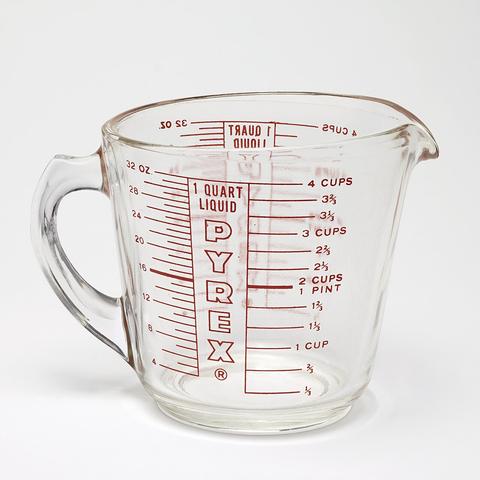
@ariaflame If you are into buying vintage as I am, watch for Pyrex products with all block capital letters in the brand labeling and avoid the ones with small case lettering. Apparently the change in formulation happened the same time the old company switched branding. I still have Pyrex glassware I bought and was gifted 30 years ago, it has the old branding.

@femme_mal @ariaflame "While it is literally true that the material used in manufacturing Pyrex brand glass bakeware has changed from borosilicate glass to soda lime glass, the brand's current owner, World Kitchen, claims that changeover began back in the 1940s and long antedates Corning's 1998 sale of the brand"

Re: the industry in general, "since the 1980's, most, if not all consumer glass bakeware manufactured in the U.S. […] has been made of soda lime"

https://www.snopes.com/fact-check/exploding-pyrex/

Does Pyrex Brand Bakeware Shatter?

Consumers claim Pyrex brand glass bakeware is now manufactured from a different material and thus more susceptible to breakage.

Snopes

@CA7746 @ariaflame The Snopes piece was originally published in 2009; the latest content in that piece is from 2011 and based on Consumers Reports' 2010 study.

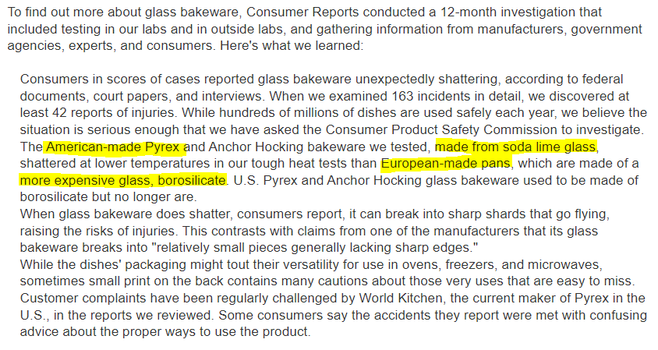
We can't be certain what Pyrex's former owner WK meant by "changeover began" in the Snopes article. Did ALL lines made by Pyrex change? Over what period of time was soda-lime phased in, especially since Pyrex still used borosilicate in EU in 2010?

As Snopes wrote, the claim is mixed and their own work is as well.
https://www.consumerreports.org/cro/news/2010/12/family-safety-warning-glass-bakeware-that-shatters/index.htm

Family safety warning: Glass bakeware that shatters

If you're planning to do some family baking this week or next, read on. Pyrex and other brands of glass bakeware are a staple of many kitchens, with marketing that dates back decades, touting its versatile uses. In recent...

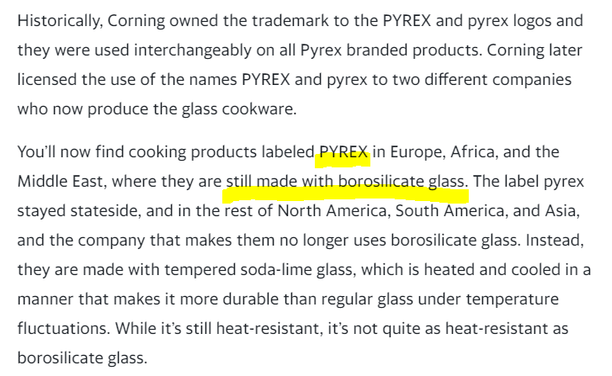
@CA7746 @ariaflame Reporting last month re: PYREX and pyrex brands and borosilicate or soda-lime glass production.

https://www.yahoo.com/lifestyle/pyrex-vs-pyrex-safer-133000341.html

Yahooist Teil der Yahoo Markenfamilie

@femme_mal @ariaflame "Corning Incorporated began making Pyrex glass bakeware from borosilicate glass in 1915 and in the 1940s began making Pyrex glass bakeware from soda lime.
Today [circa 2011], World Kitchen uses the same soda lime plant in Charleroi, Pennsylvania, to make Pyrex glass bakeware that Corning Incorporated used and has not changed the manufacturing process"

https://web.archive.org/web/20111026114654/http://www.pyrexware.com/index.asp?pageId=30

Pyrex® Products – Making Cooking a Little Easier

@CA7746 @ariaflame Charleroi PA hasn't been the ONLY manufacturing location of Pyrex glass products.

Corning Inc. was named Corning for a reason, after all.

@femme_mal @ariaflame
"two companies allowed to distribute Pyrex kitchenware [circa 2020]:
* International Cookware for Europe, Middle East & Africa [PYREX, made in Châteauroux, France, boro]
* Corelle Brands for US, Asia & Latin America [pyrex, soda]"

https://international-cookware.zendesk.com/hc/en-gb/articles/360011862740-Difference-between-Pyrex-USA-and-Pyrex-Europe

"While the Pyrex® brand was born […] in Corning, NY, it has been made in various places Currently [2015=World Kitchen, 2023=Corelle Brands] manufactures Pyrex consumer products in Charleroi, PA."

https://web.archive.org/web/20150612115710/https://pyrex.cmog.org/faq

@femme_mal @ariaflame Corning had licensed out the Pyrex brand to Newell Cookware Europe. A soda-lime factory in Sunderland, UK had made Pyrex from 1922 to 2007. Arc International acquired Newell in 2006, and moved production to France (boro plant linked above?). They sold their Pyrex division to International Cookware group. Which was bought by private equity Kartesia in 2020. Duralex bought in 2021.

So US went boro>soda in 1940s. And Europe went soda>boro in 2007.

https://en.wikipedia.org/wiki/Pyrex#History

Pyrex - Wikipedia

@femme_mal @ariaflame * That Wikipedia article's Composition section claims a 1980s pyrex shift but has weird citation.

The end of the sentence cites World Kitchen saying 1940s (linked above). The end of the paragraph cites a George Mason Uni STATS interview with a consultant, whose clients had included World Kitchen, saying "the industry as a whole switched from borosilicate started in the 1980s".

@femme_mal @ariaflame NYTimes 2020: "A representative at Corelle Brands told us, "Pyrex glassware [has] been manufactured from heat-strengthened soda lime glass since the 1950s." However, they did not disclose when Pyrex stopped using borosilicate altogether, and to our knowledge the company never made a formal announcement."

https://www.nytimes.com/wirecutter/blog/tempered-vs-borosilicate-glass/
From the works cited, the author seems to have done legwork interviewing folks who'd know what's publicly knowable.

Why We’re Not Worried About Pyrex Bakeware “Exploding”

We don’t think you need to be fearful of using tempered-glass items, but you should still treat them with care.

The New York Times

Telling people a company is going out of business when that isn't accurate isn't harm free. If enough potential buyers believe this, the company may be damaged by loss of sales. It hurts the company as well as existing product owners who rely on OEM parts to extend the life of products in which they've invested.

Like me.

@femme_mal @staidwinnow

My intent with this thread was not to save the owners of Instant Pot.

@HeavenlyPossum @staidwinnow So you don't really believe companies which make quality products should survive, or you just like using them as examples of capitalism's failures.

If only you'd chosen 'fast fashion' in general as an example instead of a specific company you might accidentally appear to endorse.