 Preston Lab
In our new paper at Cerebral Cortex, we find that the brain may connect related experiences by reactivating semantic knowledge in medial prefrontal cortex and integrating knowledge about both experiences in hippocampus. 🧵 https://doi.org/10.1093/cercor/bhad179 @nealmorton

Real-world events are often related to previous events you’ve experienced. We asked how the brain stores new memories to either integrate them with related memories and promote reasoning about connections between them or differentiate them to avoid interference.
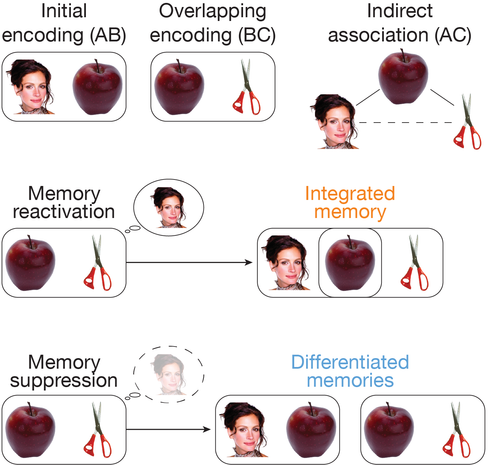
Participants studied initial (AB) pairs and overlapping (BC) pairs. They learned the pairs well but varied in their ability to infer indirect associations (AC). We asked whether variability in inference accuracy is related to how memories are organized in the brain.
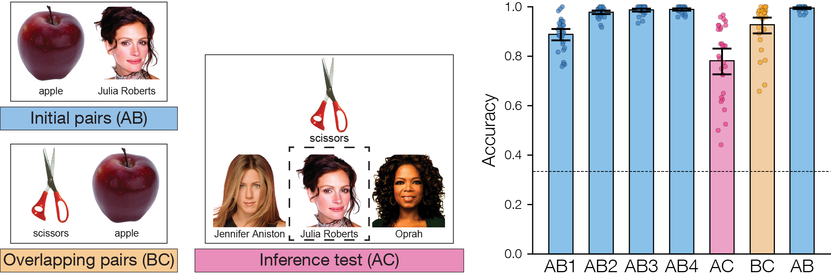
We predicted that memory reactivation would support increased inference accuracy, while memory suppression would lead to worse inference. We found that memory reactivation in right inferior frontal gyrus and anterior medial prefrontal cortex predicted inference accuracy.
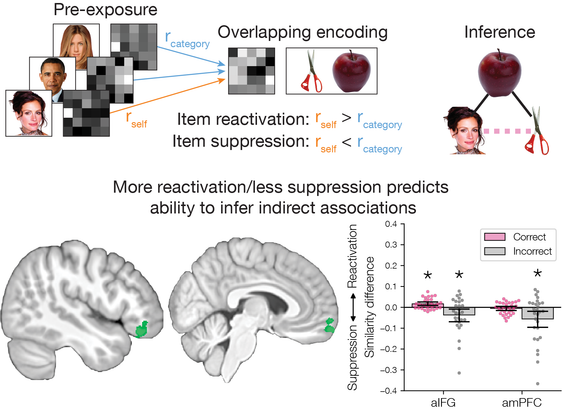
We next examined how information from both events is represented in the brain during learning of overlapping pairs. To do this, we used a method we previously developed that estimates the semantic similarity of items based on their Wikipedia entries.
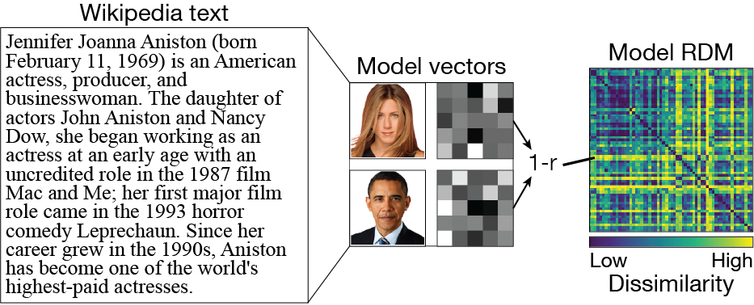
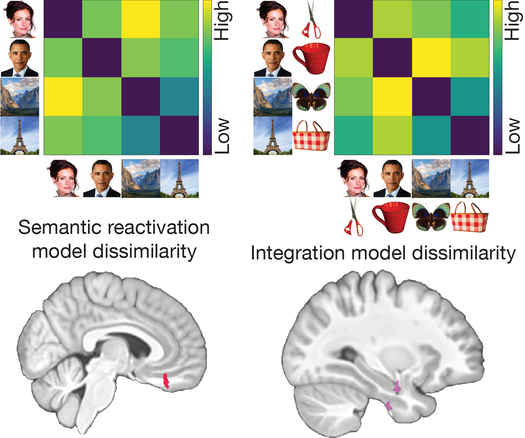
We calculated the similarity of brain patterns during encoding and compared this similarity to predictions from our model of semantic similarity. We found evidence of reactivation in medial prefrontal cortex and integration of features of both events in medial temporal lobe.
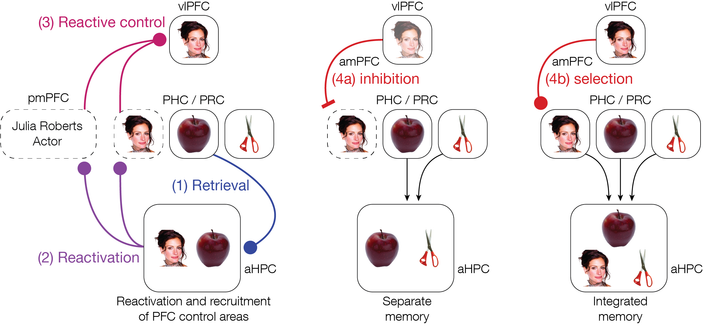
We propose that presentation of an overlapping pair triggers reactivation of perceptual and semantic features, signaling a change from prior experience. Prefrontal cortex then influences whether the prior memory will be inhibited or selected to form an integrated memory.
Code for running all analyses is publicly available: https://doi.org/10.5281/zenodo.6967582. Code for estimating semantic similarity based on Wikipedia entries is also available: see https://osf.io/72apm/ and https://doi.org/10.5281/zenodo.4453878.
Bender study: Pattern analysis of memory reactivation, suppression, and integration
This version includes analysis code used in the paper. It removes the Matlab code, which has been replaced by Jupyter notebooks. It also includes a procedure for reproducing all analyses using scripts and notebooks.