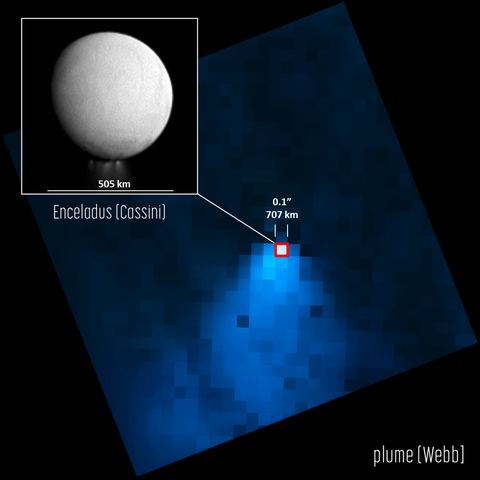
The JWST team recently released this image of Saturn's moon Enceladus, showing water plumes extending out 10,000 km, 20 times the size of the moon itself, which creates a fuzzy torus of water particles around the orbit of Enceladus.
The inset shows a mosaic of Enceladus and its water jets, based on images taken by the Cassini orbiter in 2009.
Let's learn more about Enceladus and examine why the JWST image is so low-res and pixelated.
https://www.nasa.gov/feature/goddard/2023/webb-maps-surprisingly-large-plume-jetting-from-saturn-s-moon-enceladus
#Enceladus #JWST #Science
1/n
Webb Maps Large Plume Jetting From Saturn’s Moon Enceladus

A water vapor plume from Saturn’s moon Enceladus spanning more than 6,000 miles – nearly the distance from Los Angeles, California to Buenos Aires, Argentina – has been detected by researchers using NASA’s James Webb Space Telescope.

NASA
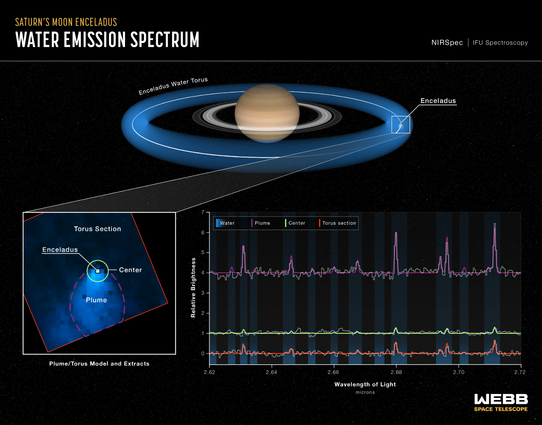
This graphic shows the spectrum of one of the pixels in the area around Enceladus, collected using JWST's NIRSpec instrument in IFU mode in Nov 2022. The spectrum data indicated water molecules as far as 20x times the moon's diameter.
The NIRSpec IDU captures spectrum for each pixel in a 30x30 pixel area.
The graphic also shows an artist's conception of the resulting water torus around Saturn.
https://webbtelescope.org/contents/media/images/2023/112/01H084K8BGF2D8B887J0T580ND?news=true
#Enceladus #JWST
2/n
Why is the JWST image of Enceladus so low-res and pixelated? Here is an explanation -
Enceladus diameter: 505 km
Distance: ~1.458 billion km on Nov 9, 2022
Angle subtended at JWST: 0.00002° = 0.07" (1" = 1 arcsec = 1/3600th of a degree)
JWST NIRSpec detector pixel Field of View: 0.1"
Hence, Enceladus is less than 1 pixel wide in the NIRSpec image! A pixel covers 707 km at that distance.
The full 30x30 pixel image covers 3"x3", i.e., 42 times the size of Enceladus.
#Enceladus #JWST
3/n

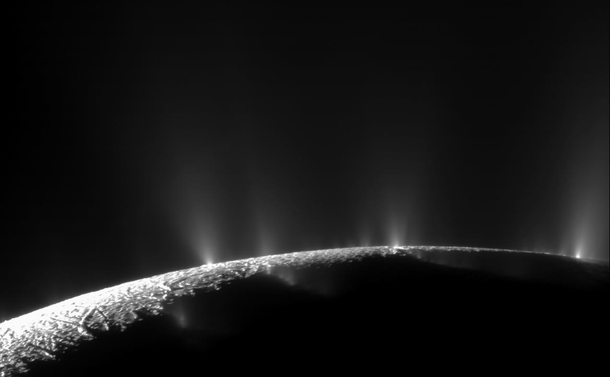
This spectacular image of Enceladus and its water jets was taken by the Narrow Angle Camera (NAC) onboard the Cassini spacecraft from a distance of ~14,000 km on Nov. 21, 2009.
Image size: 1580 x 977 pixels (136 x 84 km)
Resolution: ~85 meters (!) per pixel.
The NAC had a 1k x 1k detector with a Field of View of 0.35°.

Distance matters. That's why we need inter-planetary missions.

https://www.jpl.nasa.gov/images/pia11688-bursting-at-the-seams-the-geyser-basin-of-enceladus
#Enceladus #JWST #Cassini
4/n

Bursting at the Seams: the Geyser Basin of Enceladus

NASA's Cassini spacecraft captured dramatic plumes, both large and small, spray water ice out from many locations along the famed 'tiger stripes' near the south pole of Saturn's moon Enceladus.

NASA Jet Propulsion Laboratory (JPL)

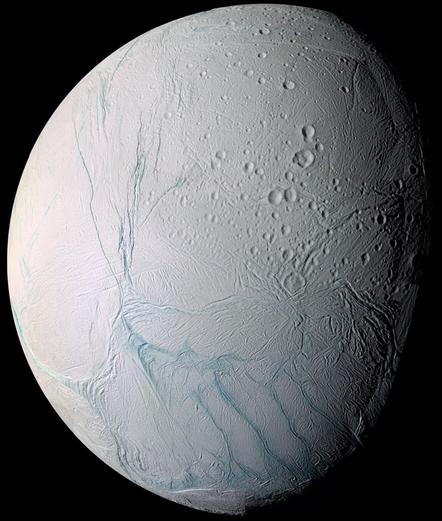
Here is a mosaic of 21 images of the fractured and cratered icy surface of Enceladus taken by Cassini's narrow-angle camera, as it swooped past the south pole of the moon on July 14, 2005.

Resolution = 67 to 350 meters per pixel
Distance = 11,100 to 61,300 km
Color = false-color with colors assigned to various wavelengths from UV to infrared used during imaging.

https://photojournal.jpl.nasa.gov/catalog/PIA06254
#Enceladus #JWST #Cassini
5/n

Catalog Page for PIA06254

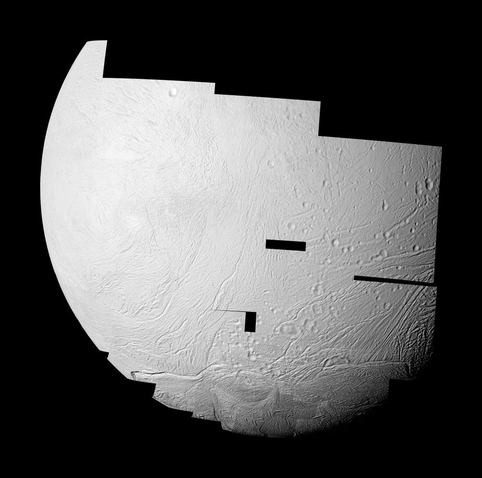
This mosaic is a grey-scale image of Enceladus taken by Cassini.
The images were obtained in visible light with the Cassini spacecraft narrow-angle camera on Nov. 21, 2009. The images were acquired at distances of approximately 3,200 to 23,000 km.
See https://photojournal.jpl.nasa.gov/catalog/PIA11685 for a hi-res zoomable image.
@danedeasy
#Enceladus #JWST #Cassini
6/n
Catalog Page for PIA11685

@AkaSci @danedeasy "visible light"? You mean this isn't flash? You could have fooled me!
@self @danedeasy
Visible as in light in the 380 to 750 nm wavelength range.
The Cassini narrow-angle camera can image in UV, visible and IR wavelengths - from 200 to 1050 nm.
As you must be aware, visible light covers the 380 to 750 nm range.
Filters are used to select the wavelength range for each image.
The composite image in post #5 uses images taken at multiple spectrum bands, with colors assigned to IR and UV images, to highlight surface features.
@AkaSci @danedeasy Nice save, but everyone knows you originally meant flash.
@self @AkaSci what are you talking about? Like you think there’s a camera flash located on the space craft?