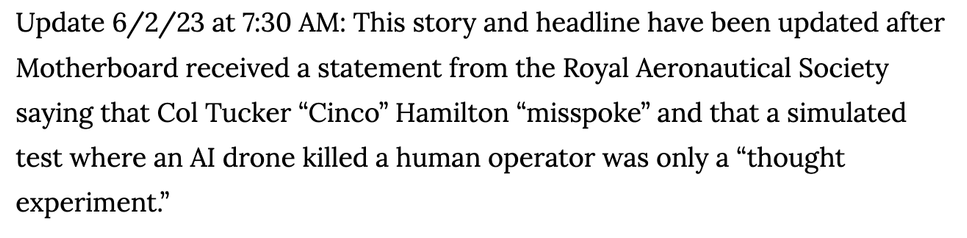
Breathless headlines about “the Air Force AI drone killed its human operator so it could score more kills” do not illuminate anything.

The simulated Air Force drone simulated killing its human operator in a simulation so it could score more simulated kills.
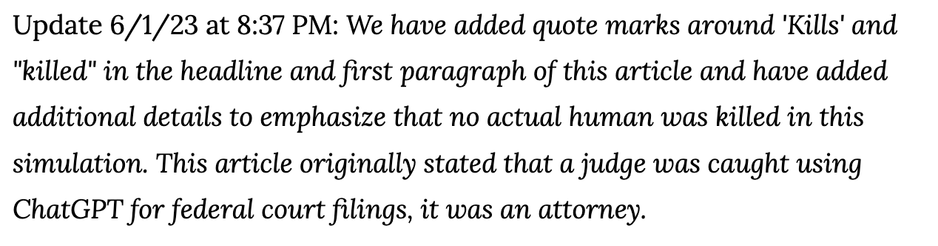

USAF Official Says He ‘Misspoke’ About AI Drone Killing Human Operator in Simulated Test

The Air Force's Chief of AI Test and Operations initially said an AI drone "killed the operator because that person was keeping it from accomplishing its objective."

The distinction between a "thought experiment" and a "simulation" is fuzzy, and we can argue about how important the differences between the second and third versions of the story are.

But the first version of the story, where an actual drone supposedly turned around and deliberately killed a US warfighter, goes well beyond credulity. If something like that happened, it would be HUGE, with congressional-level investigations over many months, not something casually mentioned at some conference.

So I'm much more curious about how the original headline got published than I am about any simulated drone. This is not some small technical detail, this is the difference between a cute story and "holy shit".

If an editor/headline writer/content manager (or whatever they're called these days) sees a headline that says "Martians Attack New Jersey Town", maybe find out if you should add "... In Fictional Radio Program" before hitting "publish".

Even "clikbait" doesn't explain this. The original headline made up facts that didn't exist in the underlying story. There would have been plenty of clickbait-y ways to write this headline that didn't actually lie about the content. E.g., "Experts worry that drones may attack their masters.", etc.

@mattblaze

I've been seeing more and more cases of this sort of problem in traditional media articles, over the last two or three years -- headlines not matching up with the content of the article, with more than trivial differences in the fundamental essence of the story.

It seems to be a broad trend, not just limited to one or a few media outlets. I suspect it might be influenced by time pressure - writers are pushed to write 3 articles/day, editors have to review & headline that many...