Steve Gayner
 Wonder of Science
Relative rotation periods of planets in 2D.
Credit: @Physicsj
Relative rotation periods of planets in 2D.
Credit: @Physicsj
@simon_brooke @wonderofscience @Physicsj There are so many different random factors in even just one star system that you'll inevitability end up with a number of strange looking coincidences.
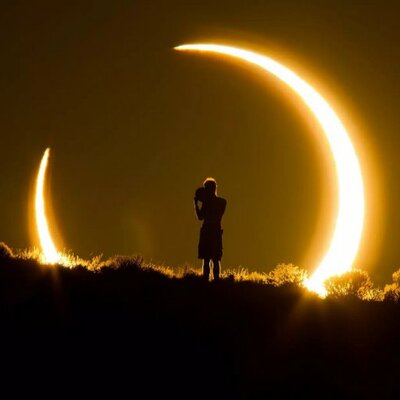
Though the biggest one is the Sun having 400 times the diameter of the moon and also being 400 times as far from Earth, making them look nearly identical in size.
Annular eclipses should be extremely rare in a galaxy, but we just happen to get one.
If Neptune would rotate vertikal it would be perfect!
🤔🤓
I had to think twice why the rotation time of earth is not exactly 24 hours. And why that doesn't mean, that once a year, midnight is at 12:00 instead of 00:00
Very cool. Looks like it uses the celestial day for Earth, but the solar day for Venus (haven't checked the others).
Jupiter goes all that way in *nine hours*?? Peppy!
 Philipp Suessmann
 Enby Shark
 KristinMuH
 Simon Brooke
 Yora
Yora Geo
Geo Cris
Cris Stargeezer Smith
 J. Randall Todd
 Lucas
Lucas John Mastodon
 eyebrowsgerri will not comply
 Rai Aren 🖖✨📚🇺🇦
 Tyler 👋
 Locomotoro
 lazysupper 🍂🍁 salguod, man
 BigLinter
 I am who I am.
 Christopher Faille
 Thomas
 Till
Till Stevens R Miller
 Dana Priesing
 Dennis Faucher

 kattekrab
 Michael
 PhDog 🇮🇪
 woolie
 Kevin Karhan
 Aviva Gary
 CautionWIP 🎃+🇨🇦+🏳️🌈=