
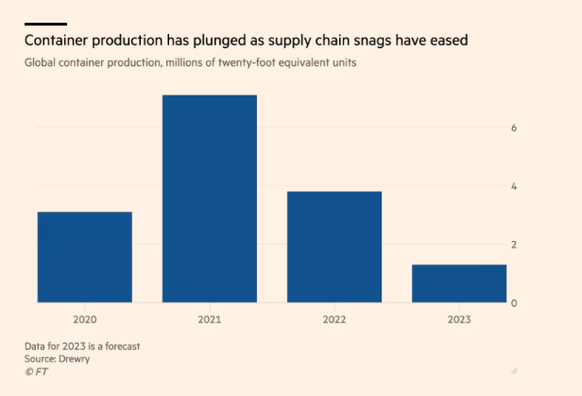
Meanwhile in #suplychain #logistics, the production of #containers has sharply declined as global trade continues to be constrained & a surplus of containers sits at ports around the world.

Whether this is a lead or lagging indicator is an interesting Q.: does it merely reflect a previous surge & now over-capacity in containers ready to be used, or does it reflect worsening expectations for global trade?

Or given these are 20ft containers, does it relfect a swing back to larger 40ft units?
@ChrisMayLA6 The question about supply chain lead/lag is more interesting. The container ship business is subject to boom-bust cycles due to the lag between demand and new supply (years to commission a new big ship).

In engineering a feedback loop with a delay can easily create oscillation, so this is not surprising. See the Beer Distribution Game for a toy example in supply chains. https://en.wikipedia.org/wiki/Beer_distribution_game.
(cont...)

Beer distribution game - Wikipedia

@ChrisMayLA6
(... cont)
What is more surprising is that economists don't seem to do stability analysis. They figure out the static solution and assume job done. In control theory that is the *start* of the work, not the end. This is a clear example of market failure requiring some kind of market-wide coordination to predict demand and plan accordingly.

@tokensane

Ha ha, yes absolutely right on #economists - Geoffrey Hodgson has a great book on this called: How Economics Forgot History, which also includes the frequent lack of dynamic analysis... so yes, you're right on the button as regards fluctuation in logistics provision, but in itself does not negate is indicator qualities (although it of course modifies them)