This thread is now available as a blog post:
https://innig.net/teaching/liberal-arts-manifesto

–––

In college, I took a class called The Letters of Paul. I took it for two very good reasons:

1. I was (and am) named Paul.
2. The prof, Cal Roetzel, was (and is) cool.

I didn’t figure it was an especially practical course. It was for fun, for the challenge, for the cultural knowledge, for the pleasure of doing it.

WHAT LIBERAL ARTS EDUCATION IS FOR: A THREAD

1/
What Liberal Arts Education Is For – Teaching – innig.net

The class turned out to be more less “A Letter (singular) of Paul:” we spent the semester reading Paul’s letter to the Romans, at a rate of about 3 sentences per week.

Why so slow? Because we read multiple translations of each of those sentences, and multiple commentaries on them, spanning many centuries — plus a bit of social and historical context. Slow, diligent, careful. And…
2/

We asked, over and over: “What do we think Paul was thinking, given that he chose those words? What do we think each commentator thought Paul was thinking? Why do we think they thought he was thinking that? Does it really make sense for Paul to have thought X? For us to think they thought he thought X?“ …etc. A theory of mind hall of mirrors!
3/

The heart of the course: “What can we learn about what other people are really thinking, about their mental models of the world, by paying very careful attention to the words they use?”

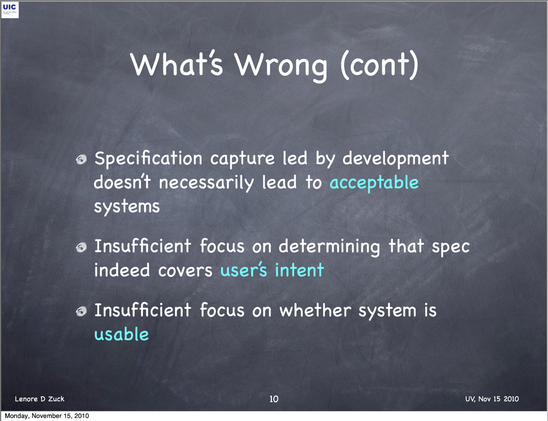
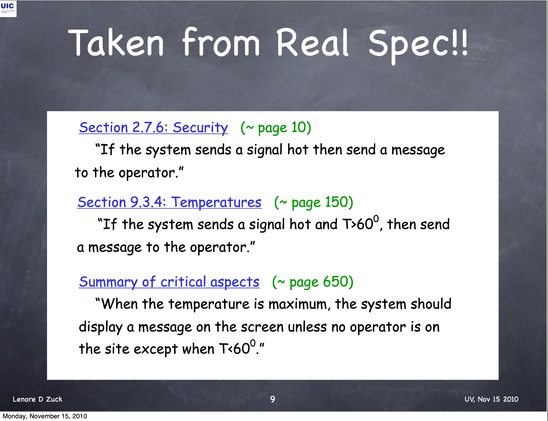
And I thought that course had •absolutely no practical relevance• to my career as a software developer until I started encountering text like this (from a presentation by Lenore Zuck, https://fm.csl.sri.com/UV10/slides/UV-Zuck.pdf, ht @AndrzejWasowski):

4/

When I’m on a software project, I try to listen hard to what everyone is saying, to the words they choose. “Don’t blame me! They asked for it!” is never good enough. I ask critical questions about what people are really thinking, what we’re all hearing each other say, from the start.

I have saved many companies on many projects a whole lot of money (and tears) by using that skill to nip misunderstandings and hidden assumptions in the bud early.

A skill I honed in a Religious Studies course.
5/

Here’s the hidden truth of education:

You don’t know what you’re preparing for.

Your teacher doesn’t know. Your school doesn’t know. Your future employer doesn’t know. Nobody knows. Not really.

Much of what you’re preparing for doesn’t even exist yet. We •hope• it doesn’t exist yet: don’t we educate students in the hope that they will make the world better by changing it? By creating realities that don’t even exist yet?
6/

@inthehands Gotta say, I do question, as a 70+yo, the utility of what it took to get ready for SAT Math. And not just for me, for most who work/live on the social science space.

@wndlb @inthehands

What do you mean by "SAT Math"? Do you mean the mathematics portion of the SAT?

I don't understand why one would "get ready" for that; it's been a few decades since I took it, but my impression was it was just math of the ordinary kind you'd do elsewhere in school.

@fizbin @inthehands As a lawyer, I have used a lot of skills, but not the advanced high school math. Perhaps I would have if I had gotten involved more with statistics, but not even with financial planning.

@wndlb
@inthehands

Many parallel threads of responses spring to mind, most probably not useful.

However, I will say that I don't understand the dividing line you have between "advanced" high school math and not. I understand a division between "requires calculus" and not, and I suppose one could wall off trigonometry as its own thing, but since all SAT math is non-calculus, you seem to see some other distinction where I only see a cohesive whole divided up only because of the school year.

@wndlb @fizbin @inthehands Hmm, "advanced high school maths"? As a computer scientist, I've never thought "I don't need that math", but regularly do think "I wish I had spent more attention in that math class". From statistics to linear algebra to calculus and set theory.