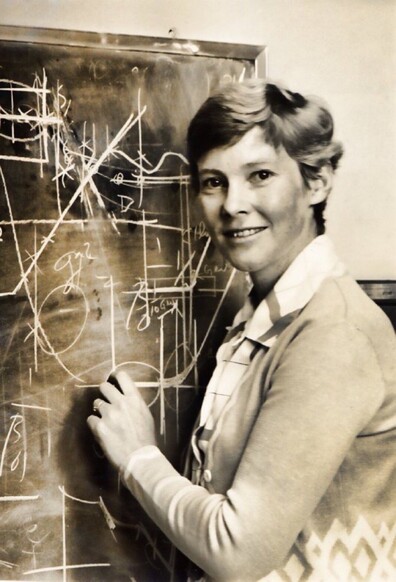
Physicist Helen Quinn was born #OTD in 1943. She is best known for Peccei-Quinn theory, a proposed explanation of the Strong CP problem of quantum chromodynamics.

Peccei-Quinn theory also implies the existence of a very light particle –the Axion– which is a pretty good dark matter candidate.

Image: H. Quinn/ @QuantaMagazine
Axions may or may not exist - but we're not just making things up

Everything theoretical physicists do is speculative, and likely wrong, except for the things we get right, says Chanda Prescod-Weinstein

New Scientist

So what is the "strong CP problem,” why does it need a solution, and what did Quinn and her collaborator Roberto Peccei propose?

In particle physics, and in physics in general, we are always looking for symmetries of nature.

A symmetry is a way you can transform a physical system (like rotating an object, or shifting its position) or your description of a physical system (swapping out the particles in your model for different combinations of those particles) that leaves the physics unchanged.

Some transformations are “continuous.” That means I can do them a little bit or a lot or not at all. For instance, a sphere looks the same if I rotate it. I could rotate it by a large angle, or a small one. Rotating it by an angle of zero is the same as not rotating it at all.
Other transformations are “discrete.” You either do them or you don’t. For example, you can swap left and right like a mirror's reflection. “A little bit of reflection” isn’t an option. Unlike rotation angle, there's no continuous parameter describing the amount of reflection.
There are three discrete transformations of interest in particle physics. They change the dynamical objects or the parameters appearing in our description of the physics. If the new description is still consistent with what we see in Nature, the transformation is a symmetry.
The first transformation is charge conjugation (C), which swaps every particle with its antiparticle. The second is parity (P), which flips one or more spatial directions like a reflection in a mirror. And the third is time reversal (T), which reverses the direction of time.

Some rules of physics don't work the same way if we apply one or two of these discrete transformations. But the framework of particle physics, quantum field theory, MUST work the same way if we simultaneously make all three changes (CPT).

The Weak Interaction — one of the three interactions appearing at low energies in the Standard Model of particle physics — clearly isn’t invariant under just C or P. Only left-handed particles and right-handed antiparticles participate in the Weak Interaction.

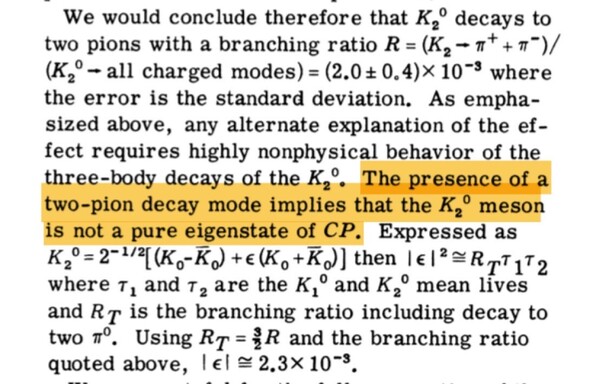
For a while, physicists thought CP — charge conjugation accompanied by a simultaneous parity transformation — would be a symmetry of the Weak Interaction. But that is violated as well.

Ref: https://journals.aps.org/prl/abstract/10.1103/PhysRevLett.13.138

Evidence for the $2\ensuremath{\pi}$ Decay of the $K_{2}^{0}$ Meson

Phys. Rev. Lett. 13, 138 (1964)

Physical Review Letters

Anyway, quantum chromodynamics (QCD) is the theory of quarks and gluons that describes the Strong Interaction.

Based on the rules for how we construct theories of particle physics, there's good reason to expect CP transformations wouldn't be symmetries of the Strong Interaction.

Except, when we do experiments looking for evidence of CP violating processes in QCD, we don’t find anything. This leads to what physicists call "the Strong CP problem."

There’s a number θ appearing in the rules for the Strong Interaction that quantifies the amount of CP violation. It could take any value between 0 and 2π; as far as we know there is no physical principle that fixes it to a particular value.

Experimental bounds put θ *very* close to zero, which is surprising. Zero is the only value of θ where CP violation does not occur.

There’s more real estate not close to zero than there is close to zero, so why did θ end up taking this one special value?

Another name for this sort of problem is “fine tuning.” Unless a number in your theory has a good reason to be very small, you don’t expect it to be very small. If it happens to take a special value, you expect it must be the result of some physical mechanism.

(Some physicists question how much stock we put in "fine tuning” and “naturalness” as criteria for whether or not some aspect of a theory is problematic or requires explanation. That is justified, but it's a topic for another thread.)

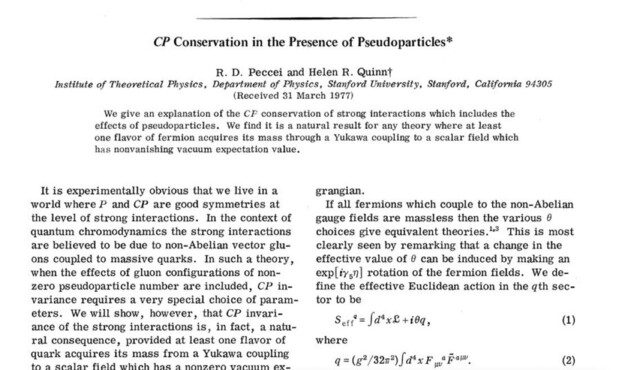
In 1977, Quinn and Peccei proposed a mechanism to explain the lack of CP violation in QCD.

The parameter θ isn’t static, they reasoned. Rather, it’s a field itself. The dynamics of this field within QCD naturally cause it to settle down to a value of zero.

Ref: https://link.aps.org/doi/10.1103/PhysRevLett.38.1440

$\mathrm{CP}$ Conservation in the Presence of Pseudoparticles

We give an explanation of the $\mathrm{CP}$ conservation of strong interactions which includes the effects of pseudoparticles. We find it is a natural result for any theory where at least one flavor of fermion acquires its mass through a Yukawa coupling to a scalar field which has nonvanishing vacuum expectation value.

Physical Review Letters

In quantum field theory particles arise as excitations of fields.

Wilczek and Weinberg both worked out the details of the new particle produced by the Peccei-Quinn mechanism.

Wilczek named it “axion” after a brand of detergent, because it cleaned up some outstanding problems.

The original version of the axion, studied by Weinberg and Wilczek, was experimentally ruled out. But it’s a lovely idea that fits naturally into our expectations for particle physics, and there are many variants that are of phenomenological interest.

In particular, some models with axions lead to light (small mass) particles that are unlikely to interact with most Standard Model particles. The numbers of axions produced in the early Universe make them attractive candidates for Dark Matter.

Besides the @chanda piece on axions that I linked at the start of the thread, here is a very accessible article in @QuantaMagazine by Frank Wilczek.

https://www.quantamagazine.org/how-axions-may-explain-times-arrow-20160107/

Time’s (Almost) Reversible Arrow | Quanta Magazine

The irreversibility of time may be a clue as to what makes up the universe’s dark matter.

Quanta Magazine

Now here comes the good part.

In addition to her work in fundamental physics, Dr. Quinn has also been involved in physics education. She is one of the founders of the Contemporary Physics Education Project.

http://cpepphysics.org

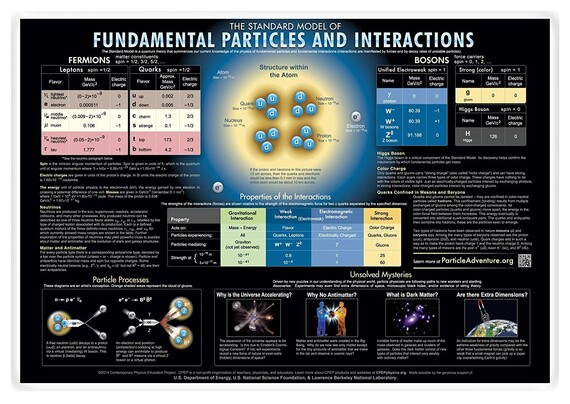
You may be familiar with CPEP's work. Their chart mapping out the particles, interactions, and unanswered questions of the Standard Model is a classic. You can find it on the walls of offices and classrooms, or taped up above nerd desks everywhere.

You can get that particular chart (and find other fun resources) here:

https://www.cpepphysics.org/fundamental-particles/

Image: CPEP / DOE / NSF / LBNL

Fundamental Particles – Contemporary Physics Education Project

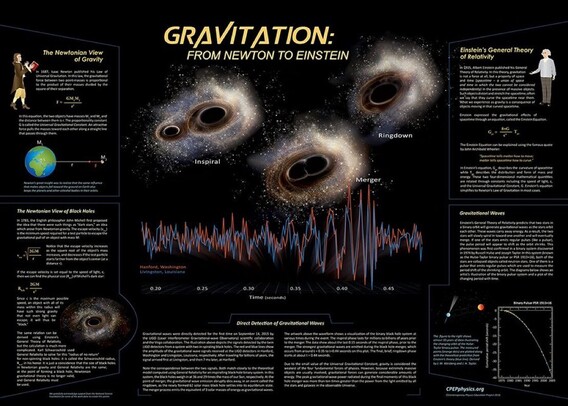
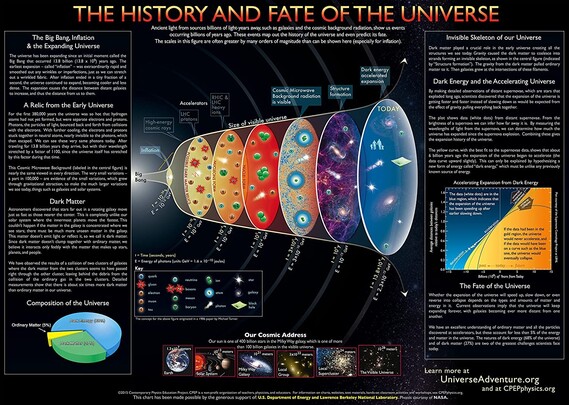
They also have a great "History and Fate of the Universe" chart, as well as a bunch of *new* material on Gravitation that includes recent LIGO results.

Image: CPEP
Link: https://www.cpepphysics.org/gravitation/

Gravitation – Contemporary Physics Education Project

Okay fine they also produced a classic "History and Fate of the Universe" chart, you can't not post that one.

Image: CPEP / DOE / LBNL / NASA
Link: https://www.cpepphysics.org/history-and-fate-of-the-universe/

History and Fate of the Universe – Contemporary Physics Education Project

@mcnees interesting thread. Unless I'm mistaken, proof of the existence of Dark Matter as a prediction of QCD (some kind of axion) is so far, unsuccessful. It's a nice idea, but nobody has found a way to prove that it exists and the theory is a valid representation of something more than very clever mathematics. Unlike say the Higgs boson. How long do you think this path will be pursued? It seems inherently hard to prove or disprove.
Another question: Quantum Physics has great successes. Semiconductors and Lasers being two outstanding examples. But despite lots of effort we aren't there yet with axions. So aside from understanding the mechanism of dark matter, are there any practical applications you can see for axions along the lines of lasers, or semiconductors?