Continued: it's striking that the authors didn't even use conventional machine learning procedures to develop their classifier.

Rather, they chose features that made sense to them as indicators.

These were not even indicators of fake papers, but rather indicators of non-response to a survey —which of course is a very different thing than authorship of a fake paper.

The mind just boggles.

"Note that the tallying rule [private email, no international collaborators] identifies likely fakes, but it cannot determine with certainty whether a given publication is actually (legally) a fake. Nevertheless, it is a reliable tool to red-flag scientific reports for further analysis and is a rational basis to estimate the upper value of fake publishing in biomedicine."

RELIABLE TOOL?

RATIONAL BASIS?

How could anyone write this stuff and post it in good faith?

And then there's this:

"It is important to keep in mind that our indicators provide a red flag, not legal proof, that a given manuscript or publication might be fake. However, it is the authors' burden of proof to demonstrate that their science can be trusted."

BULLSHIT.

It is absolutely not the authors' burden of proof to demonstrate that their science can be trusted when the criteria used to question their work are (1) their email address and (2) the lack of international collaborators.

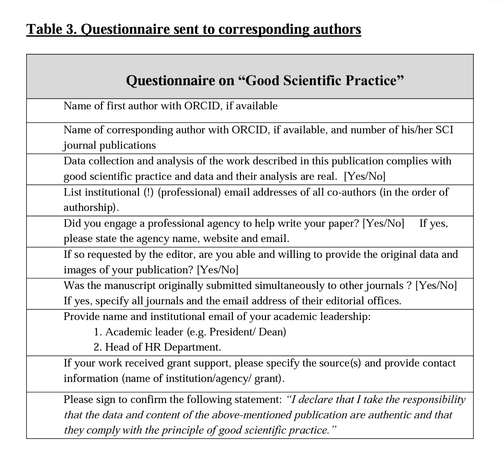
And then there's the survey they used to "validate" their hopeless instrument.

How would you respond if you received this from some random account?

As a misinformation researcher, I get all sorts of politically motivated harassment that looks a lot like this. Last thing I'm going to do is give them contacty information they could look up themselves for my university president, dean, HR people, etc.

To presume that not answering implies guilt is outrageous.

Finally, I want to stress that it is no defense whatsoever to say that the algorithm could be used simply as a preliminary screen to red-flag papers for additional scrutiny.

If one is going to propose machine-learning classifier to make instrumental decisions that affect careers and reputations, one must carefully and thoroughly consider issues of fairness and risks algorithmic harm that might arise.

The authors of this preprint don't even mention such issues.

Not only does the Science story fail to call them on this; its author falls into the one of the oldest and most pernicious traps around algorithmic bias.

The author contrasts the use of "automated methods" with reliance on "human prejudice", entirely overlooking the fact that the automated methods proposed here are nothing but the explicit and fully-descirbed instantiation of human prejudice.

It's truly an embarrassment all around.

UPDATE: The paper is on pubpeer, with a response from lead author Sabel.

I find it to be a completely unsatisfactory effort at misdirection, but decide for yourself.

The irony of this guy writing a preprint that spectacularly overestimates the frequency of fake papers using ridiculous methods, getting Science and NPR and a host of right-wing news organizations to pick it up, and then saying "The loss of trust in science is the key issue we should worry about."

https://pubpeer.com/publications/0CE23D5DD5AD6929404AF03D700623

PubPeer - Fake Publications in Biomedical Science: Red-flagging Method...

There are comments on PubPeer for publication: Fake Publications in Biomedical Science: Red-flagging Method Indicates Mass Production (2023)

Pardon my confusion but does anyone have any idea what in the absolute fuck this guy is talking about here?

"So conceptually (mot not mathematically) you can add 10% to our number and subtract 28% of the 44/37% of or false alarms, though strictly methodologically speaking this is not permissable"

@ct_bergstrom You have missed the point, the important point, that Spotify has a bazillion fake songs! Something, something. Therefore Science is rotten to the core! QEB

For those not familiar with our methodology, QEB means Quod Est Bullshit.
#QEB