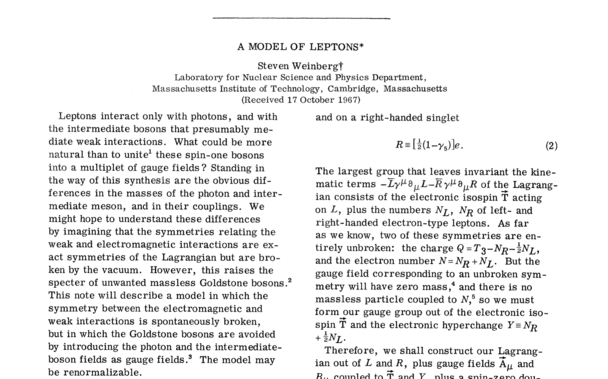
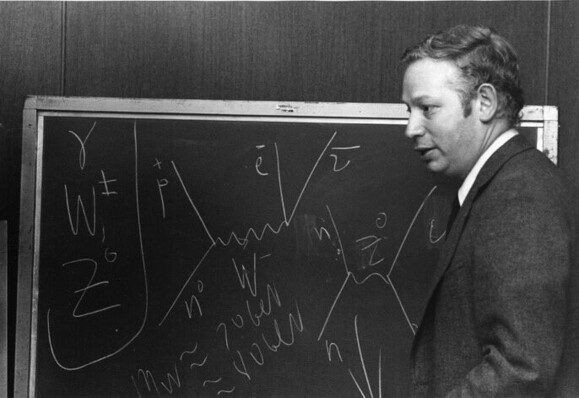
Physicist Steven Weinberg was born #OTD in 1933. His 1967 paper "A Model of Leptons" presented a unified theory of the electromagnetic and weak nuclear interactions, and is the most cited paper in particle physics.

Besides his groundbreaking work in particle physics, Weinberg is known for contributions to cosmology and astrophysics, as well as numerous textbooks and popular works.

Image: AIP Emilio Segrè Visual Archives
Weinberg submitted "A Model of Leptons" to Physical Review Letters in October of 1967. It describes a key component of the Standard Model, and is the most cited particle physics paper in inSPIRE.

His model describes a unified electroweak interaction at high energies. At low energies, spontaneously broken gauge symmetry gives mass to the W and Z bosons, while the photon remains massless. The result is a short range weak force and a long range electromagnetic interaction.

https://journals.aps.org/prl/abstract/10.1103/PhysRevLett.19.1264

A Model of Leptons

Phys. Rev. Lett. 19, 1264 (1967)

Physical Review Letters

“It’s what keeps you going as a theoretical physicist to hope that one of your squiggles will turn out to describe reality.”

They were very good squiggles!

https://home.cern/news/news/cern/50-years-iconic-model-leptons-published

50 years since iconic 'A Model of Leptons' published

Today, 50 years ago, Steven Weinberg published the iconic paper A Model of Leptons, which determined the direction for high-energy particle physics research from them on. This paper lies at the core of the Standard Model, our most complete theory of how particles interact in our universe. Just two pages long, Weinberg’s elegant and simply written theory was revolutionary at the time, yet was virtually ignored for many years. But now, it is cited at least three times a week. Proving the validity of Weinberg’s theory inspired one of the biggest experimental science programmes ever seen and CERN has built major projects with these discoveries at their heart: the Gargamelle bubble chamber found the first evidence of the electroweak current in 1973; the Super Proton Synchrotron showed, in 1982, the first evidence of the W boson; and most recently the Large Hadron Collider, in 2012, confirmed the existence of the Higgs Boson. Steven Weinberg visiting the ATLAS collaboration in 2009. (Image: Maximilien Brice/CERN) Speaking to the CERN Courier Weinberg, now 84, describes what it’s like to see his work confirmed: “It’s what keeps you going as a theoretical physicist to hope that one of your squiggles will turn out to describe reality.” He received the Nobel Prize for this iconic, game-changing theory in 1979.   Read more about the original theory, and an interview with Steven Weinberg in this month’s CERN Courier.   

CERN

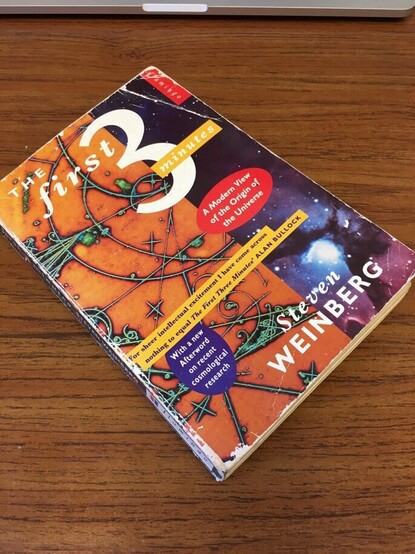
If you haven't already, I encourage you to read Weinberg's "The First Three Minutes," a beautifully written particle physics history of the Hot Big Bang. If you have, I encourage you to read it again.

It was last updated in 1993, so in some ways it is outdated (inflation, dark energy). But it's a classic. My copy is tattered from re-reading.

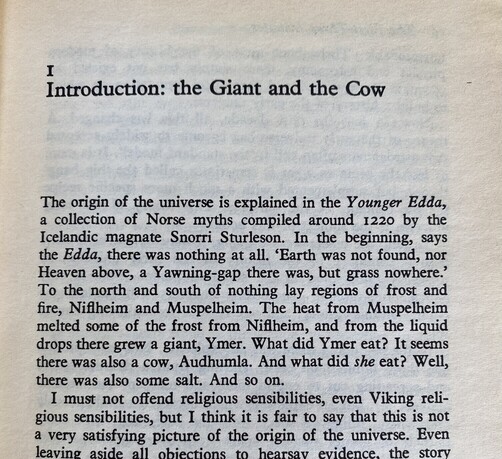
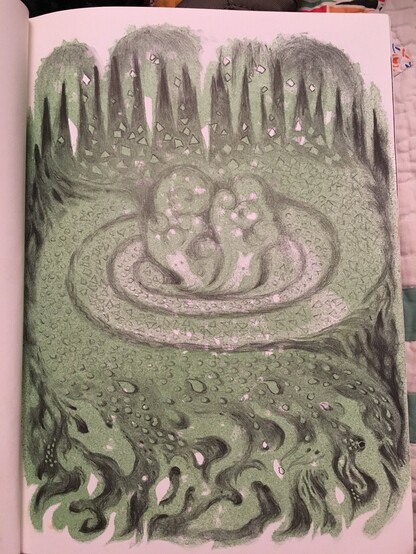
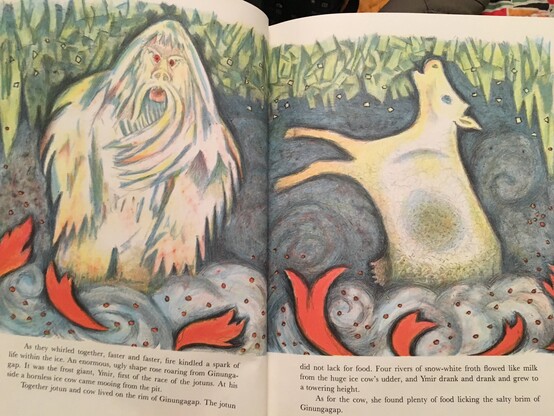
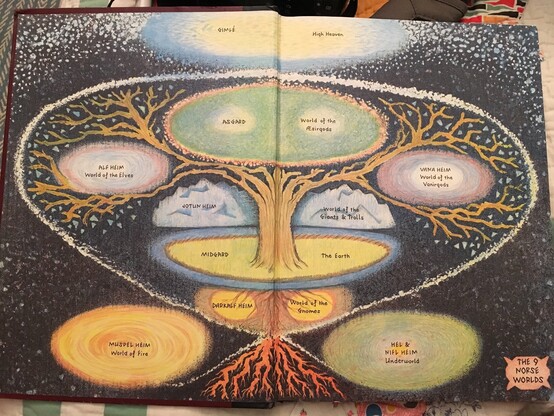
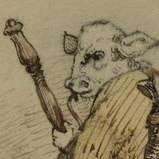
"The First 3 Minutes" opens with a creation story: the frost giant Ymir, the primeval cow Auðumbla, and the yawning void Ginnungagap.

My favorite popularizations of cosmology, whether Norse or modern, all begin with this story.

He also wrote this in his cosmology textbook. Funny and relatable as a matter-of-fact statement, but also my favorite inadvertent physics humblebrag.

"Look, I tried to recreate the mistakes, but my brain just kept replacing them with the correct results."

Steven Weinberg passed almost two years ago. He was a towering figure of 20th and 21st century physics and I admired him tremendously. I read his books to pieces, joined his research group at UT-Austin, learned Cosmology from him, graded his courses, read drafts of his textbooks.

Let me share a things he wrote, some of which I've written about at length on here, all of which are worth your time. No attempt to be comprehensive or even representative in what follows!

First, “What is Quantum Field Theory, and What Did We Think It Is?” A short, personal history of the development of quantum field theory and a lovely explanation of our modern understanding of QFTs as Effective Field Theories.

https://arxiv.org/abs/hep-th/9702027

What is Quantum Field Theory, and What Did We Think It Is?

This is a talk presented at the conference ``Historical and Philosophical Reflections on the Foundations of Quantum Field Theory,'' at Boston University, March 1996. It will be published in the proceedings of this conference.

arXiv.org
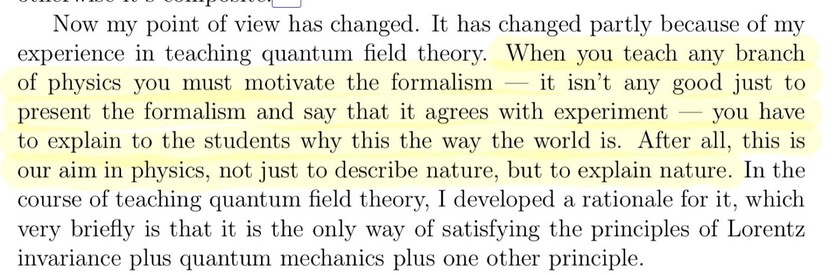
That paper is a writeup of a conference talk. There's a remark in there that is always buzzing around in the back of my head when I’m preparing a class or writing a paper.
“…not just to describe nature, but to explain nature.”

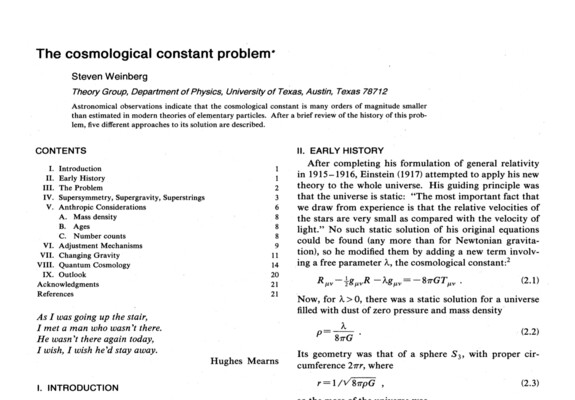
Next, “The Cosmological Constant Problem.”
Weinberg’s classic review of the catastrophic mismatch between the amount of vacuum energy measured by cosmologists and astronomers, and the predictions made by quantum mechanical theories of particle physics.

Imo this remains one of the most intriguing problem in all of physics. The paper was published about ten years before the discovery of the accelerating Hubble expansion likely driven by a minuscule positive vacuum energy.

https://repositories.lib.utexas.edu/bitstream/handle/2152/61094/Weinberg_1989.pdf

“Living in the Multiverse”
An opening talk for a conference in which Weinberg confronts the String Landscape and its anthropic implications. “We lose some, and win some.”

One time, when I was in grad school, I asked Weinberg about some point from the anthropic discussion in the 1989 review paper. He gave me a funny look and said that people my age shouldn’t be flirting with anthropic reasoning, we should try to come up with real solutions.

https://arxiv.org/abs/hep-th/0511037

Living in the Multiverse

This is the written version of the opening talk at the symposium "Expectations of a Final Theory," at Trinity College, Cambridge, on September 2, 2005. It is to be published in Universe or Multiverse?, ed. B. Carr (Cambridge University Press).

arXiv.org

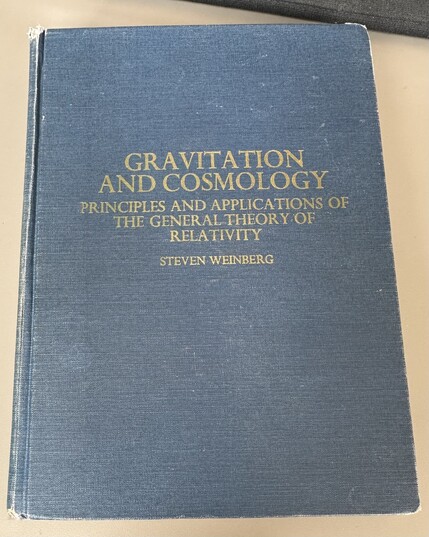
And finally, this fun little bit from his book “Gravitation and Cosmology.”

A great book, but a common complaint is that it is maybe not the best place to learn GR.

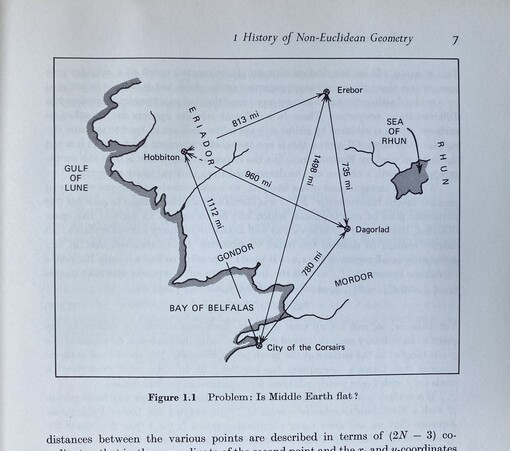
On the other hand, does your favorite GR textbook tackle the really big questions like “Is Middle Earth flat?”

(Here is my own little humblebrag: The picture above is my copy of the book sitting on my desk. It was given to me by Weinberg when I was his cosmology grader. As a poor grad student I didn't own a copy, I just checked it out of the library. He thought it was crazy that I was grading the course but didn't have a copy of the book, so he took this copy down from his shelf and gave it to me. It's a treasure.)

Anyway, here is a remembrance of Weinberg in Physics Today, with stories and anecdotes from me, @preskill, and others:

https://pubs.aip.org/physicstoday/Online/5387/Steven-Weinberg-1933-2021

Oh, and please take just a few minutes to watch this wonderful animated conversation with Weinberg.

https://vimeo.com/578891190

Dreamer of a Final Theory

Vimeo

“The effort to understand the universe is one of the very few things that lifts human life a little above the level of farce, and gives it some of the grace of tragedy.”

— Steven Weinberg, The First Three Minutes

@mcnees Disciplinary narcissism. There's no shortage of experts who reflexively condemn the rest of humanity for studying something else or for not studying at all. And there's nothing admirable about it.
@tb Imo that's an unfair reading of that part of the book. The quote is part of a personal reflection on finding meaning in his work. It isn't denigrating other disciplines so much as trying to find some comfort when confronted with what can feel like a pointlessness of Nature.

@mcnees That seems fair, and I'll defer to your expertise — not least for your point that experts are (of course) human like everyone else. That said, it's a real problem when they forget that, something I was thinking about this AM.

https://tldr.nettime.org/@tb/110305059398760859

And thank you for your thoughtful reply, which my own cantankerous one maybe didn't deserve.

ted byfield (@[email protected])

I realized just now that "impostor syndrome" is one of these psycho-social phenomena that'll spread and spread, chewing up and spitting out whole demographics tranche by tranche. And as more and more people are convinced they're somehow "fake," #AI will fill the gap with a new "real." Signs of this happening are everywhere already.

tldr.nettime
@tb Oh I totally get it. That’s not an unreasonable read of the quote in isolation, I just can't post the whole page as a coda to the thread. Still, a great read if you get a chance.
@mcnees I'll make it a point to do so — partly for what you say, partly for what @Smutny says in another ~branch of this thread, and partly because (as it happens) I'm taking notes for a chapter that touches on the ~visual aesthetics of cosmological models (as in Fernand Hallyn's Poetic Structure of the World, about Copernicus and Kepler).
@tb @mcnees It isn’t supposed to be read as admirable. Invoking Marx’s line about history as“farce”and “tragedy”, he was trying to say that life has fundamentally no meaning, and the pursuit of intellect in the form of understanding nature is to give us something, some grace, a bulwark against time in the cosmic loneliness. This sentiment had always been prominent in his writing.

@Smutny, that's a dazzlingly beautiful paragraph you just wrote there — a gift in its own right.

@mcnees

@Smutny @tb @mcnees and I’m reading and rereading your post trying to figure out how “cosmic loneliness” could come from groucho marx but that’s not who you’re discussing here is it? (its because you wrote “farce”)
@collette Thanks for the careful reading! It was Karl Marx.

@mcnees

Love this whole Weinberg tribute thread. In many of your OTD posts, you weave in beautiful anecdotes about the quiet, graceful humanity of the person. I find this Weinberg example very touching in his perceptual awareness of the situation that prompted him to gift you the book. Another shining example you told of this kind of perceptual awareness by a prominent person recognizing how a simple act could benefit others is the magnificent Joe Polchinski anecdote at https://twitter.com/mcnees/timelines/805900100862115841

Collection / Twitter

Twitter

@mcnees Does he find a positive curvature ?

Tolkien lore says that the Earth got round at some point before the Lord of the Rings takes place (but the final resting places of the Elves did not move, so that now it's up in the skies).

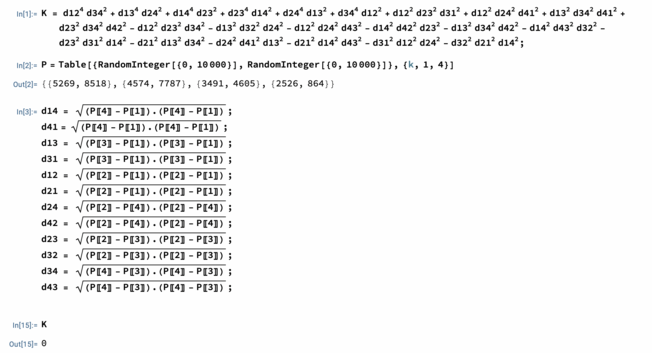
@legendarybassoon Yes! We can see this explicitly. Given four points on a flat plane there are six distinct pairs of points. The distances between them should satisfy a constraint.

Here it is, illustrated with six random points on a 10,000 x 10,000 grid.

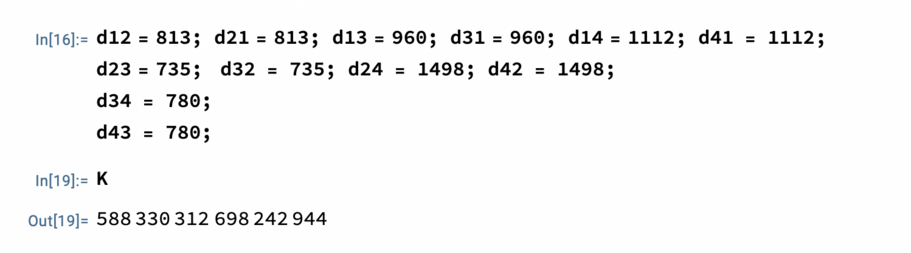
@legendarybassoon Now here is that combination of distances from the map of Middle Earth in the figure. The combination does not vanish, as it must on a flat plane (or cylinder). The surface of Middle Earth is curved.

@mcnees I'm very happy ! Now how much is it curved ? If it were a sphere, how much of the sphere would be covered by the usual Middle earth map?

I hope it doesn't wrap around several times...

@mcnees I notice your formula is homogeneous of degree 6 in the distance, whereas the curvature should be homogeneous of degree -2. Should I divide the big number you obtain by one of the distances to the power 5 to obtain the radius of the would-be sphere?
@mcnees all distances are about 10^3 miles, and so is K/10^15... The constants 2 and pi start to be important!
@legendarybassoon @mcnees Big Tolkien fan here. IIRC, the Shire is around Warwick in England. Minas Tirith is around Venice in Italy.
@legendarybassoon @mcnees The end of the Second Age. It's covered in the SIlmarillion, and the show is leading to that event...