There's no Mastodon slump.

Sign-ups continue to increase -- albeit, not at the same rate as in November -- November was a spike.

While Monthly Average Users (MAUs) decreased since November, it's increased again this month (according to @Gargron).

But what's more interesting is that Half Year Average Users (HYAUs) is at a peak.

And we're very close to breaking 1 billion posts per month!

See chart.

https://mastodon.fediverse.observer/stats

Fediverse Observer checks all sites in the fediverse and gives you an easy way to find a home from a map or list or automatically.

Mastodon Sites Status. Find a Mastodon server to sign up for, find one close to you!

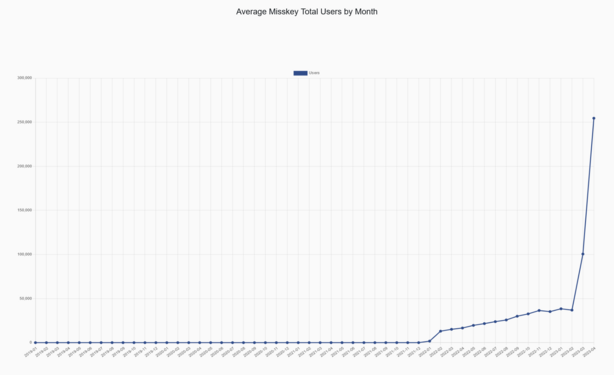
But this chart for Misskey is even more interesting to me. This is
Average Misskey Total Users by Month.

The growth is absurd -- and it has been validated by multiple sources.

Misskey is part of the Fediverse, and it talks to Mastodon.

The armchair pundits who talk on and on about Mastodon's non-existent "slump" -- which I've shown isn't happening in a previous chart -- aren't even considering the broader Fediverse.

Here's the Average Pixelfed Posts by Month.

Does this look like a slump to you?

The tech press would love Mastodon to fail and Bluesky to succeed.

Why? Because it fits very neatly into a pre-determined narrative.

Mastodon is supposedly made by a ragtag squad who flew too close to the sun.

And Bluesky is supposedly made by Silicon Valley—they’re supposed to win.

There’s nothing the tech press love more than an outcome that’s predetermined.

The tech press very much want to frame this as Mastodon vs. Bluesky.

But have they ever considered that if the protocol underlying Bluesky (AT protocol) ever took off, Mastodon could just use it—thereby talking to Bluesky?

It’s as though their narrative of “competition” doesn’t work in this situation!

Every app on the Fediverse could talk to Bluesky if they really wanted to, and Bluesky really was as decentralized as they say they want to be.

For example, look at Friendica. It uses at least four protocols to talk to other server software:

1. DRFN
2. Diaspora
3. OStatus
4. ActivityPub

In theory, adding AT protocol shouldn’t be a big deal—it’s open source.

The question is whether Bluesky actually wants to federate with other servers.

The real competition isn’t “Mastodon vs. Bluesky”.

It’s “ActivityPub protocol vs AT protocol”.

One is used by nearly 25,000 servers. The other is used by one server.

On a per node basis, which one do you think is winning?

@atomicpoet
I think the AT protocol embodies several good ideas. And maybe some curious decisions.

IMHO the most likely scenario is this: Future versions of ActivityPub will contain some of the good ideas.

The two weak points of AT protocol seem to be the as-yet-undecided Distributed Identifiers (this is where I would start to ensure a walled garden, if I was a mean person) and the higher complexity of the implementation (but maybe it just looks that way to me).

@wakame @atomicpoet Well, we'll see once it's really tried and tested in a multi-server environment.

It is very easy to win in a race where your opponent is operating in a messy real-world environment, while you are only an idea written down on paper, only tested in a very clear and controlled space.

@wakame @atomicpoet What is baffling to me, and probably telling of the project as a whole, is that they consulted with ActivityPub experts before deciding to create a whole new protocol. The stated reason was that ADX/ATP would support true nomadic identities, so they could not support AP. And yet, the DID system has only a placeholder solution. They do not have “true” distributed IDs - the alleged advantage over AP.
@wakame @atomicpoet Like their claims about “moderation”, which turns out not to be moderation as widely understood, but just muting, and the single node “federated” nature of the platform, it’s all bold claims that shrivel up when actually examined.
I’m beginning to suspect that they are a bespoke emperor’s tailoring outfit, only forced to launch as someone started asking where all the money had gone.