A neat bit of physics history.

Lord Kelvin delivered the lecture "Nineteenth-Century Clouds over the Dynamical Theory of Heat and Light” to the Royal Institution of Great Britain #OTD in 1900. He spelled out two major problems that 19th century physics seemed unable to address.

Fixing these problems required radical new ideas, and eventually lead to the pillars of 20th century physics: special relativity and quantum mechanics.

You can read the lecture here: https://archive.org/details/londonedinburgh621901lond/page/n4/mode/2up
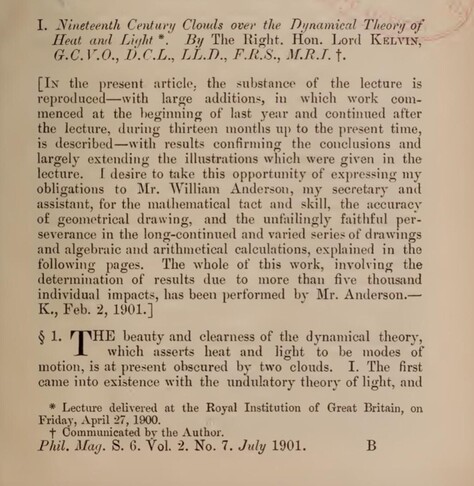
The London, Edinburgh and Dublin philosophical magazine and journal of science : Free Download, Borrow, and Streaming : Internet Archive

Title from cover

Internet Archive

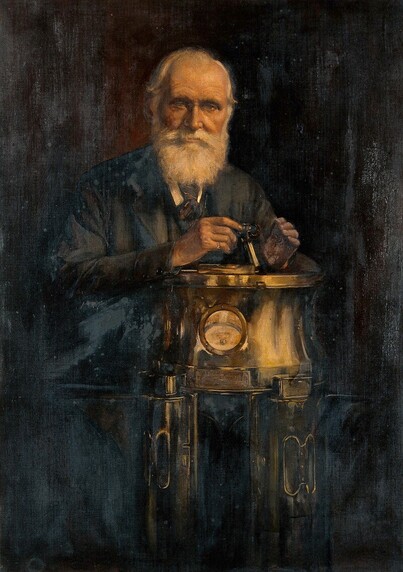
There is an apocryphal story about the great physicist William Thomson — Lord Kelvin — in which he surveys the state of physics at the end of the 19th century and judges it nearly complete. I heard it repeated by a professor when I was an undergraduate.

Image: Harry Herman Salomon / Wellcome Collection

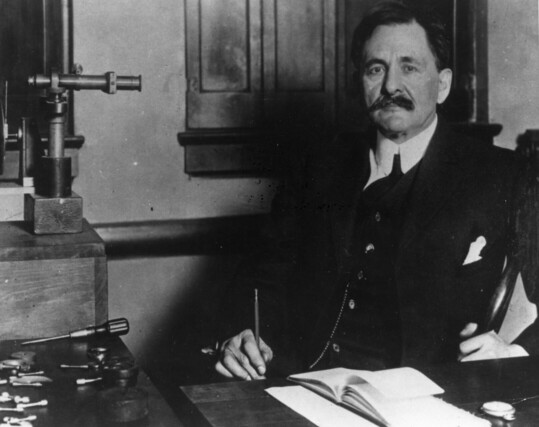
Likewise, comments attributed to the physicist Albert Michelson (especially in an 1894 speech) suggest that he thought there was very little left to do in the field, except perhaps take more detailed measurements of various properties of matter.

This story is better known; when I ask colleagues they have usually heard some variant of it.

Image: U. Chicago News Office

Stories like these are always told as the set-up for a punchline: Physicists of the era thought the fundamental questions had all been answered, when in fact there were deep and fatal problems with their theories. Perhaps they did not notice because they were too attached to familiar ways of thinking?

They are cautionary tales about what we think we know and how we think we know it.

It may be that Kelvin made some comment that, over the years, was transformed through retelling into the sort of story outlined above.

But we don’t have to wonder what he really thought about the state of physics as the 19th century drew to a close. It is all laid out there in the lecture I linked to in the first post.

Lord Kelvin's lecture begins

“The beauty and clearness of the dynamical theory, which asserts heat and light to be modes of motion, is at present obscured by two clouds.”

Again, you can read the whole thing (starting on page 1) here: https://archive.org/details/londonedinburgh621901lond/page/n4/mode/2up
The London, Edinburgh and Dublin philosophical magazine and journal of science : Free Download, Borrow, and Streaming : Internet Archive

Title from cover

Internet Archive

The first cloud is the question of the lumineferous ether, the hypothetical medium that most 19th century physicists assumed was necessary for the propagation of light and other forms of electromagnetic radiation.

But by 1900, physicists had spent almost 13 years wresting with the null result of Michelson and Morley. As far they could tell, there was no ether. Attempts to explain away the non-detection were becoming increasingly convoluted.

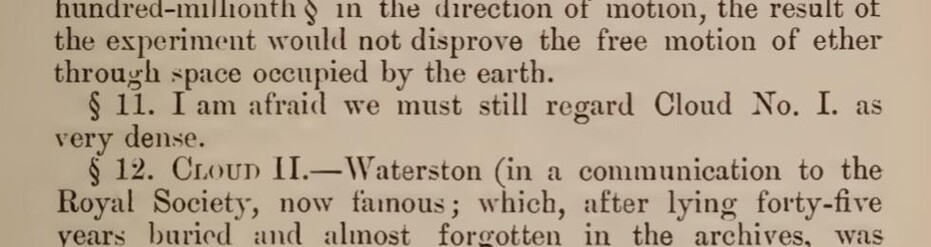
Kelvin goes on at length about various problems with how an object might move through the either, and confesses that he couldn’t find any fault with Michelson and Morley’s experiment.

He sees no resolution: "I am afraid we must still regard Cloud No. 1 as very dense."

His discussion of the second cloud begins with an examination of the kinetic theory of gases. Lord Kelvin is troubled by a number of problems that follow from the equipartitioning of energy among the various modes of a gas.

This idea, when combined with what was known at the time about thermodynamics and electromagnetism, leads to a paradox: The total energy emitted by a blackbody in thermal equilibrium seems to be infinite. In 1911 Paul Ehrenfest would dub this the “ultraviolet catastrophe."

(Note that the ultraviolet catastrophe was *not* Kelvin’s specific complaint! But it is probably the most dramatic consequence of the ideas he was wrestling with. In terms of how we see things now, I think it is okay to frame it this way.)

Again, Kelvin sees a collection of challenges that physics, as it was understood at the time, had not been able to answer.

What is interesting about Kelvin’s lecture is that the two problems he points out, that he describes as clouds hanging over physics, are precisely the problems that required the revolutionary new ideas of the early 20th century for their resolution.

Einstein takes the null result of Michelson and Morley seriously. Eliminating the ether implies that the laws of electrodynamics hold in all inertial frames. Therefore all inertial observers measure the same speed of light, leading him to special relativity.

Planck’s claim that matter emits radiation in discrete chunks, further refined by the founders of the old quantum theory, cures the ultraviolet catastrophe by fundamentally altering the microscopic accounting of blackbody emissions.

The stories about 19th century luminaries declaring physics to be nearly complete, are always presented as cautionary tales about blind spots.

But Kelvin (and many of his colleagues) were not oblivious to the problems facing their theories! Far from it. They were acutely aware of these problems, struggled with their resolution, and talked about them as likely routes to real progress in the field.

@mcnees

I believe Kelvin is also the person people like to quote as saying (~1900) that heavier-than-air flight will always be impossible, when what he *actually* said was that *steam* power would never be able to do it (since one could never get the power/mass ratio high enough), an observation that remains true to this day (*)

(*) I suppose it's possible we'll develop some kind of magic lightweight ceramic that finally makes the featherweight steam engine possible, but it still hasn't happened yet (most likely since nobody's actually been working on it and there isn't a whole lot of reason to).

@mcnees
"We know everything there is to know about this murder except for motive, means, and opportunity."