
Very happy to see the 2nd paper from my master's thesis research ‘”There are some things that I would never ask Alexa” – privacy work, contextual integrity, and smart speaker assistants’, co-authored with Dr Grant Blank (
@oiioxford ).

https://www.tandfonline.com/doi/full/10.1080/1369118X.2023.2193241
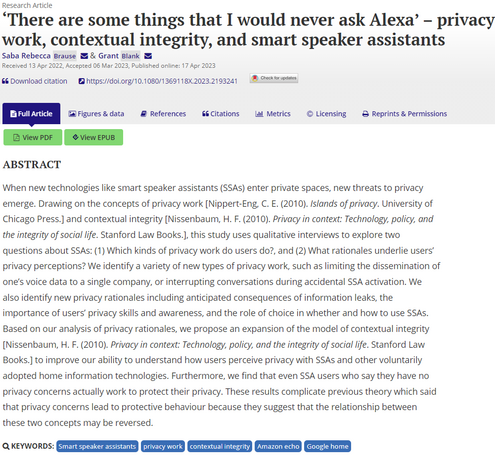
‘There are some things that I would never ask Alexa’ – privacy work, contextual integrity, and smart speaker assistants

When new technologies like smart speaker assistants (SSAs) enter private spaces, new threats to privacy emerge. Drawing on the concepts of privacy work [Nippert-Eng, C. E. (2010). Islands of privac...

Taylor & Francis
In this paper, we explore privacy work and privacy rationales of smart speaker assistant (SSA) users.
Drawing from Nippert-Eng’s concept of privacy work, we identify new types of privacy work, e.g. limiting the dissemination of one’s voice data to a single company, or interrupting conversations during accidental SSA activation.
Additionally, drawing on Nissenbaum’s contextual integrity concept, we identify new privacy rationales including anticipated consequences of information leaks, the importance of users’ privacy skills and awareness, and the role of choice in whether and how to use SSAs. Based on this, we propose an expansion of the model of contextual integrity to improve our ability to understand how users perceive privacy with SSAs and other voluntarily adopted home information technologies.
Furthermore, we find that even SSA users who say they have no privacy concerns actually work to protect their privacy. We argue that these results complicate previous theory which said that privacy concerns lead to protective behaviour because they suggest that the relationship between these two concepts may be reversed.
This article has been long in the making, starting out with my master’s research
@oiioxford , further development and write-up @Weizenbaum_Institut , and editing and publication
@IKMZ . I am very grateful for the support I received at each of these places.
I am also thrilled to publish this work open access thanks to the support of University Library of the University of Zurich.