 plurigrid 🐝
 Terence Tao
I'm beginning to see where the comparative advantage is between myself and current-generation #AI tools.
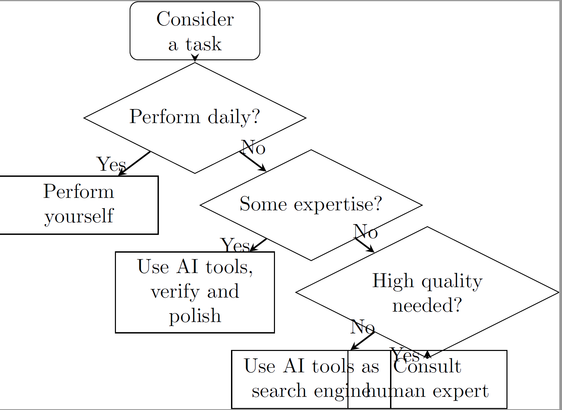
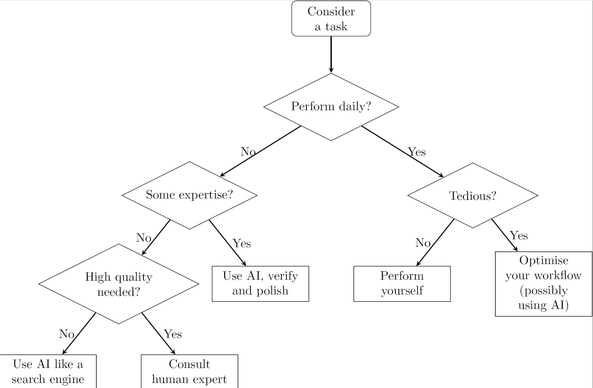
For tasks that I perform on a daily basis, I have developed enough techniques to optimise my workflow that AI tools don't add much for me. Most obviously with regards to research mathematics, but also for instance in composing emails; I installed a plugin that lets GPT4 write email responses for me at the click of a button, but I almost never use it, because I already can write suitable email responses rapidly through decades of practice.
For tasks that I have some expertise in, but little practice, AI tools are helpful: often I can use them profitably to create a first draft of the output, which I can then verify and polish, or at least use as inspiration. (In some cases the inspiration is due to deficiencies in the AI product, in the spirit of Cunningham's law, but it can still be a more productive process than if I tried to work things out on my own). Examples in this category include data processing, translating to a foreign language, or writing text in a format that I rarely use (e.g., a public speech, a rules document, etc.)
For tasks that I have little expertise in, and do not require extremely high quality and reliable output, one can simply ask the AI tool and follow its advice more or less blindly. Here the AI functions as a slightly more convenient version of a traditional search engine.
Finally, for tasks that I do not have expertise in, but for which quality and reliability are needed, neither the AI or myself can resolve the task, and I have to consult a human expert. An example would be a repair of a complicated, expensive, and delicate piece of equipment.

 Chris L
 fl
fl felix (grayscale) 🐺
 PixelPenguin27