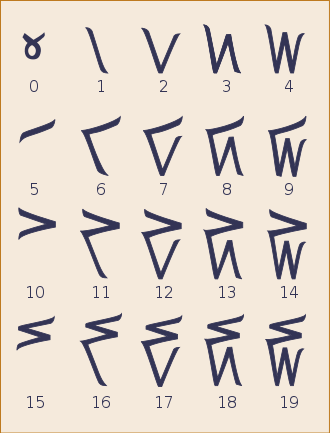
I'm fascinated by the Inuit-Yupik-Unangan languages in Alaska, Canada and Greenland. There are many of these languages: they ring much of the Arctic Ocean. I just learned that they use a base 20 system for numbers, with a 'sub-base' of 5. That is, quantities are counted in scores (twenties) with intermediate numerals for 5, 10, and 15. This makes a lot of sense if you look at your fingers and toes.

But the Inuit didn't have a written form of their number system - until the early 1990s, when high school students in the town of Kaktovik, Alaska invented one! There were just 9 students at this small school, and they all joined in.

They used 5 principles:

• Visual simplicity: The symbols should be easy to remember.

• Iconicity: There should be a clear relationship between the symbols and their meanings.

• Efficiency: It should be easy to write the symbols without lifting the pencil from the paper.

• Distinctiveness: There should be no confusion between this system and Arabic numerals.

• Aesthetics: They should be pleasing to look at.

They decided that the symbol for zero should look like crossed arms, meaning that nothing was being counted.

This was the start of quite a tale!

(1/n)
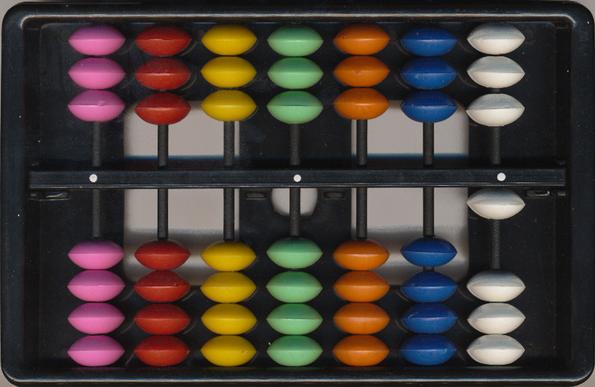
The students built base-20 abacuses. These were initially intended to help convert decimal numbers to base 20 and vice versa, but soon the students started using them to do arithmetic in base 20.

The upper section of their abacus has 3 beads in each column for the values of the sub-base of 5, while the lower section has 4 beads in each column for the remaining units.

(2/n)

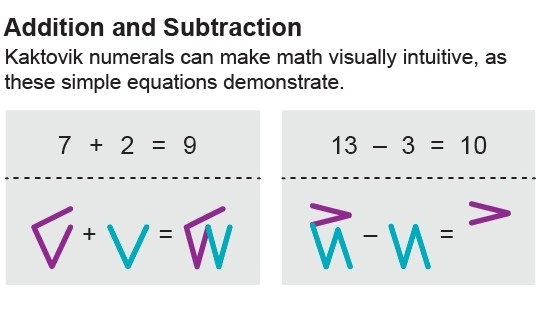
The students discovered their new system made arithmetic easier than it was with Arabic numerals. Adding two digits together often gives a result that *looks* like the combination of the two digits!

(3/n)

The students also found that long division was more fun with Kaktovik numerals! They noticed visually interesting patterns. They discovered that they could keep track of intermediate steps with colored pencils.

(4/n)

After the students of Kaktovik invented their new numerals, their scores on standardized math tests improved dramatically! Before, their average score was down in the 20th percentile. Afterwards, their scores shot above the national average.

Some argue that being able to work in both base 10 and base 20 was helpful - much like being bilingual.

I suspect that even more important was the sheer process of developing their own system of numerals! Getting engaged in mathematics is so much better than learning it passively.

But this was just the start of the story. The new numerals began to catch on... but then:

"Under the federal No Child Left Behind Act, from 2002 to 2015, schools faced severe sanctions—or even closure—for not meeting state standards, provoking a “scare” that some local educators say squeezed the Kaktovik numerals into a marginal role despite the system’s demonstrated educational impact."

For more, read this:

https://www.scientificamerican.com/article/a-number-system-invented-by-inuit-schoolchildren-will-make-its-silicon-valley-debut/

(5/n)

A Number System Invented by Inuit Schoolchildren Will Make Its Silicon Valley Debut

Math is called the “universal language,” but a unique dialect is being reborn

Scientific American
@johncarlosbaez I was also fascinated by this article. If you are a visual learner, it seems like a much easier way to learn math.