Following Elsevier's decision to raise the article processing charge for NeuroImage to $3,450, all editors (inc. chief editors) from NeuroImage and NeuroImage:Reports have resigned, effective immediately.

I am joining this action and have also resigned.

Full announcement: https://imaging-neuroscience.org/Announcement.pdf

Elsevier continues to prey on the academic community, claiming huge profits while adding little value to science. But we the academic community hold the power and can withdraw our consent to be exploited at any time. That time is now.
I urge colleagues to abandon NeuroImage and NeuroImage:Reports as scientific outlets for new work. If Elsevier continues these journals, do not serve on their editorial boards and do not submit new articles to them. Elsevier has no power to profit from us if we simply say No.

Instead, the editorship of NeuroImage and NeuroImage: Reports is merging to launch a new non-profit OA journal called Imaging Neuroscience, with a much lower APC.

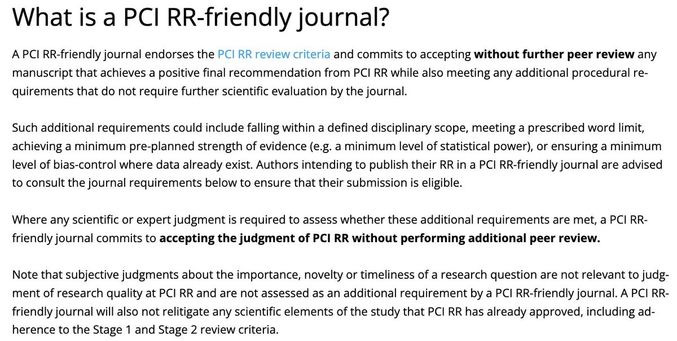
I will edit Registered Reports (RRs) at this journal, which will also be PCI RR-friendly.

https://rr.peercommunityin.org/about/pci_rr_friendly_journals

PCI Registered Reports

Peer Community in Registered Reports

This means you will be able to submit your RR preprint to @pcirr, get openly reviewed and recommended and then publish in Imaging Neuroscience (or any other eligible journal) without further peer review.

This preprint-led workflow gives maximum power to authors while ensuring rigorous review, and is the future of the Registered Reports format.

There remain some loose ends to tie up concerning ongoing submissions at NI and NI:R. If you have a RR in progress with NI, or NI:R is listed as a PCI RR-friendly journal in your Stage 1 recommendation, then I will contact you individually to explain the options.

But the short of it is that you will either be able to continue with NI/NI:R or Imaging Neuroscience will have your back.

This resignation draws a final line under 10 years of various editorial roles I have had at Elsevier journals. I have felt conflicted the whole time.

A small number of key people within Elsevier were instrumental in supporting Registered Reports in the early years, and I’m very grateful to them (you know who you are).

But those people are now gone and the company as a whole is a parasite. So let's move forward together as a community and leave Elsevier behind.

/end

@chrisdc77 Great work.

I was intrigued by this: "Elsevier responded to all editors stating that the APC would not be reduced because they believe that market forces support the current APC"

would you be able to share the text of what they said?

I fully believe APCs (not just Elsevier, but many other places, e.g. Springer Nature, which wants 3 times as much) are set by market forces, rather than by costs. But did they admit that and put it in writing?

@sje @chrisdc77 Love to hear about this too.

@chrisdc77 I highly support this effort.

Do you have any thoughts about moving to "post-publication review", as eLife are doing? https://elifesciences.org/about/peer-review

Peer review and publishing at eLife · eLife

eLife is pioneering an approach to scientific publishing that combines the immediacy and openness of preprints with the scrutiny of peer review by experts.

eLife
@chrisdc77 Best of luck. As a long-time editor in both the creative and scientific fields, my income has gone down while the fees go up. I no longer can survive on doing the very craft I excel in. I feel your pain, so to speak, and I hope you are able to figure something out. It seems as though capitalism knows no limits and follows no rules.
@chrisdc77
So, Chris, I wonder if the Editorial Board will be bold enough and brave enough to find a Diamond OA home for their reformed journal?
Since for many researchers, the only meaningful ‘lower APC’ is actually £0