 Christina Warren
Good. Cornell did the right thing here but I’ll admit to being (pleasantly)surprised it was this resolute. If an individual professor wants to do content warnings as a courtesy, fine. But trying to make that mandatory is not OK. #xp https://www.nytimes.com/2023/04/12/nyregion/cornell-student-assembly-trigger-warnings.html?smid=nytcore-ios-share&referringSource=articleShare

I know this is impulse but I fundamentally don’t agree with trigger warnings as a concept. I’ll try to honor them/respect people who need them if I know in advance, but I fundamentally don’t believe in them. I’m glad Cornell pushed back.
This shit started when I was in college and I don’t think it has had a positive effect on anyone. If anything, the ability to guard ourselves from anything potentially upsetting has made us more polarized and less able to connect with one another or to truly understand and empathize with trauma.
 Jeff C. 🇺🇦🇬🇱
@film_girl As someone close to somebody who has PTSD (due to sexual assault) I’ve seen enough to know that triggers ARE very real, but the extent to which people have extended the notion to encompass things that basically boil down to being shitty ideas has become excessive in some cases.
You see it here, too, with some of the fairly innocuous things that people put behind content warnings.
@film_girl In the end, higher education is about being exposed to all sorts of ideas, some of which are going to be distasteful or upsetting on some level. People need to be prepared for that as a core part of the experience.
Honestly, a lot of it seems borderline disrespectful toward people who have (actual) trigger reactions due to traumatic incidents in their past.
@jeff I agree! And people who have actual triggers are usually (not always, but usually) better equipped to handle those triggers when they happen or if it is that debilitating, to have a convo with a professor in advance.
 clutem
@film_girl I agree. It made us unable to have debate on opposing viewpoints. I understand it but I don’t think it has helped the millennial and gen Z.
 Joe Fabisevich
@film_girl I'm sympathetic to people being hurt and strive to respect people's boundaries, especially people I’m close with. But in a setting like college it's going to be impossible to simultaneously respect everyone's boundaries at the same time. More generally than trigger warnings you're going to encounter people from all walks of life who've been through nearly every possible experience, and to believe they can be protected from anything hurtful or harmful is an unreasonable expectation.
 Allan Chow
@film_girl that's cool.
I use them like annoying commas.
 Mike Stevens
@film_girl I suppose it's a byproduct of inclusiveness? Hard to claim to be an inclusive platform or community if you aren't also trying to keep traumatised people from being 'triggered' by certain discussions and comments.
 Jack the Lion
@film_girl With all due respect, you're sounding a bit like an early onset boomer by saying it's valuable having people face things that activate PTSD in them.
In my opinion CWs are a net positive. If you don't need em, ignore em. If you do, I'm glad it's there for you.
@Jackthelion I mean, exposure therapy is literally one of the best ways to treat PTSD and obv. I’m not conflating the two things but let’s not pretend there is a medical reason for CWs. There isn’t. If people want to use CWs, that’s fine. And as I said, I’ll always defer to kindness. But trying to make it mandatory in a college setting is absolutely stupid. I’m a millennial. This shit started with us and I’ve been consistent in my unease about it for years.
 Larry Garfield
@film_girl Yes, exposure therapy is very useful. But subjecting someone to therapy without their consent is ethically wrong on many levels.
If someone wants to use a book with a triggering topic for exposure therapy purposes, great, that could work really well. But it should be their choice, not something to be surprised at in the middle of doing homework.
The devil is in the details on this sort of thing.
@Crell I was being glib and specifically said I wasn’t conflating the two ideas together. The truth is, studies show that trigger warnings don’t work or if anything, make things worse. If a professor wants to offer warnings at their discretion, that’s fine. Trying to make it a requirement is a clear assault not just on academic freedom of speech but on actually teaching many important subjects
@film_girl I don't see how it's an "assault on academic freedom", unless you're arguing that surprising someone with a rape scene in a book or extreme gore in a movie has specific academic value in itself. I absolutely agree to can go overboard, though. I don't know that is support requiring alternate assignments, for instance. That does feel excessive.
I'd be interested in seeing those studies you mention.
@Crell it’s an absolute assault on academic freedom to limit what can or cannot be said in a classroom. Like, that’s basic first amendment stuff (and yes, this is a 1A subject b/c it is about academic institutions)
Even the Cornell professors who have previously fervently supported trigger warnings in the classroom have also said that forcing it is a clear violation of academic freedom. See next post for studies.
Studies:
Summary: https://www.psychologicalscience.org/news/releases/trigger-warnings-distress.html
https://www.sciencedaily.com/releases/2019/03/190319142312.htm
(Same study but a more concise abstract)
https://www.sciencedirect.com/science/article/abs/pii/S0005791618301137#bib7
https://psycnet.apa.org/record/2020-25347-001 (follow-on study)
https://journals.sagepub.com/doi/10.1177/2167702620921341
(2020 study focusing on individuals with trauma histories)
https://www.newyorker.com/news/our-columnists/what-if-trigger-warnings-dont-work#:~:text=Most%20of%20the%20flurry%20of,the%20distress%20of%20negative%20memories (Harvard prof analysis of a lot of the studies over the last few years)

@Crell “unless you're arguing that surprising someone with a rape scene in a book or extreme gore in a movie has specific academic value in itself”
I don’t hate that argument. There is absolutely academic value in specific works of literature, art or film. As well as in things like war photography or documentary footage. But the real suppression is when you decide what can and cannot be said in a classroom. This is no different than trying to ban any discussion of CRT in the classroom.
@film_girl I think we're talking about different things here. There is absolutely academic value to unpleasant war photography. No question.
But it's also reasonable to say before showing the slide deck "so, there's gonna be dead bodies in these pics, prepare yourselves." That's not forbidding discussion or suppressing or banning anything. Just giving people a heads up. I don't see any academic value in making that a surprise.
@Crell if the professor wants to do that, that’s totally fine. It is not OK to demand that professors make those announcements. The research is almost overwhelming in showing that giving that heads-up doesn’t net any positive effects (neutral is most common) but can actually cause more short-term anxiety and negative thoughts, and in people with trauma could make things worse. From that New Yorker article I linked to:
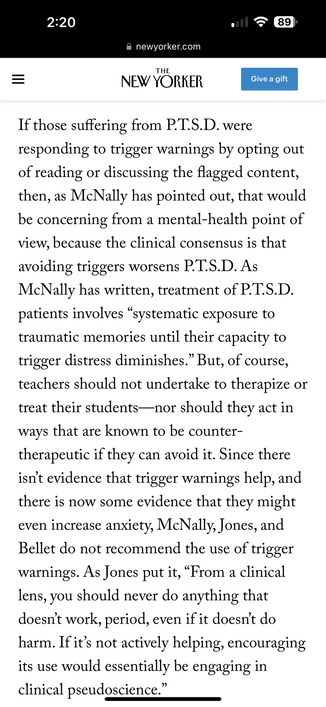
@Crell the previous rationalization was about preventing harm. And if there was conclusive proof it did that, I’d be more sympathetic (I still wouldn’t support making it mandatory in higher ed, which is the context here). But the studies show the opposite. If a professor wants to offer a heads-up, that’s fine. Requiring it is not.
@film_girl What makes a difference if the prof does it unilaterally or does the exact same thing as university policy? (Haven't looked at your links yet. Packing for a trip.)
@Crell there is no university policy. That’s the point. Students tried to force the university to adopt a policy requiring warnings. The university politely and resolutely rejected any such policy.
 Brett Elliff
@film_girl Alright, it’s not just me that’s noticing this. That’s a relief.
@film_girl I agree. Fun fact I live about an hour from Cornell.
 ethan
ethan@film_girl I returned to college and finished a BA at 45 (graduated last May). There were classes where every discussion was focused on triggering material as problematic and we were unable to get at the root issues or form responses. But there were also students deeply traumatized by their experiences and genuinely triggered. I don’t know the best response but Cornell has a point - life will come at you without warning. And we can’t fix problems by avoiding pain.
@film_girl Trauma therapy and therapy is general would help. One professor forewarned the class that the books we read would have some specific problematic passages. He wanted everyone to try to read them for discussion, but also gave specific page numbers to skip for the worst bits and brief synopses of those parts were available. I felt that was a good mix of psychological and pedagogical care.
@strangebirds yah, if the prof wants to do that, that’s fine. Personally, if I found content important enough to teach, I wouldn’t be willing to go through all those hoops to help people avoid stuff. If it’s important to teach, teach it. It’s not like there aren’t a million summaries of things available to people who refuse to engage on their own.