#Patreon and other "creator economy" companies tout the total number of creators on their platforms, and the total amount of money they've collectively made. But I haven't seen much analysis of how that money is distributed among the creators. In particular, how is #LifeInPatreonia? 1/
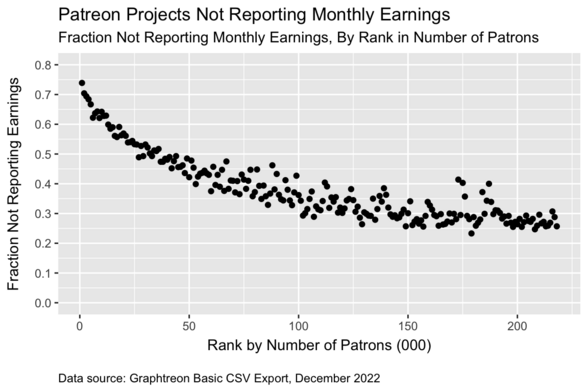
#Graphtreon data can help answer this, but note: Only 60% of #Patreon projects make earnings visible, and only 25% of top projects (by number of patrons) do. I look just at projects reporting nonzero earnings from monthly charges, 120K+ projects in all. #LifeInPatreonia 2/
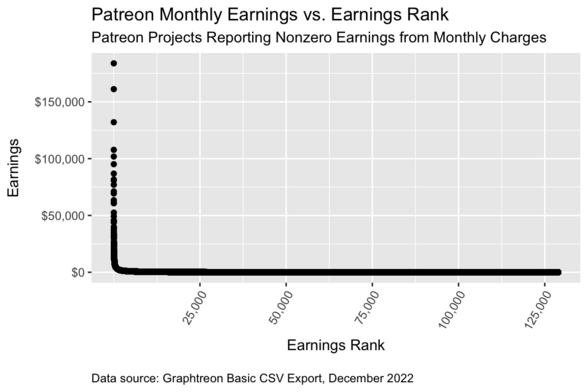
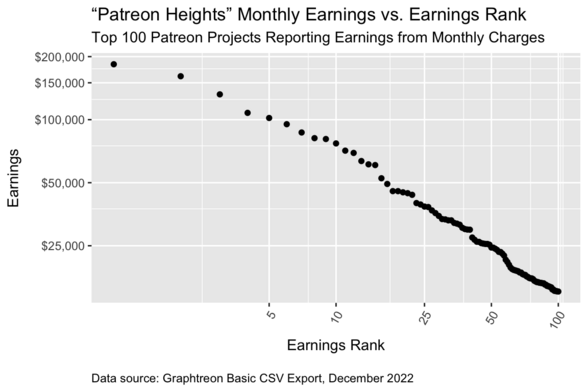
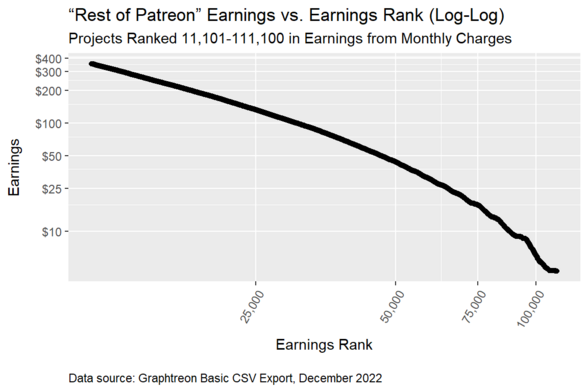
So, on to the analysis: #LifeInPatreonia is great for the projects at the top of the rankings, not so great for anyone else. Earnings fall off fast once you get past the top #Patreon projects ranked by earnings from monthly charges 3/
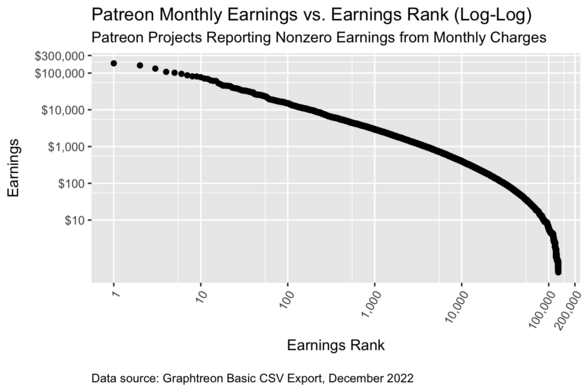
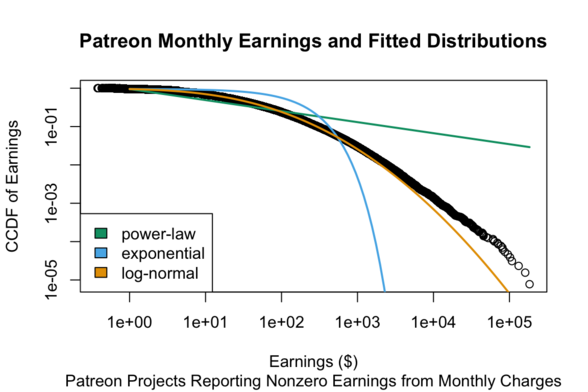
Let's try that again with a log-log scale: earnings for #Patreon projects drop off exponentially as you go down the list in order of earnings. When you get to the lowest-ranked projects earnings drop off even faster. #LifeInPatreonia 4/
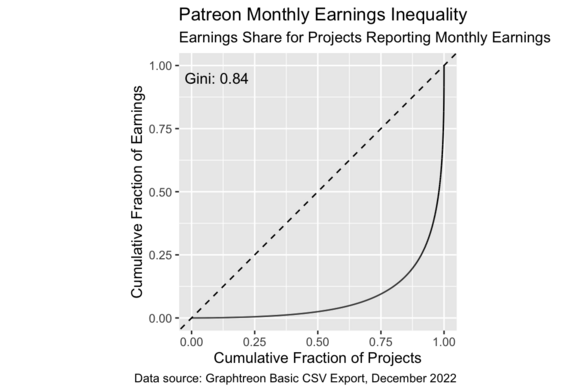
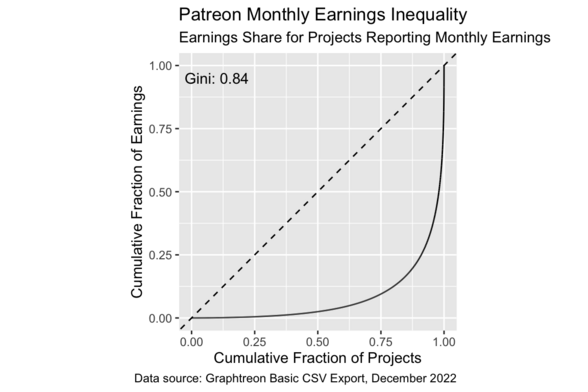
If it were a country then #Patreon would be the most unequal country on earth, with a Gini index of 0.84 (0 = completely equal income distribution of income
Sorry, forgot to include all the text: If it were a country then #Patreon would be the most unequal country on earth, with a Gini index of 0.84 (0 = completely equal income distribution of income, 1 = most unequal) (Compare to South Africa, world's highest Gini index: 0.63) #LifeInPatreonia 5/
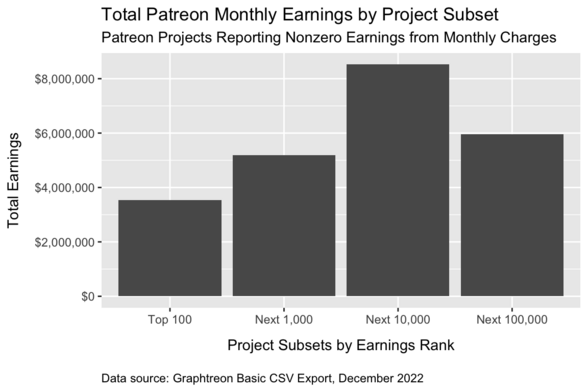
It's better to think of #Patreon projects as living in different places. #LifeInPatreonia is great in #Patreon Heights (top 100 projects by earnings): median earnings almost $25K/month or almost $300K/year (compare to Loudoun County VA at median $150K+/year, richest in US 6/
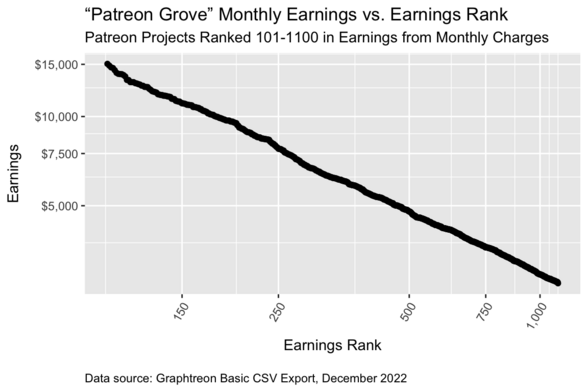
#LifeInPatreonia is tougher but still bearable in #Patreon Grove (next 1,000 projects by earnings): median earnings $4.2K/month, $50K/year. A person could live on that, and many do: lots of places in the US with median household income around $50K 7/
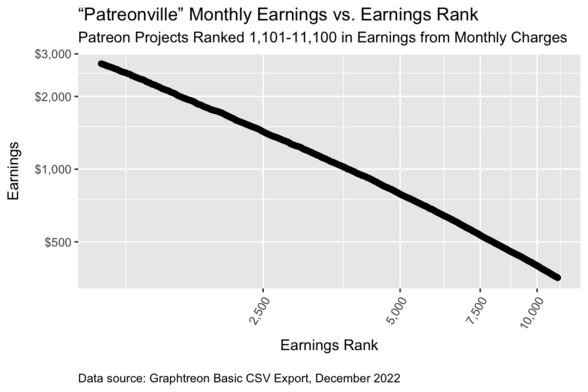
Patreonville houses the next 10,000 #Patreon projects by earnings. At median earnings of $660/month, under $8K/year, a creator would be under the US poverty line without a day job or support from partner/family. But outside the US #LifeInPatreonia might be livable some places 8/
Finally, the next 100,000 #Patreon projects: median earnings $28/month, $340/year. For projects in the rest of Patreonia, #LifeInPatreonia is a "hobby business" for creators, unless they happen to live in a really poor country. 9/
These four subsets, each 10x the last, have comparable overall earnings, and are presumably roughly equally profitable for #Patreon assuming near-zero marginal costs for each new project. So hype up the top few creators to attract 10s of 1000s of casual ones. #LifeInPatreonia 10/
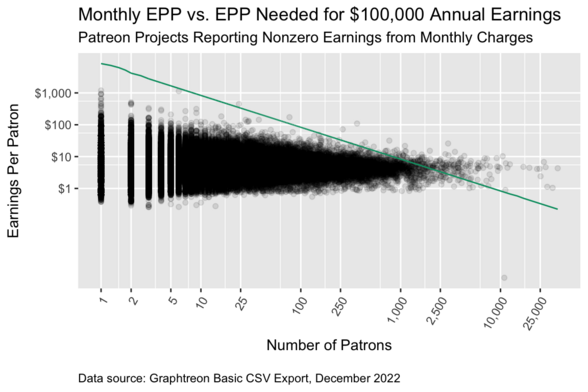
But didn't Kevin Kelly say creators just need to find 1,000 true fans (x $100/year/fan)? Chances of that on #Patreon are near zero: a miniscule fraction of 1% of projects meet that criterion, a slightly less miniscule fraction (above green line) get $100K/year any which way. 11/
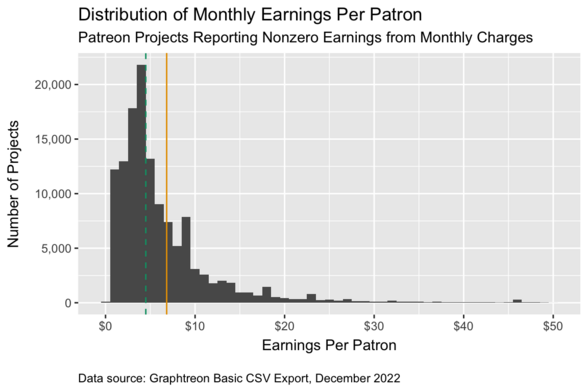
For #Patreon projects, median earnings per patron is $4.50/month, $54/year. $100/year (or $200/year, etc.) patrons do exist, but the big problem is getting 1,000 (or 500, etc.) of them, enough to make big money. #LifeInPatreonia 12/
Nerd time: Everyone talks about "creator economy" platforms as having power-law dynamics. Not so for #Patreon at least: project earnings are best modeled as following a log-normal distribution, like pretty much half the universe. #LifeInPatreonia 13/
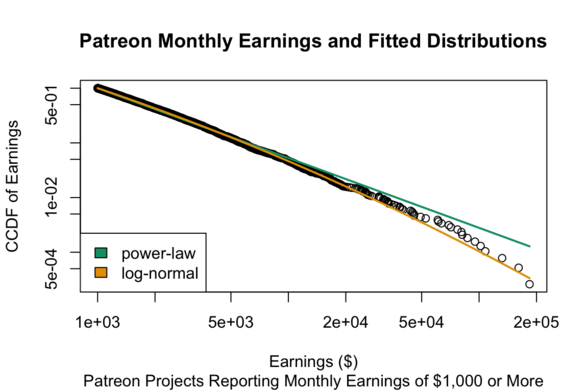
I mean, maybe it looks sort of like a power-law distribution when you fit models for the earnings of the top #Patreon projects (over $1,000/month), but log-normal is still the better fit even there. #LifeInPatreonia 14/
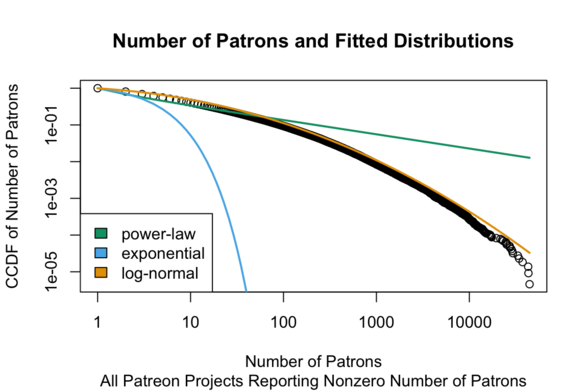
By the way, that's true for the number of patrons too, as modeled for 217K+ #Patreon projects, whether they report earnings or not: yet another log-normal distribution. (If you're curious, earnings correlates 0.84 with number of patrons.) #LifeInPatreonia 15/
Why log-normal? Possibly because running a successful #Patreon project requires being good at a number of things, which multiply together. Small differences in performance on each of many factors lead to wide variation in overall success. (Sorry, no graph for this one) $#LifeInPatreonia 16/
And that's all folks. For the full story of income equality among #Patreon projects (and all R code, so #rstats people with $120 for #Graphtreon data can reproduce the results) see https://rpubs.com/frankhecker/1025912 #LifeInPatreonia 17/17
RPubs - Life in Patreonia: Income Inequality among Patreon Projects

Sorry, provided the wrong URL initially. I edited it, but just in case: "Life in Patreonia: Income Inequality among Patreon Projects" https://rpubs.com/frankhecker/1025912
RPubs - Life in Patreonia: Income Inequality among Patreon Projects