My impression is that the first field that AI will massively disrupt is not medicine, not writing, and not education, but software engineering. The thing about software engineering is that the computer can often check its own answer, and iterate to a better one. Not so easy in other fields. So progress in AI writing software will be very, very fast.

I'm guessing there will still very much be a job for software engineers, but it's going to change fast.

@ben Yes and no. From what I see now, AI can handle tactical questions (“implement quicksort” or "write a regular expression”), but I doubt very much it can come up with a higher-level architecture, because there won't be such patterns out there on the Internet. And testing? It's not always easy even for humans to convert a requirement into a set of test cases.
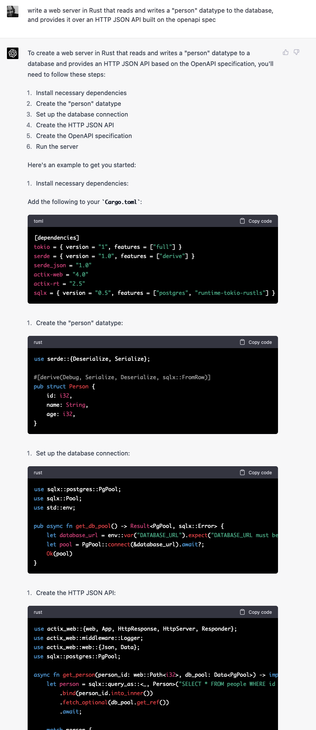
@SteveBellovin I agree that architecture is likely to be an area that resists AI a little longer but... I'm not sure how long. Check this out, via GPT4:
@SteveBellovin I'd add that, even if you're 100% right, there's a lot of software engineering jobs that are strictly tactical, little architecture.
@ben @SteveBellovin there is probably a lot of software writing and testing that could be automated. Look behind and see the impact of static analyzers or sanitizers. Not very hard to project that forward with better tech. But "writing clear specs of what you want the software to do?"
@huitema @ben There is certainly a lot that can be automated—but there's a lot that can't. To me, it looks like a productivity enhancer, not a replacement, for today's programmers.

@SteveBellovin

100% agreed! For those using GPT-variants to develop code, the nature of their jobs changes slightly, but it still stakes someone who understands the problem domain to specify what is needed.

These LLMs seem like a tool like an IDE is a tool, only more so. And I love it!

@huitema @ben