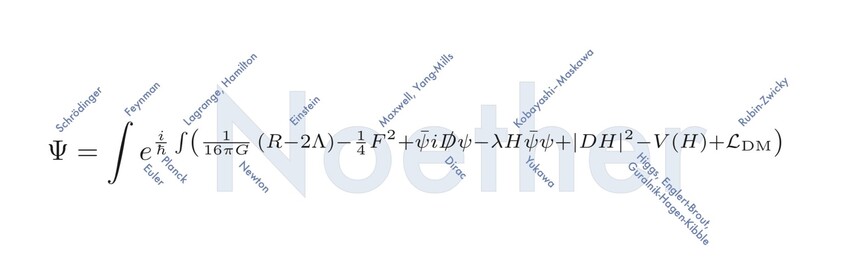
Mathematician Emmy Noether was born #OTD in 1882. She made groundbreaking advances in abstract algebra, and her eponymous theorems articulated the deep connection between symmetries and conserved quantities in physics.

Image: Public domain, photographer unknown
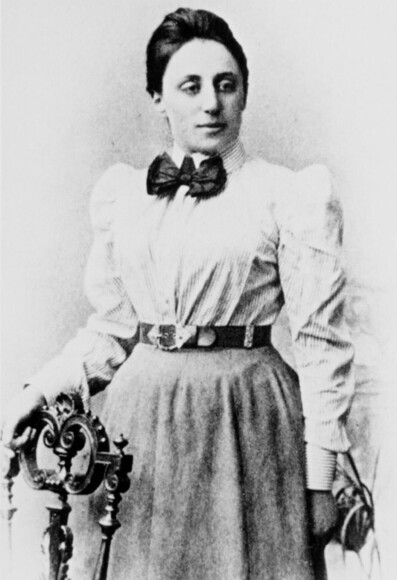
Emmy Noether began university at a time when women studying mathematics were only allowed to sit in on lectures. Even then, the professor’s permission was required.

She spent her first two years at Erlangen, then a year at Göttingen where she attended lectures by Hilbert, Klein, Minkowski, and Schwarzschild. Noether returned to Erlangen, where she began her doctorate in 1904. Three years later she was done, summa cum laude.

But women still weren’t allowed to assume academic posts, so she moved home. She continued to work on problems in abstract algebra.

Noether became known as a talented and creative mathematician. In 1915, Hilbert and Klein asked her to return to Göttingen to help with their program in mathematical physics. At the time, Hilbert was racing against Einstein to articulate the ideas underlying General Relativity.

Some faculty from other departments objected to a woman taking an academic post at the university. But Hilbert , who was having none of it, dismissed them.

“After all,” he said, "we are a university, not a bathhouse."

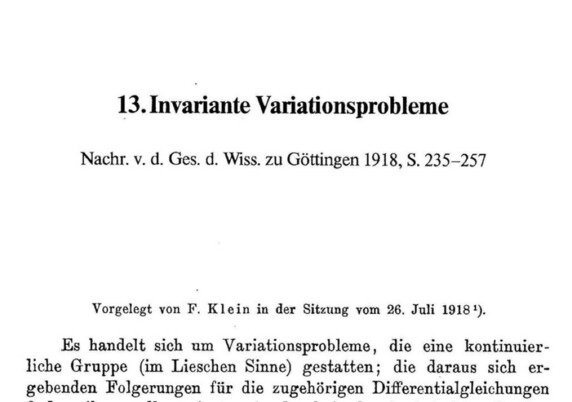
While at Göttingen, Noether proved the two theorems that bear her name. It is the first theorem, often just called “Noether’s Theorem,” that associates conserved quantities with symmetries of physical systems.

http://cwp.library.ucla.edu/articles/noether.trans/german/emmy235.html

Emmy Noether's Famous Paper

A symmetry is something you can do to a system (or to the way you describe the system) that leaves its physics unchanged.

For example, a collision between two masses works the same way in my office as it would in the lab down the hall.

Moving the masses down the hall and running the experiment in this new location — a shift in position that we call a “translation” — is a symmetry of the physics.

Likewise, the masses will scatter in precisely the same way if you run the experiment a year from now – a translation in time can be a symmetry. You might also rotate the experiment and find the physics is unchanged.

Noether’s Theorem tells us that every symmetry of a physical system implies the existence of a “conserved quantity” that does not change as the system evolves.

For translations in space the conserved quantity is momentum, for time it’s energy, for rotations it's angular momentum.

[Aside: A fun exercise for students of physics is to work out the conserved quantity associated with boosts for a system that is Lorentz invariant. You should think about Galilean boosts (t,x) -> (t, x + v t) first and then consider the relativistic case.]

For a complicated system, the symmetries may be more involved than the examples I gave above.

In that case, Noether’s theorem shows us, starting with the basic setup for describing the physics of the system, how to determine the conserved quantity associated with each symmetry.

This is very useful information! The details of a complex collision might be messy and hard to follow. But knowing there are quantities that remain the same before and after the collision can help us pin down the end result, given some information about how things started out.

A symmetry, as described above, hews pretty closely to the dictionary definition. We move an experiment down the hall, or change its orientation – actually do something to it.

But there is a another, closely related use of that term by physicists.

In many of our physical theories there is some redundancy in how we describe the physics. Exploiting that redundancy to alter the description in a way that leaves the physics unchanged is called a "gauge symmetry."

Noether’s Theorem gives conserved quantities for gauge symmetries, as well!

The canonical example of a classical theory with a gauge symmetry is electromagnetism. Figuring out how to change our description of charged particles to preserve the redundancy in the description of electromagnetism implies the conservation of charge via Noether's theorem.

Gauge symmetries are fundamental ingredients of the quantum mechanical theories used to describe particle physics (we even call them "gauge theories"). So Noether’s Theorem has been essential for developing the Standard Model of Particle Physics and understanding its predictions!

Let me quickly illustrate the difference between a symmetry and a gauge symmetry.

[You actually, physically rotate an object and it looks the same. That's a symmetry.]
◾ → ◆ → ◾

[You write down a model, recognize a redundancy in the description, and say “ta-da!” That's a gauge symmetry.]
◾ → ◾

There is a local (varying from place-to-place) redundancy in our description of gravity via general relativity: the choice of coordinates cannot matter.

The thorny problem of figuring out how conservation of energy works in this context prompted Noether’s work on her theorem!

Here is a thread from earlier this year about Noether's work on conservation of energy in GR. Klein got lots of credit, but he and Hilbert both acknowledged that the result belonged to Noether.

https://mastodon.social/@mcnees/109734841593777790

In all these cases, Noether’s Theorem relies on what is called a “variational formulation” of the physics. Another common name for this is an “action principle.”

Almost every modern physical theory is (or can be) formulated in this way. So Noether’s Theorem really is central to understanding a lot of modern physics.

Physicists like Einstein and Hilbert quickly understood the importance of Noether's work, but many prominent scientists of that generation and the next were unsure of the primacy of variational principles. So for many years Noether's work wasn’t fully appreciated.

By the second half of the 20th century, variational principles had reemerged as the language in which most theories were formulated. Noether’s work was rightly recognized as one of the foundational insights of modern physics.

As a physicist, I am most interested in Noether's work on symmetries and conservation laws. But she is best known to mathematicians for her contributions to abstract algebra.

In 1932, she delivered the plenary address at the International Congress of Mathematicians. Just a year later, the Nazis purged Jews from German universities and Noether was forced to flee to the US.

Noether took a position at Bryn Mawr, and remained there until she passed away in 1935.

Now, let me share a few links to some of the many great resources for learning more about Emmy Noether and her work.

First, a 2019 “In Our Time” podcast on Noether.
https://www.bbc.co.uk/programmes/m00025bw

And here is Dr. Ruth Gregory, a physicist at the University of Durham, giving a lecture on Noether at the Perimeter Institute. (I was at this wonderful talk.)
https://www.youtube.com/watch?v=O7BBL5LF3qM

BBC Radio 4 - In Our Time, Emmy Noether

Melvyn Bragg and guests discuss the ideas of one of the great 20th-century mathematicians.

BBC

A lecture at the Institute for Advanced Study by Abel prize-winning mathematician Karen Uhlenbeck, explaining Noether's contribution to our understanding of symmetries and conservation laws.

https://www.youtube.com/watch?v=Ca7c5B7Js18&embeds_euri=https%3A%2F%2Ftwitter.com%2F&feature=emb_logo

Symmetry and conservation laws: Noether's contribution to physics - Uhlenbeck

YouTube
My friend and collaborator @AstroKatie , talking about Noether for The Laborastory:
http://thelaborastory.com/stories/emmynoether/
Dr Katie Mack on Emmy Noether - The Laborastory

Scientists telling the stories from the science history books. The event is held each month in Melbourne.

The Laborastory
@mcnees So there’s Noether’s Theorem, and then she also proved a Noether theorem.
@mcnees bescheidener Hinweis in eigener Sache: „Noether's Theorem on a page.“ Das Noether-Theorem auf einer Seite: Diese sehr einseitige Darstellung des Noether-Theorems erfüllt die hohen Anforderungen, die an private Veröffentlichungen im Internet gestellt werden. Sie ist durch ein populärwissenschaftliches Buch über das wundervolle Theorem der Emmy Noether inspiriert, das in der Bibliothek jedes Gelehrten fehlen sollte. https://www.alm-paulusch.de/Noether_Theorem.pdf #math #formeldestages

@mcnees

I knew about the Noether Theorem in school, but never knew its creator was a woman. Badass.

But also, I now feel anger and sadness at the school system for not teaching me that.

D'où la formule de groupe : « Non, t'es rien » 😉
@apyth