 John Carlos Baez
The center of our galaxy is a wild and woolly place! Besides a black hole 4 million times the mass of our Sun, it's full of young clusters of stars, supernova remnants, molecular clouds, weird filaments of gas, and more.
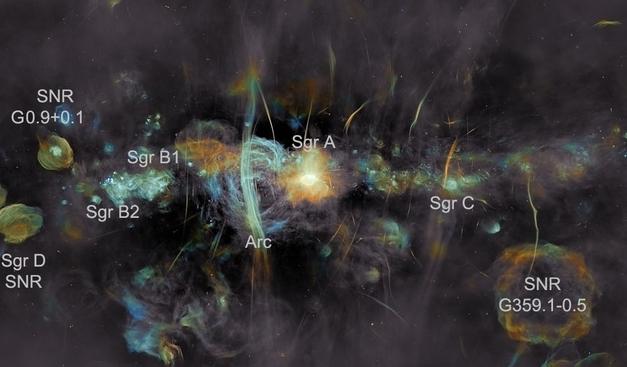
It's in the constellation of Sagittarius, hence "Sgr".
Sgr A contains the supermassive black hole, a supernova remnant, and the Minispiral: a three-armed spiral of dust and gas falling into the black hole at speeds up to 1000 kilometers per second.
The Radio Arc is the largest of a thousand mysterious filaments that emit radio waves: these make the Galactic Center "woolly". Nobody knows what causes them! Behind the Radio Arc is the Quintuplet Cluster, which contains one of the largest stars in the Galaxy - but more about that some other day.
Sgr B1 is a cloud of ionized gas. Nobody knows why it's ionized. Like the filaments, perhaps it was heated up back when the black hole was eating more stars and emitting more radiation. Sgr B1 is connected to Sgr B2, a "giant molecular cloud" made of gas and dust, 3 million times the mass of the Sun.
The distance from Sgr A to Sgr B2 is 390 light years. That gives you a sense of the scale here! The whole picture spans a region in the sky 4 times the angular size of the Moon.
The two things called SNR are supernova remnants - hot gas shooting outwards from exploded stars. Sgr D is another giant molecular cloud, and Sgr C is a group of molecular clouds.
So, a lot is going on.
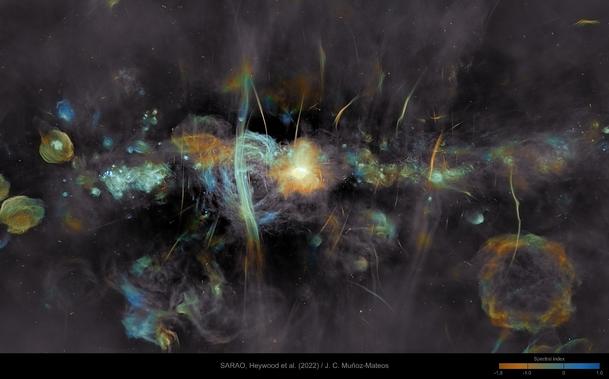
Let me show you the same picture in all its glory without the labels.....
(1/2)
 theHigherGeometer