
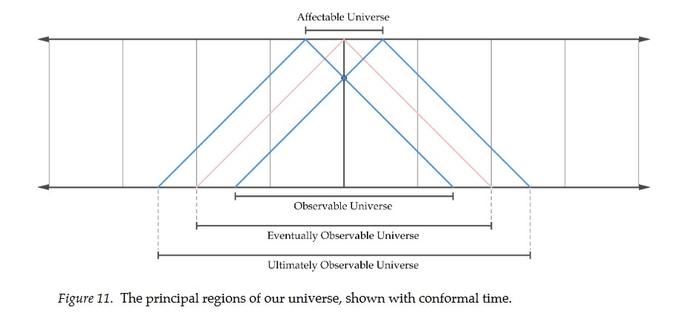
Toby Ord's chart shows 4 things:

• Everything we can observe now is the "observable universe".

• Everything we can ever observe if we stay here is the "eventually observable universe".

• Everything we can ever observe if we send spacecraft out in every direction at all speeds slower than light is the "ultimately observable universe".

• Everything those spacecraft can ever affect is the "affectable universe".

His chart is drawn in funny coordinates where a galaxy at rest moves straight up the page and light moves at 45° angles. The Big Bang is the horizontal line at the bottom, and the infinite future is the horizontal line at top. The expansion of the universe is hidden in these coordinates!

How big are these 4 things?

• When we observe distant galaxies we see what they were like long ago, when they were closer. Those galaxies *now* form a ball of radius 46 billion light years in diameter. So people say the radius of the observable universe is 46 billion light years. But beware: we can't see what the galaxies in the observable universe look like *now*.

• The galaxies in the eventually observable universe *now* form a ball of radius 63 billion light years.

• The galaxies in the ultimately observable universe *now* form a ball of radius 80 billion light years.

• The galaxies in the affectable universe *now* form a ball of radius 16 billion light years.

These figures change with time. For example, shortly after the Big Bang the radius of the affectable universe was 63 billion light years. It has now shrunk to 16 billion light years. 90% of the galaxies we could in theory once reach - if we could have started right away - are lost to us now!

(1/2)
Of course, all these numbers are based on our current cosmology, which says that as the universe expands and ordinary matter thins out, the effect of dark energy becomes more important, and the universe starts expanding almost exponentially. If our theory of cosmology is wrong then these numbers are wrong!

You might wonder why the affectable universe has a finite radius even though the universe will last forever in our current theory. The reason is that because the universe is expanding faster and faster, it's impossible to catch up with distant galaxies. So the only galaxies we *can* reach are those that are less than 16 billion light years away now.

For more, read Toby Ord's paper:

• Toby Ord, The edges of our Universe, https://arxiv.org/abs/2104.01191

(2/2)

The Edges of Our Universe

This paper explores the fundamental causal limits on how much of the universe we can observe or affect. It distinguishes four principal regions: the affectable universe, the observable universe, the eventually observable universe, and the ultimately observable universe. It then shows how these (and other) causal limits set physical bounds on what spacefaring civilisations could achieve over the longterm future.

arXiv.org
@johncarlosbaez The notion that most of the universe is in principle inaccessible to us always makes me feel profoundly...something...sad?...awed?...small?
@michaelgemar - I feel a bit *frustrated*. But I'll be gone long before we even explore a minute fraction of the affectable universe.
@johncarlosbaez Yeah, I realize that it is absurdly irrational to be upset that light can’t reach us from some parts of the whole universe when we’ve barely made it to the moon.
@johncarlosbaez linking to the paper in part as a reminder to dig in on this later: https://arxiv.org/abs/2104.01191
The Edges of Our Universe

This paper explores the fundamental causal limits on how much of the universe we can observe or affect. It distinguishes four principal regions: the affectable universe, the observable universe, the eventually observable universe, and the ultimately observable universe. It then shows how these (and other) causal limits set physical bounds on what spacefaring civilisations could achieve over the longterm future.

arXiv.org
@tsrono - thanks! I should have given the link.
@johncarlosbaez Then there’s the path taken by a photon between emission and detection. Also unobservable.