
I think the dominance of the venture capital model in tech have somewhat skewed founder perceptions of small business failures.

VC-backed companies die suddenly. But most bootstrapped companies die slowly.

The following observations from this old Marginal Revolution blog post (on, of all things, the reality TV show The Profit) are mostly correct, and I think about them a fair amount.

https://marginalrevolution.com/marginalrevolution/2018/04/lessons-from-the-profit.html
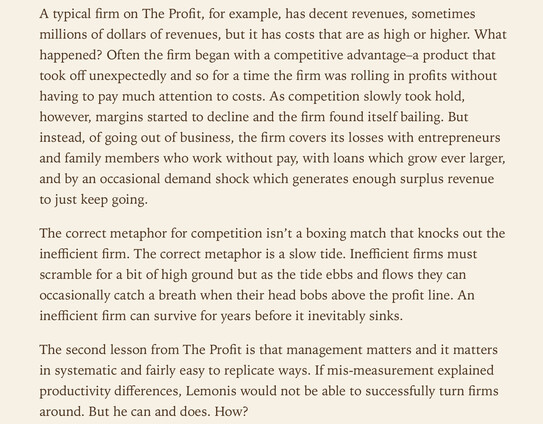
Lessons from "The Profit" - Marginal REVOLUTION

I’ve learned a lot about industrial organization watching The Profit, a reality-TV show on CNBC featuring businessman Marcus Lemonis. In each episode Lemonis buys into a failing small-to-medium-sized business and works to turn it around. Lemonis doesn’t invest in a random sample of businesses nor even in a random sample of failing businesses. Nevertheless, the […]

Marginal REVOLUTION

I remember finding out that our primary SME competitor in the point of sales space in SG had been hollowed out to become a real estate holding company.

They were basically using the cash flows from POS sales to fund property purchases.

Of course, when we started eating into their system sales, that cash flow shrank over the course of the next 5 years.

They’re still going, of course. I’d give them another decade before they fully give up.

Sometimes indie hackers/solopreneur folks ask “Why are moats so important? Plenty of small businesses exist in crowded markets and seem to do fine.”

Which, yes, correct. But failure here isn’t sudden death. Failure is spending the next 10 years swimming harder each year.

I should caveat that by saying this might not be ‘failure’ — for many proprietors, swimming harder each year, over two decades, in a business where you get to take home large amounts of (eventually declining) cash flows is actually success!

@cedricchin "Failure is spending the next 10 years swimming harder each year."

Wow, 🤯