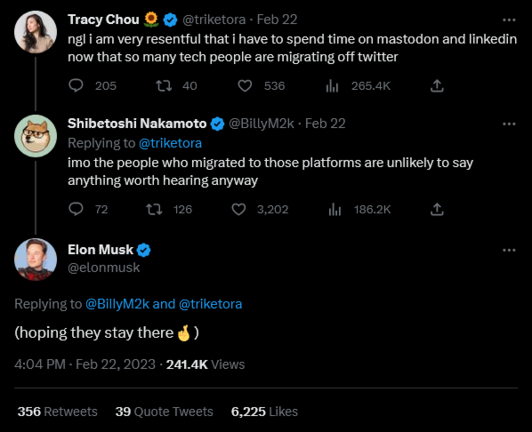
Zooming out to this whole conversation on Twitter because it really is bizarre. To summarize:

Tracy Chou: I don't like that I have to use Mastodon to read stuff from tech people.

Doge Guy: Tech people have nothing worth hearing anyway.

Elon Musk: I hope tech people stay on Mastodon.

https://twitter.com/elonmusk/status/1628546242807746561

@fediversenews

Elon Musk on Twitter

“@BillyM2k @triketora (hoping they stay there🤞)”

Twitter

So basically, if you want to hear from tech people, you must use Mastodon.

But according to Elon Musk, why would you do that? Tech people have nothing worth saying anyway. And he hopes they stay on Mastodon.

@fediversenews

Whether Elon Musk likes it or not, tech people have important things to say that a whole lot of other people want to read.

For example, here's Google employee @johnmu talking about search engine optimization.

https://mastodon.social/@johnmu/109879325577937391

This is actually something that a lot of publications might want to report on.

@fediversenews

Social networks are not always about how many people use them, but more specifically *who* uses them.

Twitter itself was never that popular compared to Facebook.

It always had an outsized influence on public culture due to who used it.

Well, now tech people and academics have migrated over to the Fediverse.

Which means that if you want to talk to tech people and academics, you have to figure out how to use it.

For many people, the Fediverse is becoming critical for work.

@fediversenews

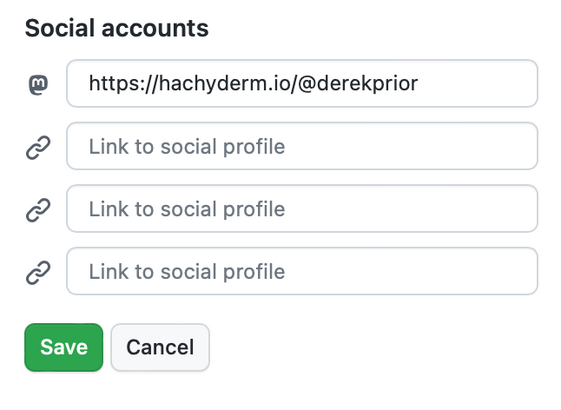
In fact, the Fediverse is now so critical to the tech industry that GitHub rolled out support for Mastodon profiles this month.

That's not a small thing.

Again, if you want to talk to tech people, a Fediverse presence is paramount.

https://mastodon.social/@nova@hachyderm.io/109790532829442644

@fediversenews

Here's the thing about network effects.

If a culture has a strong enough pull, everything adjacent to that culture gets pulled within its orbit.

This is why Tracy Chou finds herself forced to use Mastodon -- despite wishing she could stay on Twitter.

For example, where tech people go, tech executives tend to follow.

Where tech executives go, other industry executives follow.

Where executives go, VCs and investors follow.

That's how network effects work.

@fediversenews

(A whole lot of people don't like the notion of money people hopping onto the Fediverse. But that's what happens when you build something so appealing to tech people: everyone adjacent gets pulled into it.

Thankfully, the Fediverse gives us freedom of association. We can quarantine the money people if that's what we want. Which is what has effectively been done to the crypto crowd.)

@fediversenews

Let's now talk about the migration of academics to the Fediverse.

That's going to have wide-reaching implications across social media.

If Twitter continues its trend for maximum outrage-driven "virality", and the Fediverse continues its trend for quality research -- where will people go to cite high quality research?

@fediversenews

Again, what's the network effect of academia migrating to the Fediverse?

* Public policy and think tanks will follow
* R&D departments will follow
* Students will follow

Everything in academia's orbit will be pulled into the Fediverse.

@fediversenews

My expectation is that universities will launch their own Fediverse servers of sorts, maybe not even (only) Mastodon if they discover something more useful to them in time. The more tech-leaning a university is, the more likely this may be, and the more likely it won't just have a run-of-the-mill Mastodon instance.

Of course, once the server is up and running, students will be able to register accounts or even be given one right away. And they'll also be allowed to use it for private purposes, also to protect them from the open hostility in Big Social silos like the birbsite.

One step that hasn't been mentioned yet is that we'll end up with lots of graduates with Fediverse accounts and acquaintances in the Fediverse. Even if they can't stay on the university's server, they'll very likely stay in the Fediverse because, as crazy as this may have sounded a couple of years ago, that's where their friends are.
@jupiter_rowland yeah, I think this is what will happen. However there are several limitations with account migration that limit the ease and desirability of migrating at the moment. Not least of all being that you lose your post history when you migrate. Until that’s resolved, I don’t know why anyone would create an account on a server they know they’re going to have to migrate off of.
@Brendan Jones That's one of the reasons why they should use something else than Mastodon. Seriously, the reason why they use Mastodon seems to be it's all they know.

#Mastodon offers you very basic microblogging, and when you move instances, you can only take those whom you follow with you.

#Friendica, to do a big step upward, allows you what rather amounts to macroblogging. It adds stuff like text formatting, RSS and e-mail integration, a public calendar and a personal file server on top. And it lets you move your account to another node with everything on it, including the files on your file server.

#Hubzilla not only lets you move your channel(s) from hub to hub with everything on it. Its #NomadicIdentity would theoretically allow you to have the same channel(s) simultaneously on MIT's hub, on UCSC's hub, on Stanford's hub, on UCI's hub, on Berkeley's hub, on TU Harburg's hub, on four public hubs and on your personal hub which you run on a Raspberry Pi at home, and they'd all be fully in sync. Plus, on top of Friendica, it adds a WebDAV server, a CalDAV server for private calendars, a CardDAV server for contact lists, blog articles, simple websites, a simple wiki engine etc.

Netzgemeinde/Hubzilla

@jupiter_rowland
Many factors why people choose Mastodon:
- it’s familiar (basically like Twitter)
- it’s simple (if people are looking for a Twitter replacement then they’re not looking for email, rss or calendar integration)
- it has apps (I just searched for Friendica and Hubzilla apps on the App Store, nothing came up)
- the UI is more polished (though not pretty)
- network effect (following other people there)
- social proof (it’s where the people are already)