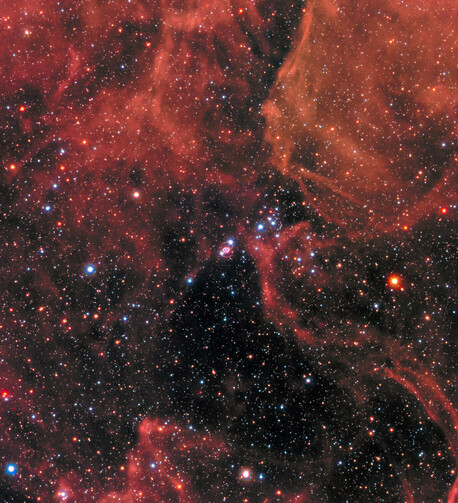
Light from supernova 1987A reached Earth #OTD in 1987. The Hubble space telescope captured this spectacular image for the 30 year anniversary in 2017.

Credits: NASA, ESA, R. Kirshner (Harvard-Smithsonian CfA, Gordon and Betty Moore Foundation), M. Mutchler and R. Avila (STScI)
This Hubble time-lapse taken between 1994-2016 shows a ring of ejected material (visible in the previous image) superheat and glow in X-ray as the shockwave from supernova 1987A slams into it.

Credits: NASA, ESA, R. Kirshner (HSCfA, Gordon & Betty Moore Fnd), P. Challis (HSCfA)

In its last stages before going supernova that star ejected large amounts of relatively slow-moving material. The ring you see in the gif was probably ejected around 20,000 years before the final explosion. The fast-moving shockwave caught up with it in a matter of decades.

Supernova 1987A is a great example of what is called "multi-messenger astronomy." This is when astronomers collect complementary data about an astrophysical event via electromagnetic detection and some other channel.

In this case a massive burst of neutrinos reached Earth about 20 hours before the supernova's electromagnetic emissions were detected.

But how is it possible that the neutrinos got here first? Did they travel faster than light?

Neutrinos are produced in huge numbers during core collapse. They interact very weakly, so they stream right out of the star and into space.

On the other hand, the photons we see were produced when a shockwave from the core collapse reaches the surface. This takes longer, so we see them later.

👆Supernova-versary!

More recent examples of multi-messenger astronomy have paired electromagnetic and gravitational wave detections to study, for example, the merger of two neutron stars.

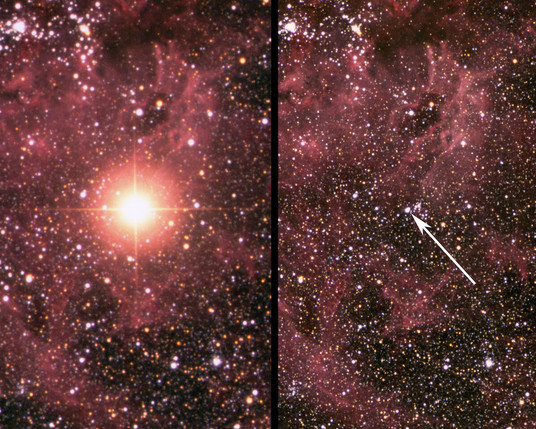
Anyway, share this post if you had this same before-and-after poster of Supernova 1987A on your bedroom wall when you were a kid. Mine came from the Smithsonian Air & Space Museum gift shop.

Image: David Malin / Australian Astronomical Observatory

@mcnees I cut that picture out of a magazine and taped it to one of my school folders (possibly a Trapper or Trapper Keeper).
@mcnees surprised we could detect them in 1987
@mcnees I have two potential answers, although they're kind of the same answer. Most neutrinos pass through the amount of matter that is in a star without interacting with it at all.
On the other hand, pretty much every type of electromagnetic radiation that comes out of a star takes a very long time to come from the center of the star to the surface because of how it interacts with The contents of that star. Essentially, a photon that is formed at the heart of a star is absorbed and reemitted
@mcnees Just an obscenely large number of times before it gets out of the star. Something like 100,000 years for a photon to make its way out of a star. Because each absorption and emission event takes time. So something happens in the middle of your star that causes it to go boom. It releases a bunch of neutrinos, almost none of which interact with the interior of the star and then the light from that going boom comes out quite a while later. Although probably a lot faster than standard
@mcnees because the start is coming apart behind and around the electromagnetic wave. Also, the neutrino pulse probably had more than a 20-hour lead because neutrinos travel just slightly below the speed of light. We don't have good measurements for how fast they travel because they're really hard to measure. But the pulses were separated by 20 hours over a distance of 168,000 light years.
@mcnees I know I said I had two options but the other option is the star option spread out across the dust of the entire galaxy and I'm not sure. The distance involved is large enough for absorption and remission to make a huge difference for light across the not quite vacuum.
@mcnees Thank you, what an amazing image!
One question, though: does Hubble have X-ray detectors? I thought it stopped at UV.
@Haldane This time lapse is showing stuff at longer wavelengths, though it should be brightest up in X-ray. (I should’ve been more careful with how I phrased it. There are composites with Chandra overlays: https://youtu.be/t7rMtVctvag )
Supernova 1987A Sonification

YouTube
@mcnees Thanks again, that's what I thought it might have been. These are beautiful observations of a literally awesome event. The sonification is interesting as well: multimessenger data visualization!