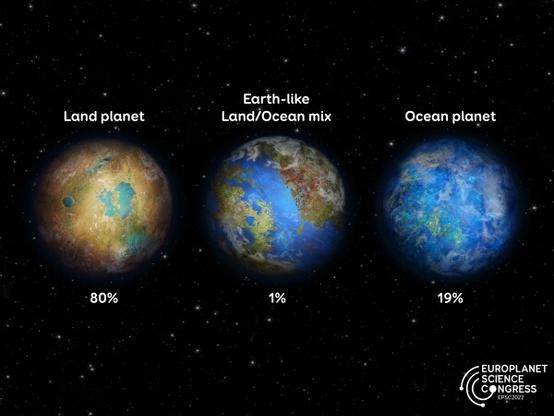
Colors of a Habitable Exoplanet

When it comes to planetary habitability, it is all too easy to let our assumptions slide past without review. It’s a danger to be avoided if we want to understand what may distinguish various types of habitable worlds. That’s the implication of a presentation at the recent Europlanet Science Congress (EPSC), which

@nyrath When will we get a model that doesn't neglect the role of surface water in lubing up plate tectonics?
Your Guide to this Fall’s Bodily Fluid Moons – darrelplant.com

@nyrath
I still feel our definition for habitable has a Terran bias. We only call Earth like planets habitable and ignore the wider range.

Ice shell world's might prove to be the most habitable locations in our galaxy for life. There could be creatures who can't fathom the idea of life evolving on a planet without a protective barrier of ice around it. "Non-ice planets are susceptible to frequent impacts and radiation!" they scoff.

@Aaron_DeVries
Now, there is a difference between "habitable" and "human habitable"

And if life exists on ice shell planets and moons, the implications is that such life will outnumber goldilocks zone life by about 4 to 1. Since there are about 4 ice shell moons and only one goldilock planet in our solar system.

#AlienBiology