 Scott Jenson
Another Hotel, another bizarre #UXDesign example: salt and pepper shakers. Which one is which? Great example of "icons aren't always enough"
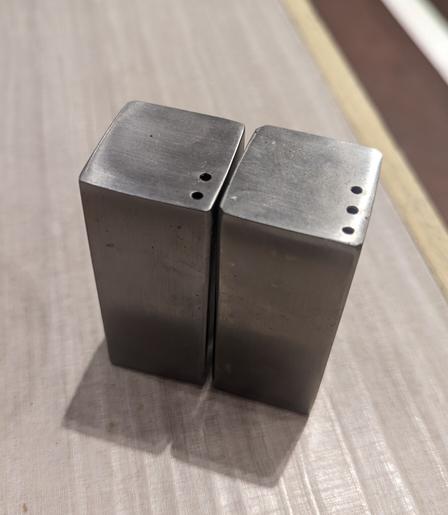
@scottjenson My partner suggested that since the word "salt" is shorter than "pepper", the salt is the 2 dots and the pepper is 3 dots.
It's not a big deal so long as you want both salt and pepper, you just put some in your hand to see if you guessed right. If you only want one, then there's a 50% chance you're going to waste some that you'll have to throw away.
@skyfaller @scottjenson "Just" pour some in your hand...and if you guessed wrong, drop it on the hotel floor? The real victim isn't the diner, but the hotel worker. (Doesn't @thomasfuchs have a discussion going about the problem of #just in #uxdesign ?)
Worse yet, you really need to test BOTH containers, because without transparency, it's hard to detect tampering by mischievous children.
@pgcommunication I was assuming a cafeteria setting where there is an obvious garbage can that you could throw it in.
And if you suspect tampering, no labeling or UX should entirely satisfy you. Even if the container is clear so you can see the material inside, there are a lot of chemicals that could look like table salt but are not. Practical jokers are the worst.
@scottjenson Weirdly, the convention is: the pepper shaker has more holes than the salt shaker.
Source: A lifetime observing salt and pepper shakers too closely
@scottjenson I would do 2 holes salt, and three holes pepper.
Too much salt, for me anyway, is worse than too much pepper.
@carlosrodriguez @scottjenson This is interesting because I always assume the other way—salt granules flow more freely than pepper, so you want fewer holes in your salt shaker to avoid over-salting.
But maybe I’ve been wrong about this. 🤔
 Glenn Fleishman
 Nelson
 pgcommunication
 dragfyre
 mattkingsfan
 Uncle CharlieA
 Matt Hauger
 Ian McKellar
 Doug 🌈🇨🇦
 Richard 🏳️🌈
 suzietchi
 Kirk McElhearn
 Iαη 🍺
Iαη 🍺 Carlos Rodríguez
 Ben Ramsey