I'm reading Olivia Manning's Balkan Trilogy right now. Apparently she was mystified by all the praise heaped on her rival, Iris Murdoch: https://www.theparisreview.org/blog/2018/06/13/feminize-your-canon-olivia-manning/
Feminize Your Canon: Olivia Manning

Our new monthly column, Feminize Your Canon, explores the lives of underrated and underread female authors.     The British novelist Olivia Manning spent her dogged, embittered career longing, largely in vain, for literary glory and a secure place in the English canon. Reassurances from friends that talented writers were often rewarded by posterity cut no […]
The Paris Review
Striking to me because I just read some Murdoch earlier in the year and was thinking about how she fits some male ideal of a woman novelist. As if the work was being judged on how smart it was, rather than its more literary qualities.
I'd say the most notable quality of Manning's writing so far is the way she subtly builds up feeling, in layers. Maybe dread, too? I can't tell yet.
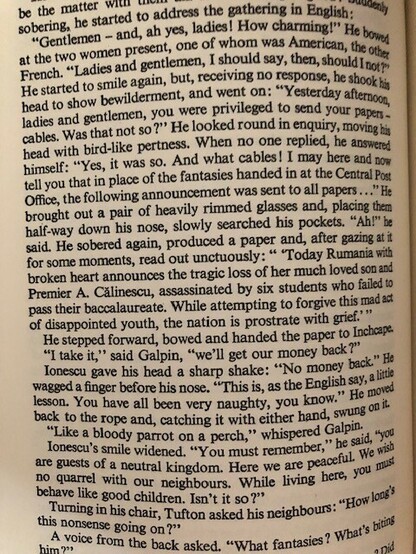
Enjoyed her depiction of a press conference/exercise in censorship:
(Călinescu was assassinated by Iron Guards with money and training from Germany, not students who had failed their exams.)
You generally get the sense of someone who kept a *very* detailed diary on her sojourn abroad. Some of the scenes come across as somewhat surreal reportage.
Both Manning and her main character, Harriet Pringle, traveled to Romania on the day WWII broke out, so from the first they knew to watch what was happening around them very closely.
Rachel Cusk wrote the introduction for the edition I'm reading, and I'm wondering if all the scenes of men lecturing Harriet about politics were an influence on the Outline trilogy. The first of which takes place in Greece, where Harriet and Guy end up after Romania.
There was, indeed, a built-up feeling of dread that became quite acute!