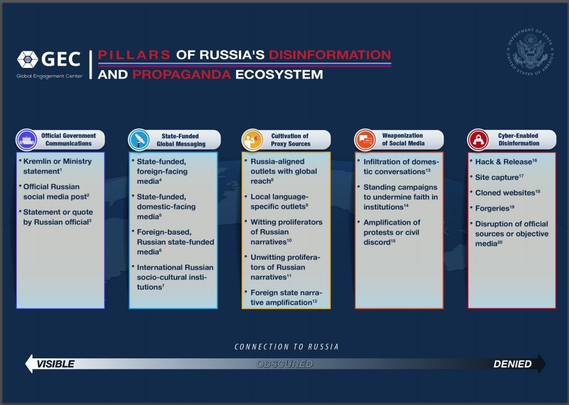
In this study, I focused on three main pillars of that ecosystem:
-Overt Russian state-funded propaganda (RT)
-Proxy sites connected to Russian intelligence (SouthFront, Global Research), which allow some degree of plausible deniability on the surface.
-Social media (in this case, Telegram groups that were set up for the truck convoy but which later became repositories for Russian propaganda).
I used a mix of OSINT tools & techniques, including GDELT.
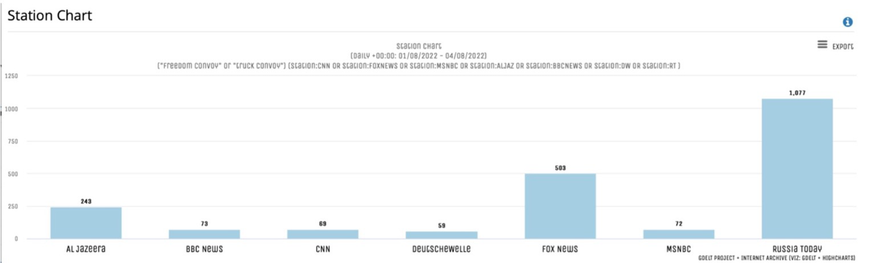
The first major finding is that Russian-funded propaganda outlet RT produced a higher volume of television coverage focused on the truck convoy than any other international media outlet.
In fact, RT produced more convoy coverage than nearly all other international media outlets COMBINED. 4/
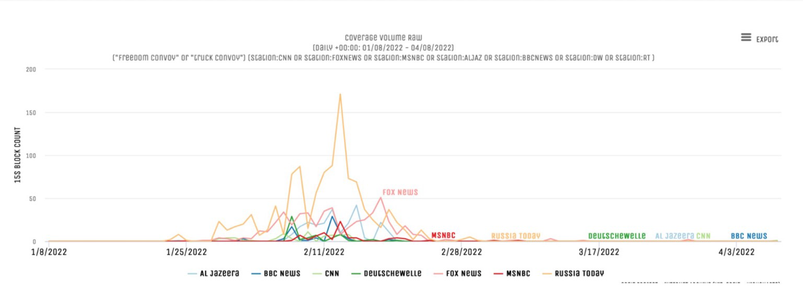
Russian-funded propaganda outlet RT (below, in orange) was also the first international media outlet to mention the truck convoy on-air, and as you can see, the peak volume far outpaced any other media outlet.
RT's early dominance is strategically important because it may have provided an opportunity for RT to set the tone for subsequent international media coverage. Given that RT's tone is whatever aligns with Russian state interests, this is significant. 5/
@marktaylor @rvawonk @donieosullivan @mehdihasan
Does your research examine the role fundamentalist churches from Alberta played in the Feb 2022 convoy?
Links to a Koch-funded think tank, Justice Centre for Constitutional Freedoms (@JCCFCanada) are concerning. This group has managed to involve some high profile Canadian Conservative Party members.
The anti-democracy movements in America also have the same parallels; political conservatives, fundamentalist Christians, & oil interests.
1/2
Examples of Russian-supported narratives from conservatives, grifters, fundamentalist Christians, and oil: all to subvert elections & intimidate judges.
https://vancouversun.com/news/john-carpay-advocates-justice-then-tries-to-subvert-it
https://www.cbc.ca/news/canada/faith-convoy-truckers-1.6350538