 Chris Trottier
Twitter is killing free API access.
Will most devs pay for access? No thanks.
If what happened to 3rd party clients proves true, I have a feeling many devs will move their efforts to the Fediverse.
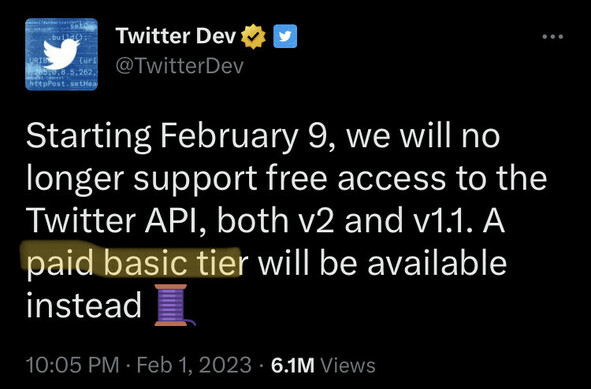
Twitter is killing free API access.
Will most devs pay for access? No thanks.
If what happened to 3rd party clients proves true, I have a feeling many devs will move their efforts to the Fediverse.
@atomicpoet let's not forget that the Fediverse still has entry barriers and a learning curve for those who aren't tech-savvy.
This would be the perfect moment for us to slay whatever is left of Twitter and convince everyone to move to the Fedi. Elon's sheer imbecility is literally providing with assists on a daily basis - from banning journalists, to promising zero censorship against the fascist, to actively working to compromise the stability of the platform, to turning Twitter's working environment into a toxic mix of chauvinism and stakanovism, to closing the APIs and killing 3rd-party clients, to the mess with the new verification program...
And, indeed, every time Elon decides to set a new bar for what being a true idiot means, Mastodon and the Fediverse get a new ripple of users.
But those ripples don't stay long. Looking at the stats of new users, one can easily overlap the peaks with Elon's acts of stupidity, but it's also true that not many of those who join in those ripples stick around.
It means that, no matter how bad other platforms are, most of the people still have trouble, for some reason, using a free and decentralized alternative that isn't run by any sociopath billionaire.
@blacklight This is where a dev ecosystem comes into play. More hands on deck, a better user experience will be created.
This is a continuing work in progress.
We see this in the current dash to create user apps.
Also, there are projects like @benbrown's single user, stand-alone NodeJS web application which requires no server dependencies, #activitypub server #Shuttlecraft, which I envision could be deployed in mass, on a user-by-user signup level. Users signup at a single sign-up page and their own single user server is created, that they own. Kind of a #Fediverse Geocities but server creation
@paul @atomicpoet @benbrown I love the idea of more apps and more decentralization efforts. But that goes at odds with how social networks work (on a sociological, not on a technological, level).
Even on Twitter, only a minority of the users used to use alternative clients. Sure, they were also those who spent a lot of time on the platform and cared the most about its features. But, statistically, they were still a minority (and probably not even those that the platform could monetize the most). Most of the people were happy with the default app, even if it sucked.
Does Twitter killing their free API and 3rd-party clients mean that those who used Twitterrific, TweetDeck or Twidere will probably move to the Fedi? Most likely yes. But, just to be clear, we're talking of a number of users within the hundreds of thousands, not more. Most of the Twitter's userbase didn't know/didn't care about APIs and alternative clients.
As I previously stated, social networks abide to the rules of (human) network effects: people tend to gravitate towards the solution with the lowest friction points, especially if that's also what most of those in their circle already use. No matter how good the alternatives are.
From this perspective, more decentralization + more user choice = more fragmentation + more friction coming from the initial cognitive burden required for adoption. We should not forget that we live in an age where consumers are used to somebody else making choices for them, and any additional burden of choice on the user is likely to decrease the chances of adoption.
Again, I'm not advocating to do things differently. I'm here exactly because of how things are done here. I'm just saying that we should be realistic about what to expect: people won't suddenly flood to Mastodon or Pleroma because they have more choice and more apps. Facebook and Twitter have managed to get away with literally anything (including things that would have taken any other business down within days in the past) because people are addicted to their products, and because they have benefited from social network effects for more than a decade. It's very hard to convince enough people to jump the gap if the alternative comes with a higher initial cognitive burden for the user.
I consider myself happy with the current number of people on the Fedi. I don't think that, given the way we do things, it makes even sense to aim for a more exponential-like growth going from here. I don't even want to think of scaling up my instance for a 10x-100x increase in federated traffic. A greater number of apps is likely to greatly improve the user experience, but only for a minority of the overall market of potential social media users. And actually I'm perfectly fine with it :)
 Fabio Manganiello
 Paul Chambers🚧