 Chris Trottier
Twitter is killing free API access.
Will most devs pay for access? No thanks.
If what happened to 3rd party clients proves true, I have a feeling many devs will move their efforts to the Fediverse.
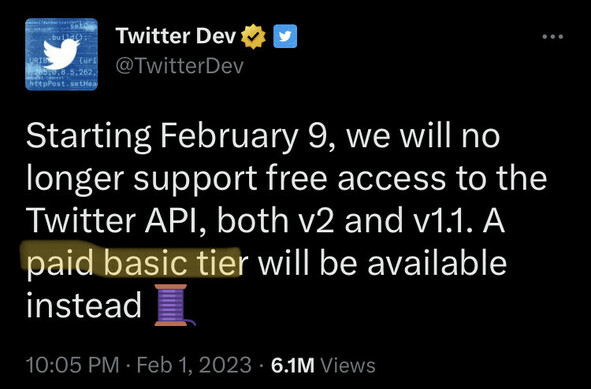
Twitter is killing free API access.
Will most devs pay for access? No thanks.
If what happened to 3rd party clients proves true, I have a feeling many devs will move their efforts to the Fediverse.
@atomicpoet let's not forget that the Fediverse still has entry barriers and a learning curve for those who aren't tech-savvy.
This would be the perfect moment for us to slay whatever is left of Twitter and convince everyone to move to the Fedi. Elon's sheer imbecility is literally providing with assists on a daily basis - from banning journalists, to promising zero censorship against the fascist, to actively working to compromise the stability of the platform, to turning Twitter's working environment into a toxic mix of chauvinism and stakanovism, to closing the APIs and killing 3rd-party clients, to the mess with the new verification program...
And, indeed, every time Elon decides to set a new bar for what being a true idiot means, Mastodon and the Fediverse get a new ripple of users.
But those ripples don't stay long. Looking at the stats of new users, one can easily overlap the peaks with Elon's acts of stupidity, but it's also true that not many of those who join in those ripples stick around.
It means that, no matter how bad other platforms are, most of the people still have trouble, for some reason, using a free and decentralized alternative that isn't run by any sociopath billionaire.
@atomicpoet btw I'm a HUGE fan of APIs and 3rd-party clients. But we should also be careful about the fragmentation effect - something that has already been affecting Linux since its birth.
Walk for a moment in the shoes of the average Joe - not the Twitter geek, not the IT enthusiast.
Joe wants to share stuff with his friends on some social platform. He learns about Twitter. He creates an account, logs in, starts posting. End.
Now Joe learns about the Fedi. And people start asking him - which platform? Mastodon? Pleroma? Diaspora? Which server? Which client? And, by the time Joe is asked the third question, he's already walked away.
As an engineer and an open-source enthusiast, I often believe that all people want and need is more choice and a more customized experience. But every time people surprise me by choosing the solution that gives them the least amount of choice and power, as long as it's something that has close to zero entry barriers.
@blacklight Sorry, I don't buy "fragmentation destroyed Linux".
Fragmentation has allowed Linux to dominate EVERYTHING.
That is: the router, the TV, the smartphone, the car, the refrigerator.
Some always say, "But what about desktop?"
Windows now has Linux, and Chrome OS is basically Linux.
In fact "average Joe" (not a good persona because no one is average) uses Linux more than any other OS.
Does he know it's Linux? Nope.
But so what?
@blacklight Devs generally have to stop being myopic about the Fediverse.
Multiple protocols and platforms and clients should exist.
This is bigger than a "Twitter replacement".
This could be bigger than the web itself if people had a little more imagination.
Think about how ActivityPub can apply to creative collaboration, gaming, commerce, and leisure.
Endless possibilities, and people already want to re-centralize.
@atomicpoet I've spent most of my life advocating for open protocols, no need for further convincing there :) backend decentralization, multiple clients and shared protocols are the foundation of the Internet.
But when I try to look at things from the perspective of average Joe, it seems to me that a social network abides to different rules, and the successful platforms eventually are those that gravitate towards centralization - because of network effects.
Average Joe doesn't care to have a choice of 30 possible apps to interact with social media. Nor about RSS feeds, ActivityPub, relays, instances, directories of users and so on. Average Joe wants to download the app that all of his friends and family members are using, register, log in, and immediately be able to communicate with them (like Facebook/Twitter). Or log in and directly be exposed to a continuous feed of self-curating content designed to be addictive, without further user interaction (like TikTok/Snapchat and, lately, Instagram).
Everything else is friction, and it creates a funnel where only very few among those who start eventually decide to stick around. The barriers to take users away from products they are already addicted to (and all of their friends are also addicted to) are high, no matter how good the alternative is. That's why these companies can literally get away with everything without ever losing too much of their user base.
Again, I'm not advocating for doing things in a more centralized way - quite the opposite: the reason why I'm here is because I can tinker with the platform and the source code to customize my experience. And I'm not even advocating to lower the barriers so more users can come in - quite the opposite: more users means heavier burden on our instances, more moderation efforts, and more chances for things to get corrupt as more admins will need more money/resources to run their thing.
But then we also have to be realistic: our requirements and expectations from social media put us in a position of minority. I think that 10M users on the Fedi is a good trade-off, and aiming for higher volumes may not even be what this thing was supposed to do (on a social/cultural/economical level, not on a purely technical level).
@blacklight Average Joe is not realistic.
No social network has been built for Average Joe in mind.
Drill down to every social network that gained traction, it was made with a specific persona in mind.
Example: Facebook was made for Ivy League students that wanted to check on the relational status of friends / crushes.
Certainly, Facebook expanded from this persona—but that's not how it started.
Same is true for Mastodon. It succeeds because the persona of who it was made for is real.
@atomicpoet I'm not saying that the Fedi should be built for Average Joe. If that was the case, I'd probably leave this place.
But, if we want something to grow to big scales, we should have Average Joe in mind, because the average person out there is neither the guy with a degree in science or engineering, nor the privacy enthusiast, nor the social activist.
True, Facebook wasn't built for Average Joe, but it's been increasingly adjusted to the point that it could appeal also to Average Joe. To the point that my parents in their 60s can easily register, use it and contact anybody they can without much technical assistance. I tried to also explain to them how they could do the same on Mastodon, but they already got lost when I tried to explain them what an instance is.
In order to get to the Average Joe, platforms like Facebook scavenged all the user data they could put their hands on, ran tons of A/B experiments to make their interface as intuitive as possible, and purposefully designed the platform to be addictive so users would come back to it as often as possible.
It's hard for us to get to the same point without some trade-offs that many people who either built or run this place would have a hard time accepting. And it's even harder because your idea would be to penetrate a market that is already heavily consolidated, with high entrance barriers, and with users who are already so addicted to the few available products that they keep using them even when those businesses are literally selling their private lives to anyone without their consent.
And, again, maybe it's better if things stay like this. I'm perfectly ok if only a minority of users who are aligned with the values and trade-offs of the Fediverse come onboard, rather than compromising too many of our values to try to make a bigger dent on Facebook's or Twitter's user base.
The Fedi is likely to grow, but it's going to be a modest linear growth rather than an exponential explosion. People will keep flocking here when Elon or Mark mess up things too much, but it's likely to be in ripples of a few thousands at a time, not millions.
@blacklight The success of Facebook isn’t that they built an app for a collective “average Joe”. It’s that they first concentrated on one persona, then expanded it to several personas, building mechanisms to keep each of these personas in their walled gardens.
However, the growth of the Fediverse will be in developing unique apps for unique personas. Not a walled garden. A flourishing ecosystem.
Schoolteachers will have their own Fediverse app. Accountants too.
@atomicpoet I wish this could be true, while keeping at the same time the growth of the Fediverse sustainable without too many compromises.
Personally I'm quite disillusioned, having been burned years ago by the way the Web 3.0 project (the real one, the semantic Web, not the crypto-scam) failed. That idea had a lot in common with the Fediverse, and many of those behind it later started working on ActivityPub too. Even that initiative was based on open protocols, decentralization and machine-to-machine markup exchange (not only markup made for the sake of human eyes).
It ticked all the boxes. Technologically speaking, it was literally the ultimate solution for how the Web should work.
Then venture capitalists realized that they couldn't make much money out of open decentralized protocols, big tech realized that the whole idea was actually a threat to their hegemony over data, the technological "progress" went where the money went, and the whole idea lost momentum.
I see the same risks for the Fediverse. Besides the barriers on the user adoption side, there are barriers on the economic side too.
Money goes where investors can make more money, where there's a high change of locking in customers, and where there's a compelling business model. There aren't many of these things in decentralized networks and open protocols. And we will need more money if we want to scale up the Fediverse - to add more servers, to pay the bills, to spend more time on moderation and maintenance etc. Volunteers like me aren't that willing to take on more duties and costs while being rewarded only with sporadic donations. So, even if we manage to jump the entry barriers and expand the user base to hundreds of millions, who's going to run the instances in charge of ingesting millions of posts per day into their federated timelines? Who is going to run and maintain the Fediverse platforms and apps for teachers, accountants and students?
I only see this happening in a world where instances become more isolated, because participating in large relays with thousands of other high-volume instances will mean pumping more content than today's instances can chew.
Or if governments step in to fund our platforms, because the private sector works on a completely different set of incentives. And that's something that is already being discussed in the EU (assuming that their current Mastodon experiment won't be just a hay fire).
However, when it comes to independence, government-sponsored initiatives and government-funded platforms come with similar problems as those that you would have by relying on the money on somebody waiting to make a profit. So I really don't see a solution on the horizon that would allows us to scale up exponentially without having to accept uncomfortable trade-offs.
The Fediverse has many solution for the technological problem. But only once we also solve the users problem ("how do we move millions of people away from products they're addicted to and onto an alternative with higher entry barriers?") and the financial problem ("how do we make sure that there are enough financial incentives in place for people to keep the lights on, even when the resources to keep them on go up a ramp?") we can think of *really* scaling things up here.
@blacklight Dragons can be slayed:
@atomicpoet I should have clarified a bit better: by "destroying Linux" I didn't mean "Linux has remained a niche product". Of course it's not, of course it's everywhere - and, of course, the desktop experience is not even that bad.
But you also raised a good point: "does average Joe know that he's using Linux?"
Average Joe doesn't need to know that his phone, TV, car and dishwasher (and, of course, all of the servers that run the Internet) are running some flavour of Linux. He perceives them as completely different products with completely different purposes and, as long as he's provided with an intuitive interface, he doesn't even have to care. Barriers have already been lowered by the producer of the good or service
That's not the same for social media. When it comes to social media, average Joe has to take an *active* action - set up an account, figure out how things work in the least possible number of steps, and get used to a new interface. And that's where the Fedi still has many friction points because of the number of choices that average Joe needs to make before being able to be an active user.
(And btw, I'm not advocating to lower the barriers to let average Joe in. We may also decide that the technical trade-offs of the Fedi are exactly what keeps it good instead of being just another centralized platform. We may also decide that we don't want to dilute the quality of the content here by letting the flood gates open).
@blacklight By ActivityPub existing, the Fediverse is ultimately the "Linux of Social Networks".
Also, I reject your premise because Average Joe is a shitty persona.
How do I know that a social media app will die? It's made for Average Joe.
 Fabio Manganiello
 guy,in,a,hat
 Scott M. Stolz