 Bleddyn Bowen
This is a rather wild opinion piece on why the US should develop and deploy a space-to-Earth bombardment weapon system, specifically a Fractional Orbital Bombardment System (FOBS). I fundamentally disagree with so much in there, so here are a few points
Some nuclear bombs delivered via a fractional orbit won't change US-China nuclear strategy which relies on ICBMs and SLBMs crossing hemispheres (or less) on suborbital flights, and FOBS is even less useful for going the long way round for a conventional joint support strike
Conventional bombs need mass, accuracy, and replenishment to have any tangible effect. US would need thousands ready to fire and thousands in reserve/ production to begin to replicate in-theatre and regional PGM/ballistic strike weapons dotted around Asia-Pacific allies.
Haven't people noticed how many conventional missiles Russia has thrown at Ukraine over the past year and still isn't winning? And what about the cost of thousands of FOBS? China has prioritised conventional SRBM capabilities against Taiwan. FOBS does nothing to help.
Wonks and academics talk about deterrence when they ought to be thinking about war from which deterrence comes. FOBS doesn't have any unique deterrent effects compared to existing nuclear and conventional weapons, partly because it doesn't have useful warfare capabilities either
I rant about this in #OriginalSin - you can't really understand or do deterrence if you haven't thought through what a war would look like (as H Khan argued), which also involves understanding the politics of such a war too. Politics is missing in much US-China war discussions.
As @[email protected] and I wrote for @[email protected], both the USSR and China explored FOBS and ditched it. It's not very useful in a world with ICBMs, SSBNs, satellite detection and tracking systems, and ineffective BMD technologies. https://www.apln.network/analysis/policy-briefs/chinese-fractional-orbital-bombardment

Again, as Cameron and I wrote, FOBS will be very expensive to build, doesn't change the China-US nuclear condition, and won't be the technological solution to political problems e.g. toppling a regime from a distance.
A great irony is that the presumption that missile defence either works well or soon will means that arguing for FOBS involves trashing suborbital ICBMs (hard to intercept in space) and replacing them with orbiting vehicles (easier to intercept in space)!
So the argument in that opinion piece is about 'more deterrence'. But a US FOBS is just irrelevant for deterrence and warfare as all it is is a different and redundant delivery method for US weapons which are already delivered via other, proven, more cost effective methods.
This is a particularly odd thing to say - ICBMs effectively provide the ability to strike anywhere on Earth through space. It's what US Prompt Global Strike was all about. And FOBS will provide no countermeasure to Chinese strike options, hypersonic glide or ballistic!

A US FOBS will do little to stop China bombarding enemy bases across the region, will not help Taiwanese forces repel an amphibious invasion, and does not provide new capabilities for the US. Similarly for China - no new capability. Yet it's described as 'game-changing'...?

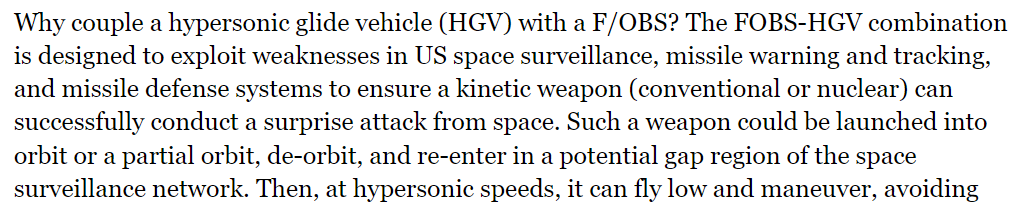
Also I'm not sure how much of a gap it is in the space surveillance network. In the Chinese FOBS test US systems were good enough apparently for an anon USSF source to say it 'defied the laws of physics' and landed within 12 miles of its target.
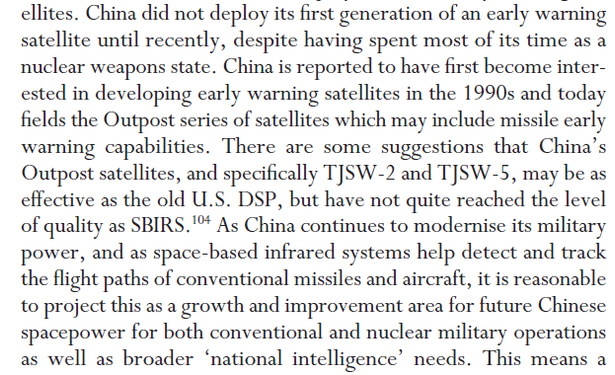
And for a US FOBS, China is expanding all manner of military satellite systems, including infrared missile launch detection and space surveillance radars, as I explored in #OriginalSin
So it's an odd viewpoint that doesn't state how delivering some bombs via a different route will stop Chinese leaders from launching an attack on Taiwan, as opposed to existing US capabilities, and importantly, those of other states in the region which it entirely ignores.
I'd wager that Taiwanese, Japanese, and South Korean military modernisation and expanding conventional strike capabilities (including the US) will be far more important for war planning and deterrence than a US FOBS could ever be.