Next week I'll be giving a talk at the University of Michigan, geared to the general public, entitled "The crisis of human collective decision-making in a social media world".

https://lsa.umich.edu/cscs/news-events/all-events.detail.html/103361-21807096.html

The talk, at 4 PM EST on Tuesday Jan 31st, will be live-streamed and is open to anyone who wants to watch. You do need to register, at this link: https://docs.google.com/forms/d/e/1FAIpQLSfdGjaDv-ijYfoO6FdOSG6QiRjQFlpEPo9Ri7gx8wxscTMsMg/viewform
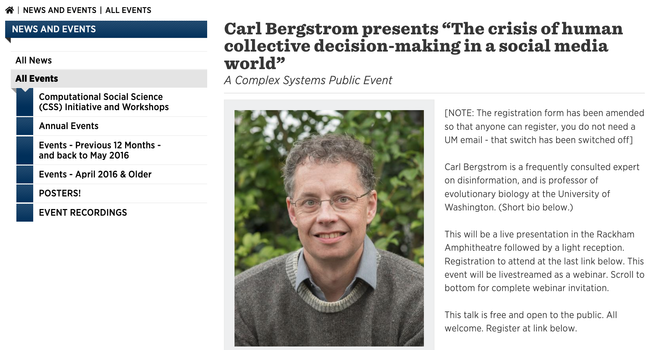
All Events | U-M LSA Center for the Study of Complex Systems

Here's the abstract.

We are a species of information foragers. Individually and collectively, we have evolved to scour our natural and social environments for useful information. Over the past twenty years, society has constructed an information pipeline, the so-called Internet 2.0, to satisfy and profit from our evolved desires for novel information and social connection.

What happens when the scale of human communication is radically transformed in the span of a generation, and our mechanisms for creating collective understanding are upended? What happens when this entire process is not stewarded to promote the spread of accurate information, strengthen democracy, and advance human well-being—but rather is to a first approximation engineered by machine learning algorithms to get people to click on advertisements?
In this talk, I’ll look at what social media and information technology more generally are doing to society, consider how we ended up here, and explore some possible suggestions for what we can do about it.

Addendum:

1) Sorry about the date mixup. The talk is next week, not today. I've fixed the original post.

2) I don't know if there will be a recording available but I will speak to my hosts about this.

@ct_bergstrom Will a recording be available? I will most likely be busy then.

@ct_bergstrom

Well, I guess we're learning the answer to this.

At least we're past the "it's only Gutenberg again" phase. Hopefully. Looking around, it seems fairly obvious our feet are not still planted in Kansas.

@ct_bergstrom Cosma Shalizi and I have a paper arguing that plain vanilla Internet 2.0, without engagement maximizing algorithms, is plausibly sufficient to explain the badness https://www.dropbox.com/s/pq089ti1kwauzso/acm-draft-2022-10-08.pdf?dl=0
acm-draft-2022-10-08.pdf

Shared with Dropbox

Dropbox
@henryfarrell This sounds like a must-read. Thank you!
@ct_bergstrom It's a stupidly simple thought experiment (preferential attachment math, basic cog psych and handwaving) but I _think_ we're right (and if there are good counterarguments that occur to you, would love to hear them so that we can engage with them)

@henryfarrell Just read it. I agree almost entirely, and in fact it's why the original title of my had some more general hedge around information technology instead of the phrase "social media". I'm careful, in general, to lay the blame on infotech including search engines rather than on social media in particular.

You've nicely illustrated the preferential attachment due to search engines. Jevin West was worried about this with Google Scholar and found partial support.

https://sociologicalscience.com/articles-v7-13-314/

The Influence of Changing Marginals on Measures of Inequality in Scholarly Citations: Evidence of Bias and a Resampling Correction | Sociological Science

Lanu Kim, Christopher Adolph, Jevin D. West, Katherine Stovel Sociological Science August 10, 2020 10.15195/v7.a13 Abstract Scholars have debated whether changes in digital environments have led to greater concentration or dispersal of scientific citations, but this debate has paid little attention...

@henryfarrell I do think you overstate the claim here: "Getting
rid of engagement algorithms, or constraining them to not guide people towards congenial misinformation, will have moderate-to-zero benefits when people seek misinformation out independently."

The fact that things would quite possibly suck even without engagement algorithms in no way establishes that getting rid of them would have only moderate benefits. I suppose some of it is fuzzy definitions—what are "moderate" benefits anyway?

@ct_bergstrom And yes - you're right that that is an overstatement that ought be corrected (happily, revisions have yet to be submitted).

@henryfarrell What you certainly can say is "We should not fall into the trap of thinking all this bullshit will go away if we can just rein in the engagement algorithms."

(Is anyone studying misinformation on Mastodon? Someone—perhaps my colleagues at the http://www.cip.uw.edu —should. Of course, there's a selection bias issue in who is on this platform....)

Center for an Informed Public

University of Washington research center. Resisting strategic misinformation, promoting an informed society, and strengthening democratic discourse.

Center for an Informed Public
@henryfarrell Also: ok if I write a short mastodon thread about your paper?
@ct_bergstrom Fine by me if you would like to!
@ct_bergstrom Thanks - I hadn't seen that West paper and at a glance it looks quite promising indeed. Glad the argument makes sense.

@henryfarrell @ct_bergstrom

A potential condensation of this line of thought:

"The truth is that which can be coordinated about without even indirect communication."

So facilitating communication/coordination may, in fact, decrease the comparative advantage of the truth.

@henryfarrell @louisevans that is very interesting and something I need to ponder for a while.
@ct_bergstrom @henryfarrell I can't dig up the original source, unfortunately—saw it on Tumblr.

@louisevans @ct_bergstrom @henryfarrell I find this topic incredibly interesting and agree with many of the arguments.

But how would you view urban legends prior to the Internet (Mikey from the Life commercials dying from Pop Rocks and soda) or the insular confirmation bias that creates things like generational racism?

@ct_bergstrom Is it today or Tuesday, January 31, 2023?
@ct_bergstrom Tuesday Jan. 31st - looks to be quite interesting, will attend if I can.
@ct_bergstrom I see now that I'm the third person to point this out 😆
@ct_bergstrom shute, missed it, hope it went well!

@ct_bergstrom Will it be recorded and emailed afterwards if we sign up and can't attend live?
ETA: whoops - looks like I'm the nth person to ask this.

Hope at some point there's a recording we can watch. It sounds quite interesting and thought-provoking.

@ct_bergstrom I don’t know who that dude is, but he doesn’t look anything like your profile picture.