Meanwhile in Edinburgh

@weaniejeanie53 that's good although if they don't want to disturb the owl they won't have sex checked them.

A female owl may be more likely to adopt an obscure home if she is brooding owlets. Why does management always refer to "He" ?

@Kay @weaniejeanie53

Why not?

It's a *very* long-standing convention (which began in British jurisprudence) that in the absence of specific information as to sex, references to "he" can be construed to include "she".

It's just a traditional shorthand, nothing more.

@keithreeder @Kay @weaniejeanie53 I'm not that far in to learning Japanese, but as far as I can tell, it easily allows to refer to stuff without assigning any gender at all. In (most? all?) European languages, this is simply not possible. Could this be a lazy translation?
Personal Pronouns in Japanese - Subjects pronouns: I, you, he/she, we, you, they

Personal pronouns do exist in Japanese, although their use is quite different from English. Native Japanese speakers choose pronouns according to the context, their gender and age, but also to whom they are...

Kanpai Japan
@weaniejeanie53 @Kay @keithreeder

It#s always hard to break up the way of thinking and learn to see the world from a different perspective. But it is also very good for the brain.

And it's very interesting to see, how different languages and cultures deal with gender. E.g. in German and in Russian, job titles always have a gender. In Germany, it is considered impolite to refer to someone with the wrong gender. You refer to a medical doctor as "Arzt" if they are male and "Ärztin" if they are female. There is a huge debate going on about this, because older texts often only use the male form and this is considered to put women into the role of second class workers. I don't want to go into details of the debate here. What I find interesting about this is, that in Russia, it's the other way around. You always use the male form, because it is considered the default. If you use the female form, you suggest, that the gender is relevant for how they do their job.

And then I start to learn Japanese with it's own very different take on gender and it's role in language and society.
And yes, in the beginning Japanese is really hard, because there are so many ways of addressing and talking about people and they basically translate all to the same few phrases in English. But it is also quite a lot of fun and interesting and all. It's definitively worth it.
@Kay @till @keithreeder makes English sound easy peasy!
@weaniejeanie53 @Kay @keithreeder Absolutely. As a non native speaker, I can tell you, that English was (so far) the easiest language I've learned. And to my knowledge, it is considered one of the easiest languages there are.
@till @keithreeder @Kay I think it’s a lot of the weird and duplicate spellings that trip people up, tenses are fairly regular etc. I’ve always thought giving a gender to objects is so unnecessary, it’s so much easier to have just the one word as in English!
@weaniejeanie53 @Kay @keithreeder Yes, in Russian an German, there are a lot of words, where you just have to know the gender. So you constantly mix them up, especially, if you already know one of them and start to learn the other. Because they often assign different genders. It's far easier, if either every object is per definition neutral (as in English) or if the word itself contains the gender. E.g. in Latin, everything that ends in -us is male, -a is female, -um is neutral. There are some additional endings, but they are relatively unambiguous, too.
@Kay @till @keithreeder how many languages do you know?! I’m typically English in that I’m not that good at languages, I was quite good at German and not bad at French but if you don’t use them you forget a lot, I’m better at them written than spoken. So many other nationalities speaking English makes us lazy!
@weaniejeanie53 @Kay @keithreeder I'm a native german speaker and as a software developer I have to know English. I also had some lessons in Russian and Latin, but was never good enough to have a conversation or read a text without having a dictionary at hand (and looking up most of the words). I also know some basic holiday stuff (like yes, no, hello, ...) in French, Polish and Danish (you know, our neighbors ;) ). Well, and now I started with Japanese on Duolingo. A great way to learn new languages by the way.
@till @Kay @keithreeder Japanese isn’t easy I think! Good luck with it. I did start having lessons in Italian some years ago but sadly didn’t keep it up, I’ll have to check out Duolingo.
Inflection

xkcd
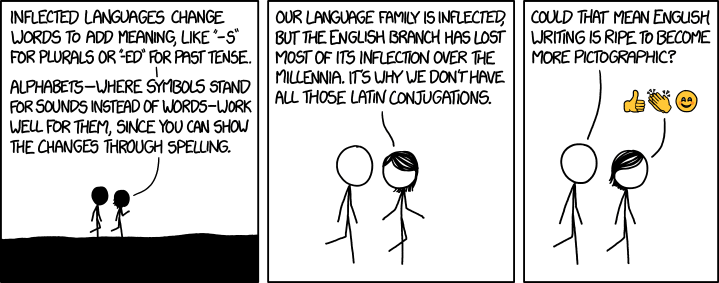
@till in 50 years we’ll be writing everything in emojis? They’re definitely handy sometimes but I can’t see them replacing writing 🤔
@weaniejeanie53 Well, half of it is humour, obviously. But the way we write has already become more pictographic through emojis.

If you type a lot and have a way to use less characters, you will probably take it. The natural conclusion is, that with the rise of virtual keyboards, the amount of standardised emojis will probably rise further. And we can actually see, that in some places text si replaced by emojis. The chances are good, that this trend will continue at least a little further, while younger generations grow up with and improve this stile of writing. I'm definitively not an expert, so I won't try to do an exact prognosis here, but I wouldn't be the least bit surprised, if this trend would go on at least a little bit longer. Though, we will probably not replace everything with emojis. I would expect more of a mix, where very common concepts are replaced with single pictographic letters (like emojis) while the rest is still written with the classic Latin alphabet and everybody still understands you, when you write only in the "classic" way.

Again, Japanese is a good example ;). They have two alphabets: Hiragana and Katakana. Katakana is the traditional set of signs. It developed over time in Japan and is rather complex. Signs can have completely different pronunciations depending in the context. Common words have their own sign. You can quickly get the meaning of any Japanese text that is written in Katakana (if you have learned it). But Katakana is closely connected with the Japanese language. There is a lot of stuff, you simply can't write in Katakana (and don't have to, if you only speak Japanese). So, when they started to have a relevant amount of contact with Europeans, they developed Hiragana.
Hiragana was developed to be able to write e.g. European names and can be mixed with Katakana. So if you write Japanese, you can completely use Hiragana or use Katakana and only use Hiragana for words, that can't be written in Katakana - or (especially if you are European and just lerning Japanese) you can use Katakana where you know the right signs and whenever you don't know the correct signs in Katakana, you can use Hiragana instead.

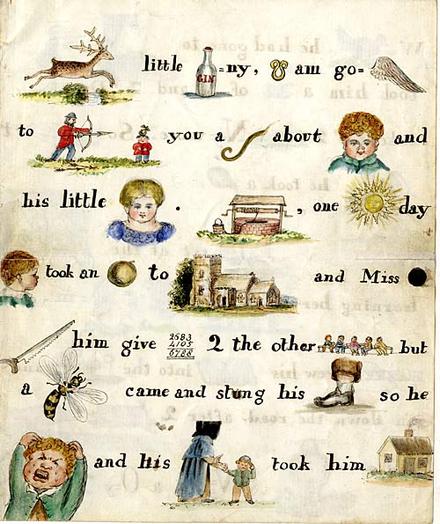
A little bit like those pictographic children's books:

@till I’m an ex telex operator and in that job you had to use as few characters as you could to keep the length of the call as short as possible, it’s a habit that’s stayed with me even now, I tend to have to make myself write things out properly. Japanese sounds a nightmare, most people in the west struggle with one alphabet let alone two!
@weaniejeanie53 It's still better than Chinese in this regard. They have over 100.000 signs. (You don't have to learn them all, though.)

And Japanese (Hiragana) signs have some internal rules, that makes it easier. Like adding a circle or to small lines in the upper right makes the consonant part of the syllable sound harder or softer. E.g. if you add two small lines to ki it becomes gi. And often, similar sounding signs also look kind of similar.
@till think I’ll stick to good old western European languages!