 Brent Toderian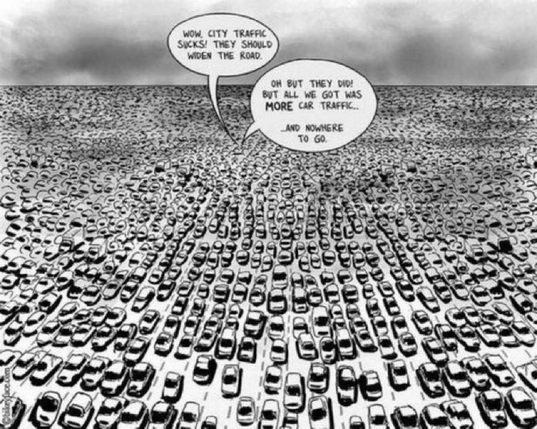
 Brian Claus
@BrentToderian hey Brent, are there any studies that look at correlations between higher thruput on roadways and economic productivity? I get the whole induced demand thing but surely some of that traffic is creating wealth which is presumably why cities keep on this direction. Is there any material out there that discusses this?
 Jack of all trades
@brianinbc @BrentToderian Like most things in #economics showing causality is very hard. Correlation by itself wouldn't tell us much.
Economic value is a poor measure of progress IMO. "How can we transport people and products effectively while not destroying the environment and our health" is IMO a much better question than "How can we make changes without negatively affecting the GDP".
@brianinbc @BrentToderian The problem with cars is that they have a lot of externalities that are not included in economic calculations. Cars produce profits for car manufacturers and oil companies, but they also produce air pollution incurring health costs to the general population. In fact, the latter are not treated as costs at all, but instead inflate GDP further via the health sector.
@brianinbc @BrentToderian Many cities around the world are banning polluting car traffic. Are the people living there worse or better off?
Is Tokyo with its robust train lines an economic dead zone?
Do people in the US enjoy their long commutes to work or to even buy groceries?
@jackofalltrades @BrentToderian Jack, I think narrative of wider roads--more traffic--more wealth or wider roads--less congestion are pretty easy for politicians to sell. So yes it is too simplistic and possibly/probably wrong but simple narratives have a lot of power. So to be convincing I think it is worthwhile exploring what are the simple narratives that you can give to the politicians that change things to your preferred modes of transportation.
@jackofalltrades @BrentToderian Keeping in mind that externalities like health and environment are often heavily discounted by people over things like money and time.
@brianinbc @BrentToderian This is perfect:
"externalities like health and environment are often heavily discounted by people over things like money and time."
If that's the case then I submit myself to the benevolent power of #democracy and accept our inevitable #climateChange - induced collapse.
@brianinbc @BrentToderian Jokes aside, public transport is more space/money/time efficient than congested car traffic.
Compare public transport ticket price with the cost of owning and maintaining a car.
Compare how many lanes and cars are needed to achieve the same passenger throughput as a single metro car.
Compare how much time trips take by car vs by public transport in cities like Tokyo or Amsterdam.
@jackofalltrades @BrentToderian I'm all in on increasing the efficiency and availability of public transport. However, it is going to remain undesirable to large segments of the cars as status symbols bunch. Many of these folks work in jobs that don't require that much in office time, accounting, lawyering, programming. I'd be curious to see a break down of income by necessity of in person work. I bet many of these jobs could be incentivised to be remote via tax breaks.
@brianinbc @BrentToderian You don't need to pander to the segment of the population that treats cars as a status symbol.
I think it may be much more pragmatic to provide alternatives to those people that depend on cars for their livelihood, i.e. the rural residents that need to commute every day.
Do it well and they will use the public transport instead of cars. Do it badly and you will get the Yellow Vests Protests.
@jackofalltrades @BrentToderian so I just read my community transit plan.
Avail: https://www.bctransit.com/documents/1507213420964
It's not really the aggressive "we are going to transform transit ridership" type of plan. They want to increase ridership from 2.7% to 4% of trips over 25 years. However, it seems achievable with low effort to convince people to accelerate things. So I suppose the question is how do you change people's minds about this?
@jackofalltrades @BrentToderian At present, I'd love to go to the theater, it's only 35 min once on the bus but it's a 30 min wait. It's a 10 minute drive. I don't mind some inconvenience but that's too much for me.
I know there's some density dynamics at play but I do feel like some carrots and sticks could be cleverly applied. I just don't know what they would look like.
@brianinbc @BrentToderian Using a car to go to the theater once in a while sounds totally fine, especially if you're in a remote location with low population density. Extra car lanes are not being added for cases like these, so I wouldn't expect extra bus lines to be added either.
The real problem is massive car traffic to and from work. Here's where people need to have real alternatives to cars.
Again, look at Tokyo: trains come very often and on time and get you to where you need to be.
@jackofalltrades @BrentToderian bit of an old link but urban ridership in Canada at least is mostly increasing quickly.
https://dailyhive.com/vancouver/canada-public-transit-rideship-growth-statistics-caanda-1996-2016
I used the theater as an example. For a commuting trip downtown where a lot of people in my community work it is similarly around a 30-60 min transit ride depending on connections and when you start your trip and around a 10min drive. This is probably similar in many small cities of around 100k.

@jackofalltrades @BrentToderian in British Columbia something around 50% of people live outside the greater Vancouver or Victoria area. There are big gains to made in increasing commuter transit ridership in small cities. In my city at least, transit is overwhelmingly used by people with incomes under 20k, according to the report above. Something like 85% of ridership. These attitudes will change slowly as transit organically improves.
@jackofalltrades @BrentToderian organic growth is perhaps a bit slow though and so how to fund and gain acceptance for dramatically increasing transit ridership? The prince George transit study suggested, for example, a community pass that people are charged for on their property taxes. Similar to garbage or water fees. This has some problems but also would inject a lot of cash into it quickly.
@jackofalltrades @BrentToderian In Canada we have a carbon tax that is largely refunded to people, some portion of this, from industrial emitters say, could be injected into transit. The problem here is that higher density centers have, rightly, gathered the predominant amount of funding for transit improvements. I'd also argue that some creativity is needed to increase commuter ridership in smaller cities.