Another stupid hot take about the Fediverse. This time courtesy of Megan McArdle from the Washington Post.

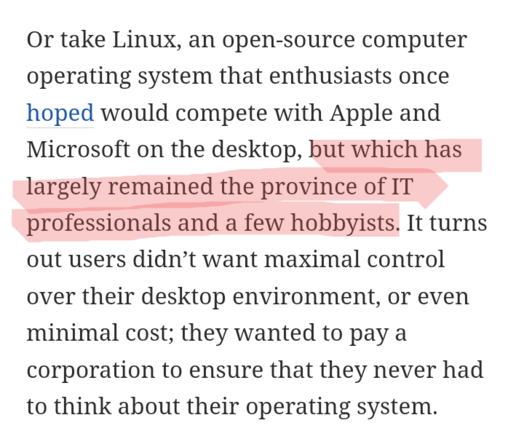
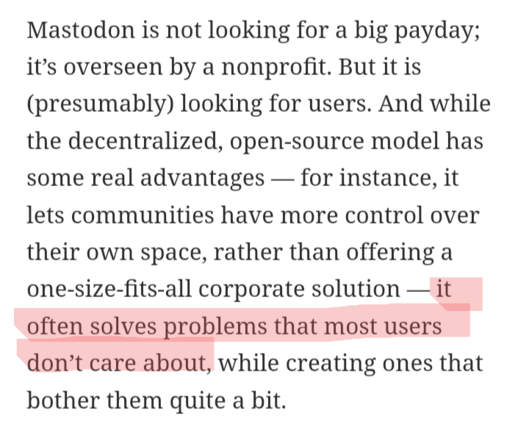
Apparently, Mastodon is doomed because it solves problems most users don't care about.

Just like Linux is a failure—because only hobbyists and IT professionals use it.

Except—unknown to Megan—Linux is a huge success which runs on everything (including your router).

Also Megan seems unaware that the *actual* problem with social media really is centralization.

https://www.washingtonpost.com/opinions/2023/01/17/twitter-mastodon-replacement-social-media/
Twitter might be replaced, but not by Mastodon or other imitators

Twitter's successor will probably be something not much like Twitter at all.

The Washington Post
@atomicpoet “Linux is a failure” *posted to a site hosted on Linux servers, then consumed on phones running Linux by connecting over network gear running linux, while drinking coffee brewed by a coffee pot also running Linux*

@mgaruccio @atomicpoet The author did mention Android so she's not completely unaware. Her point is more about Linux not making that much headway on desktop PCs which is at least true. I think it's pretty difficult to try to say it can't work out for Mastodon because it didn't work in that case.

I do think the average person has not shown all that much concern for interoperability or openness when choosing which tools to use on their computer historically.

@73ms @atomicpoet except that’s also not true. About as many chromebooks shipped as macs last year, and no1 is saying macOS is “limited to a few hobbyists”.

Average users don’t care about openness in and of itself. But they do care about better moderation, choice of apps, and whatever the next awesome thing to ship is, which are enabled by the openness. Just like Chromebook’s and raspberry pi’s are enabled by Linux’s openness.

@mgaruccio @atomicpoet You can count chromebooks if you like, sure. I don't think it fundamentally changes the picture, is covered by what she said about Android and is not really a success story when it comes to user freedom from megacorporations.

@73ms @mgaruccio In other words, Linux on the desktop is a big success. It's a success on servers, desktops, mobile—everywhere. In fact, it's the most successful OS of all time.

You can say it doesn't save users from megacorporations, but that's not its mission.

Not once in the GPL does it say, "no megacorporations allowed".

@atomicpoet @73ms @mgaruccio
i always thought that chrome os has a proprietary license > pls correct me if i'm wrong > chrome os & linux distros are two very different worlds

@testing @73ms @mgaruccio Actually, Chrome OS is based on Chromium OS, which is open source and abides by the GPL.

Several folks have already made forks of Chromium OS.

https://en.wikipedia.org/wiki/ChromiumOS#Builds_and_forks

You can also find the repo here:

https://chromium.googlesource.com/chromiumos/

ChromiumOS - Wikipedia

@atomicpoet @73ms @mgaruccio
as long as g prefers chrome os over chromium os, chromebooks may not not be considered a victory for linux or open source
@testing @73ms @mgaruccio Functionally, what's the difference between Chrome OS and Chromium OS?
@atomicpoet @73ms @mgaruccio
you raised the question of gpl's success first, now you shift to functional differences > the question is: what is the basic business model for linux to succeed on desktops? the answer is chrome os with its proprietary license, exploiting unpaid developers' work

@testing @73ms @mgaruccio Actually, Google continues to abide by various open source licenses that allow Chrome OS to exist. That includes the GPL and BSD.

As far as I can tell, I can't find a functional difference between Chrome OS and Chromium OS.

Thus, I don't know what component is, in fact, proprietary.

By the way, I have used Chromium OS before, and from what I can tell, the only difference is in logos. If someone can point out any other differences, I'd be interested in finding out!

@testing @73ms @mgaruccio Anyway, I don't disagree that Google is an exploitative company.

But I don't think their problem is that they push proprietary tech. Most of the time, they're open source.

No, the big problem with Google is how they lock you into their services. Which leverages surveillance capitalism.

@atomicpoet @73ms @mgaruccio
to me, the success of linux is something else than its use by big companies > linux has shown to the world that there are uncountable ways of regaining control over your desktop (not to speak about linux success on servers, firewalls, routers)

moreover, linux today is like a door opener for smaller projects such as the bsd's, haiku os or open indiana

@testing @73ms @mgaruccio "Success" isn't anything measurable.

But I bring up Chrome OS because certain chucklefucks keep saying that Linux will "never" be a successful OS because desktop Linux "hasn't happened".

Which isn't true—as demonstrated by Chrome.

So even by that extremely narrow yardstick, Linux still wins.

People can go ahead and move goal posts by saying, "A corporation made that"—so what? As opposed to everything else not made by corporations?

@atomicpoet @73ms @mgaruccio
agreed! linux has succeeded long ago
@atomicpoet @testing @73ms @mgaruccio I used to be a big fan of Neverware (for Mom, it was simple!), who made the Cloudready distribution of ChromiumOS. Google bought them out and if you click on neverware.com now you get dumped at Google's ChromeOS page.......
Redirecting