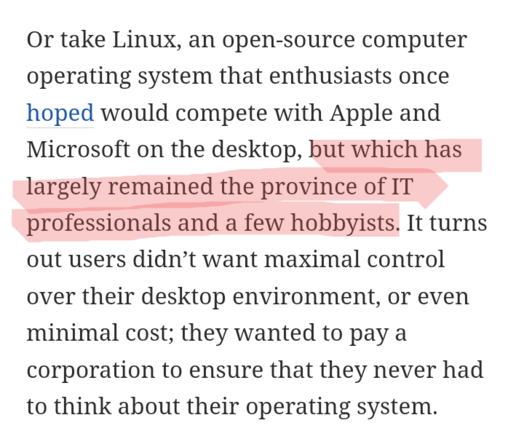
Another stupid hot take about the Fediverse. This time courtesy of Megan McArdle from the Washington Post.

Apparently, Mastodon is doomed because it solves problems most users don't care about.

Just like Linux is a failure—because only hobbyists and IT professionals use it.

Except—unknown to Megan—Linux is a huge success which runs on everything (including your router).

Also Megan seems unaware that the *actual* problem with social media really is centralization.

https://www.washingtonpost.com/opinions/2023/01/17/twitter-mastodon-replacement-social-media/
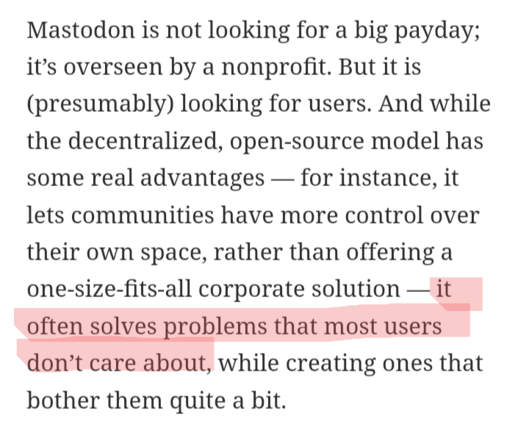
Twitter might be replaced, but not by Mastodon or other imitators

Twitter's successor will probably be something not much like Twitter at all.

The Washington Post
@atomicpoet “Linux is a failure” *posted to a site hosted on Linux servers, then consumed on phones running Linux by connecting over network gear running linux, while drinking coffee brewed by a coffee pot also running Linux*

@mgaruccio @atomicpoet The author did mention Android so she's not completely unaware. Her point is more about Linux not making that much headway on desktop PCs which is at least true. I think it's pretty difficult to try to say it can't work out for Mastodon because it didn't work in that case.

I do think the average person has not shown all that much concern for interoperability or openness when choosing which tools to use on their computer historically.

@73ms @atomicpoet except that’s also not true. About as many chromebooks shipped as macs last year, and no1 is saying macOS is “limited to a few hobbyists”.

Average users don’t care about openness in and of itself. But they do care about better moderation, choice of apps, and whatever the next awesome thing to ship is, which are enabled by the openness. Just like Chromebook’s and raspberry pi’s are enabled by Linux’s openness.

@mgaruccio @atomicpoet You can count chromebooks if you like, sure. I don't think it fundamentally changes the picture, is covered by what she said about Android and is not really a success story when it comes to user freedom from megacorporations.

@73ms @mgaruccio In other words, Linux on the desktop is a big success. It's a success on servers, desktops, mobile—everywhere. In fact, it's the most successful OS of all time.

You can say it doesn't save users from megacorporations, but that's not its mission.

Not once in the GPL does it say, "no megacorporations allowed".

@atomicpoet @mgaruccio Well, like I said counting Chromebooks doesn't fundamentally change the picture. They may be somewhat successful but they certainly have not taken over the market.

A more important point is that just like I would not consider a popular Mastodon instance that does not federate and is run by Google to be a win for the fediverse, I don't really consider Android or Chromebooks to be that for Linux either. Chromebooks pretty much killed the cheap Linux laptop.

@73ms @mgaruccio Chromebooks never killed anything.

Before they came out, most people installed Linux themselves using a CD or USB stick. Which is what people still do.

If you want a pre-installed Linux, you can get it from Dell, Lenovo, or System76.

Again, Linux was never about "no megacorporations".

You're literally making that up.

@atomicpoet @mgaruccio As for what Linux is about, probably depends on who you ask. Maybe some people would be perfectly happy with Google taking over Mastodon too and killing the fediverse just because at least the code would be used by millions... Personally I see user freedom as a significant part of Linux too.

@73ms @atomicpoet but Chromebooks didn’t kill linux, and google didn’t take it over. Whether it’s broadly used or not linux on a laptop is a great experience today, and the better HW support google drove is a big part of that.

If they decided to fork mastodon to revive google plus and somehow actually made it work this time it wouldn’t kill mastodon, and would probably mean better support for the ecosystem and at the very least some more robust code that can be backported.

@mgaruccio @atomicpoet You yourself said Chromebooks ate the Win/Linux netbook market. What I was talking about was a little later when netbooks had mostly faded. Ubuntu in particular seems to have been able to make some headway to being preinstalled by major vendors and these weren't netbooks but a few years forward you could only find Chromebooks and Windows on the same type of devices.

Not sure about the driver thing being because of Chromebooks but have no info either way.

@73ms @mgaruccio Never saw one of those devices in my life. If they ever existed, send a link.

Otherwise, I assume you're making it up.

@atomicpoet Seems a little hostile to just assume the worst and that I'd just be making this up... I have one of the Ubuntu certified Dell Vostro models that shipped with the OS back then.

@73ms I mean, you literally made up "no megacorporations" as a metric for Linux's success.

Which indicates bad faith.

So I don't put it past you to make stuff up.

Send me a link or it didn't happen.

@atomicpoet Ok, well if you think that is being bad faith I think there is no point in continuing. I was simply expressing that to me success goes a little beyond "does this run the Linux kernel". I think neither most open source nor free software advocates would really disagree with that unless we're just laser focused on whether we can say something runs Linux the kernel or not.

Have a nice day.