 Nhat An Trinh
Why do trends in social fluidity at labour market entry and occupational maturity differ? My new paper answers this question for 🇩🇪 and 🇬🇧, where social fluidity has increased when measured early in the career but appears stable when measured later (1/3) https://www.sciencedirect.com/science/article/pii/S0276562422000737
My analyses show that in both countries this is driven by increases in so-called “counter mobility”. Counter mobility occurs when someone is first intergenerationally mobile but then returns to their origin class through later career mobility, e.g. like here: (2/3)
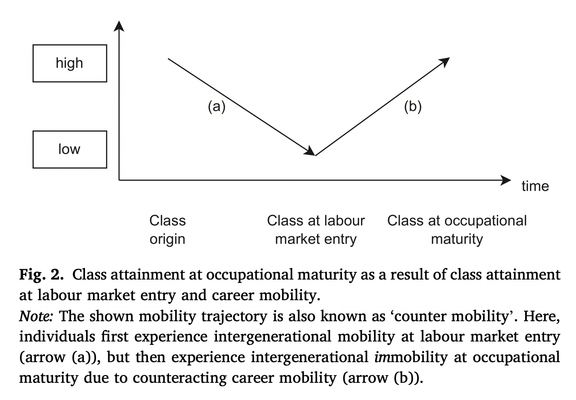
Increases in counter mobility yet differ: While in 🇬🇧, the share of ppl from salariat origins who enter the labour market in a lower class position but experience upward career mobility increases, I find the reverse in 🇩🇪... Check out the paper for all the details and analyses! (3/3)