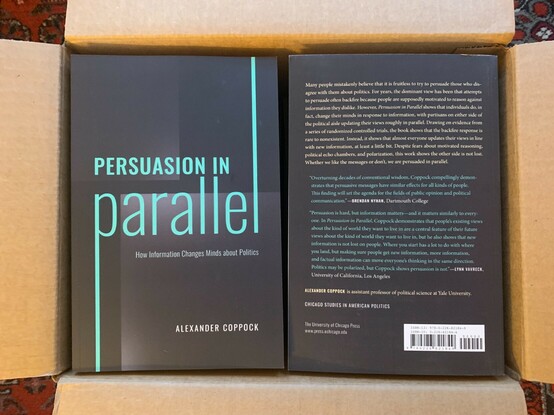
Persuasion in Parallel is now out from @UChicagoPress!

In this thread:

* The three key ideas from the book I want to put in people's minds

* Suggestions for how to include it on a syllabus

* Thank yous to the many scholars whose work I replicated or reanalyzed
Key Idea #1: The Persuasion in Parallel pattern is common

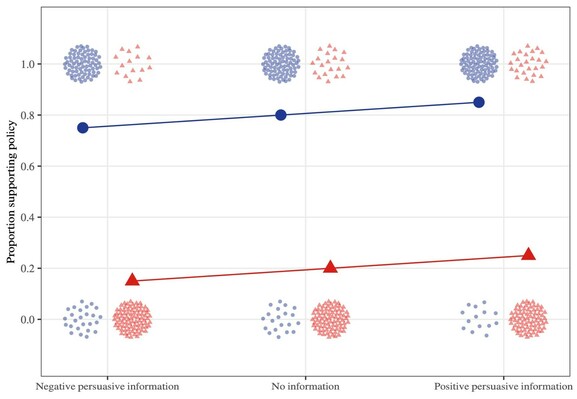
Here's a schematic instance of the PiP pattern.

Suppose on average, red triangles oppose a policy, blue circles support it.

When exposed to persuasive information, both groups update their views "in parallel"

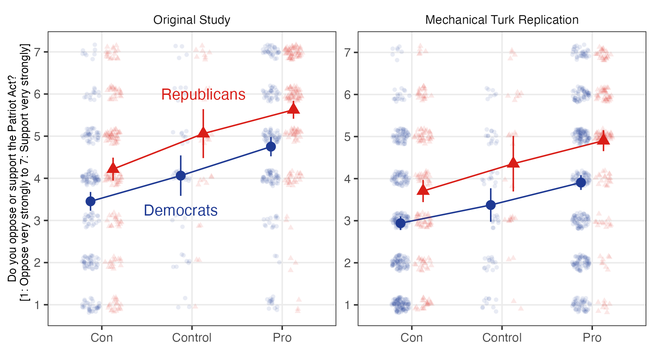
Here's a good example from a reanalysis and MTurk replication of Chong and Druckman (2010)

treatment: persuasive info for or against the patriot act
outcome: support for the patriot act
covariate: partisanship

The groups update their support for the Patriot Act in parallel.

My claim is: the PiP pattern is common, as long as

- The treatment is persuasive information

- The outcome is policy support

- the covariate is pre-treatment (I've looked at baseline support, pid, ideology, education, race, age, gender)

The evidence for the claim comes from a meta-analysis 23 persuasion experiments. Some are original experiments, some are replication studies, and some are reanalyses.

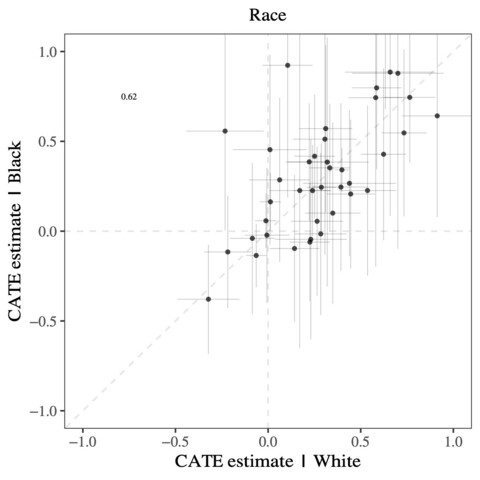
Here's all the evidence in the book:

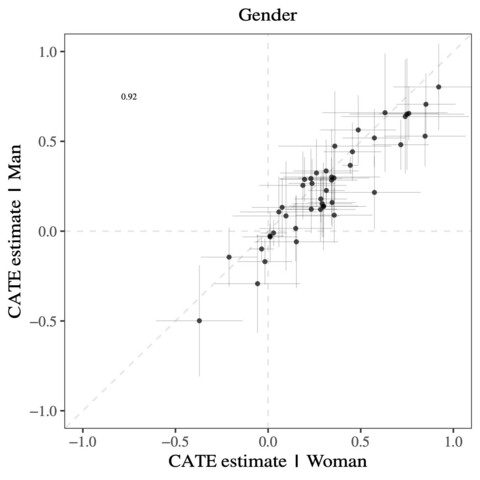
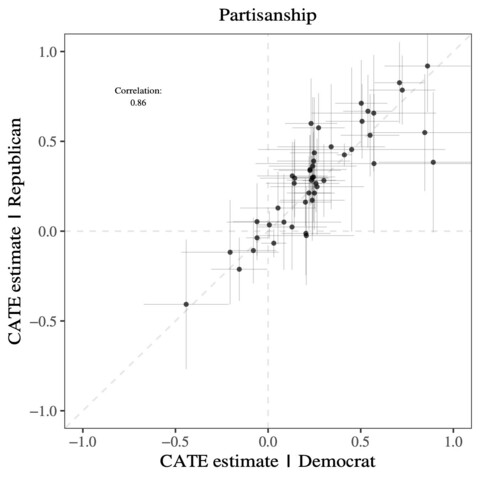
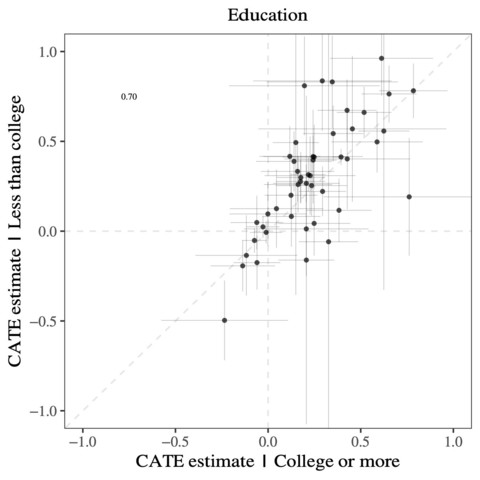
We can look at the PiP pattern in another way by correlating the CATEs, split by many different covariates.

These are the figures that convince me of key idea #1

The book discusses many design objections like:

- What does parallel even mean?
- Do we have the right covariate?
- What about measurement error?

If you've clicked through this far -- thank you!

I hope you're at least provisionally on board with the idea that the Persuasion in Parallel pattern is common.

On to key idea #2!

Key idea #2:

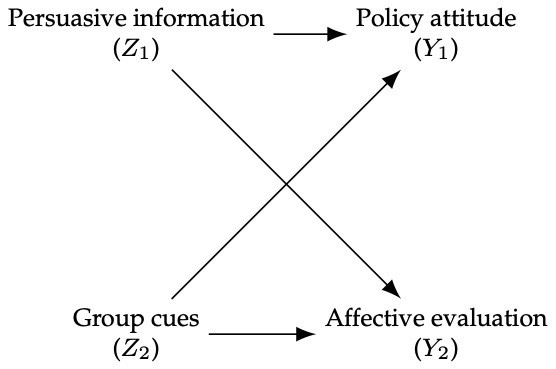
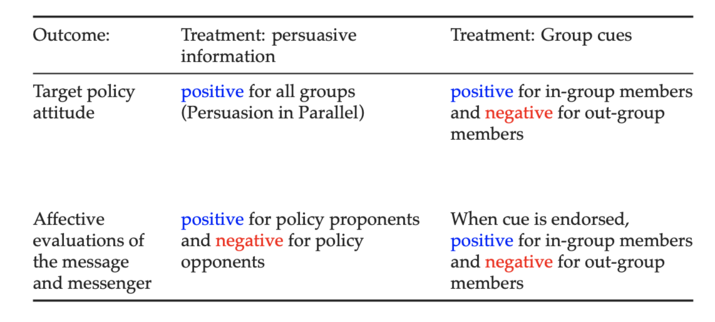
Here is a typology of political communication treatments and outcomes:

- two kinds of treatments: persuasive information and group cues

- two kinds of outcomes: policy attitudes and affective evaluations

- People update their policy views "in parallel", but if the information is "counterattitudinal," people *dislike* the message and the messenger

- Group cues (information about which groups in society support which policies) have effects on attitudes that depend on group attachments

The upshot is that persuasion comes at an affective cost.

People *do not like* being persuaded, even though they update their views in the direction of info.

In other words, those being persuaded will complain about it!

Key Idea #3: Motivated reasoning theory has a problem

MR says we have accuracy goals and directional goals when processing info.

If directional goals dominate, then the effects of info should have opposite signs for groups with opposing directions.

But since the PiP pattern is common, either...

1. Accuracy goals dominate when people encounter persuasive information or

2. Motivated reasoning isn't a good model of information processing (or at least, the MR-predicted backlash doesn't seem to occur)

Thank you again for reading this far!

Those were the three key ideas:

1. PiP pattern is common
2. A typology of political communication treatments and outcomes
3. Motivated reasoning theory has a problem

You could incorporate Persuasion in Parallel on your syllabus (it's short, at 214 pages!) by:

1. In a pol. psych class: contrast Lord, Ross, and Lepper (1979) with Chp. 2, which gives a critique of LRL
https://doi.org/10.1037/0022-3514.37.11.2098

2. In a public opinion class: contrast Zaller 92's model of opinion change with theory in Chp. 3

3. In a Am. Pol. through experiments class, focus on chp. 4 (design)

4. In a "controversies" class, contrast Taber and Lodge (2006) with Chp. 7
https://onlinelibrary.wiley.com/doi/abs/10.1111/j.1540-5907.2006.00214.x

The book is available these places:

U Chicago Press: tinyurl.com/jnwb69m3
Bookshop: tinyurl.com/5awdtyuz
Amazon: tinyurl.com/274hr6ja

Or if you'd rather not buy it, perhaps you could ask your library to acquire a copy!

An enormous thank you to the scholars who collaborated with me or whose work I replicated or reanalyzed in this book:
Emily Ekins, David Kirby, Andrew Guess, Charles Lord, Lee Ross, Mark Lepper, Denis Chong, Jamie Druckman, Ted Brader, Nicholas Valentino, Elizabeth Suhay, Michael Hiscox, Christopher D. Johnston, Andrew Ballard, Alison Gash, Michael Murakami, Sarah Kreps, Geoffrey Wallace, Diana Mutz, Kris-Stella Trump, and Ariel White.

Also thank you so much to Lynn Vavreck and @brendannyhan for blurbing the book. Your support means so much to me.

Thank you for reading this long thread! If you're moved to, please consider boosting the first post!

https://mastodon.social/@aecoppock/109705476383142321

@aecoppock Alex, I am persuaded by your argument and am confident that others will be as well, likely to a similar degree.

@aecoppock great thread Alex, looking forward to reading this when I can!

Regarding your 1 & 2 here - do you have a gut feeling as to which one is more likely? My gut says 1, but I'm also very open to persuasive evidence or thought!

@aecoppock i spent quite some time looking at the plots. It is great how much information they contain while still being clear and easy-to-read
@alex_wuttke Thank you for saying so! My goal was to pack them full of design information (it's an RCT, the outcome is a Likert scale, there are N subjects, I divided them into covariate groups) without obscuring the conclusion I wanted them to convey (parallel updating)