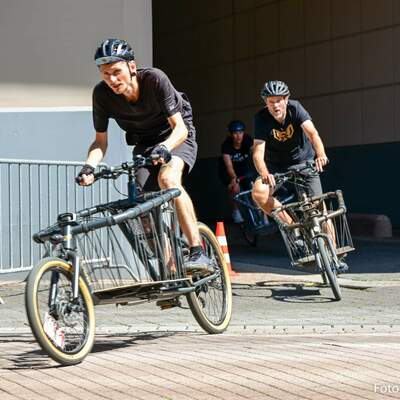
Because it has to be repeated again and again: We need to drastically reduce the number of cars to solve our problems.
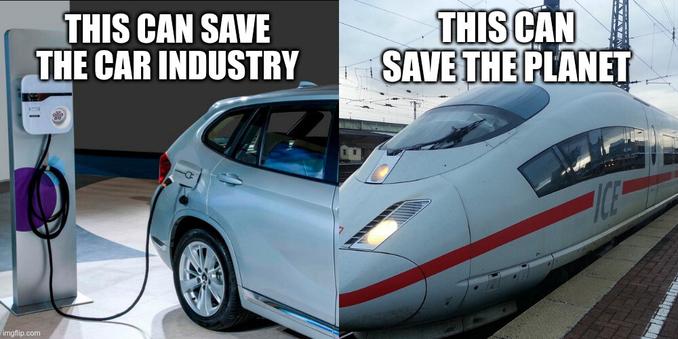
@AndiPopp than drastically invest in public transportation outside of cities…. The people there have no chance without cars…
@Grey08 Yes, this is a part of it. But increasing living density is also part of the equation. Many "non-city" areas are surprisingly unsustainable.
@AndiPopp there a minor problems first of all rental prices are insane in the city. Most people can’t effort that. Than not all people are capable to live in a city where it will be never dark or silent enough to sleep with a open window.The quality of life is also worse in a city and that will not change with les cars because there are not enough plants in a city. Also wind will be a problem between the “skyscraper” see NYC. There a many other social problems when you cram people in dens areas.

@Grey08 A few things to unpack. I give you the point of the rental prices, everything else I must kindly disagree.

The worse quality of life is not inherent to cities, but because people living in rural areas drive into cities: https://youtu.be/CTV-wwszGw8

People living in rural areas (who are financially and ecologically subsidized by city dwellers) create the problem they decry in the first place.

This does not mean everyone needs to live in Manhattan, but maybe at least Koblenz.

Cities Aren't Loud: Cars Are Loud

YouTube

@AndiPopp @Grey08 To add to Andi's points.

"Not enough plants in a city", how about we plant plants in 30% of the parking spaces? 40%?

Skyscrapers suck, and are a dead end, better to have medium rise and low rise blocks, better on every metric.

Noise: most noise comes from cars. You'd be very surprised how quiet cities are without the constant noise of cars driving around.

Light: This is a problem, but I bet that if we thought about it a bit longer, we can think of something.

@AndiPopp @Grey08 Also, to come back to the cars and noise point, even without the engine sound, cars are still quite noisy, just the sound from the tires hitting the pavement is very draining.
@ainmosni @AndiPopp @Grey08
Light is the big problem. I work at a university that does large amounts of agricultural research and without some pretty heroic engineering you have to use electricity to generate enough light for a city area to feed itself. That requires land to generate (wind, solar or hydro), unless you use fossil fuels to generate it and the problems there are obvious. Can such things be done? Sure. You have to accept the trade offs though.

@AndiPopp @Grey08
This does not mean everyone needs to live in Manhattan, but maybe at least Koblenz.

Brilliant and true

Our Western automobile-focused culture is unsustainable on a planetary scale. The global ecosystem would collapse if all people owned and used cars like we in the West do.

Any statements regarding "most people" or "all people" should take that into account.

Major branches of ethics require you to make exactly such statements. (Read Kant, for example.)
@AndiPopp
@Grey08


@Grey08 @AndiPopp
Lower rents get cut directly by owning one ore more cars. I might pay some more rent, but living in the countryside you'll pay 400 bucks for each car per month (insurance, gas, repair costs, loss of worth over time etc) most families having 2-3 cars is a ridiculously high amount of wasted money.
Most city dwellers don't need one. There is reasonable public transport and distances are short and walkable/ cyclable.
@Micha @AndiPopp yeah that's sure applied to everyone outside a city. Nope,still one car (12 Years the same),still under 400 bucks a month for maintenance costs, can sell it to the same price i bought it, half the "rent" as in a city,walk to the near supermarket for food and other things you need of a daily bases. So living in a village outside a city doesn't mean i will buy 3 or more cars. >.> It's the same discussion as LED pops up "The will buy more lights because lower power consumption.
@AndiPopp @Grey08 While this is correct, from an activist perspective it is much better to focus on private vehicles in urban areas. Because there, the benefits of removing vehicles and thus freeing public space for other activities are obvious to most people and the consequences of not owning a car are much less severe than in rural areas.
@AndiPopp @Grey08 I was absorbing perspectives until this malarkey.
@AndiPopp @Grey08
Are you assuming you can roboticize the farm work and or turn the cities into vertical farm blocks? There are problems with many of those ideas. Where I work does a good bit of research on automating farming, but it's still a long way off. The vertical farms have some serious energy problems due to the use of lighting in them unless you use mirror systems to redirect sunlight. (continued:)
@AndiPopp @Grey08
Also, there is an inherent bias in economic data in that a surprising amount of manufacturing is done in small to mid size towns by divisions of corporations, but often the production and profits are counted in the cities where the corporate headquarters are.
@AndiPopp @Grey08 The people living in villages and rural areas, the forgotten people apparently in this worldview. Everyone lives in the city, then The Wall in SA must be pretty much the big dream? My village is almost 2,000 years old, the oldest building here is from around 1300. It shows quite a modernist arrogance to throw ancient forms of society into the trash like this. https://youtu.be/3xPac81D4Kw
Video reveals 170-kilometre-long mirrored skyscraper The Line in Saudi Arabia

YouTube
@Grey08 @AndiPopp you’re exaggerating. I own a BahnCard 100 instead of a dino grill and it’s working much better than a pesky car requiring maintenance, costly fuel and parking. Most people in larger cities could realistically go car-less in Germany.
@Grey08 @AndiPopp Good excuse, next excuse.
@khroesing @AndiPopp It's a fact not a excuse. With such an answer like that i can see where the discussion would go with you.